Stop Wasting Ad Spend: Writing High-ROI Copy with Precision Prompts
Stop Wasting Ad Spend: Writing High-ROI Copy with Precision Prompts
Jan 24, 2026

If you are reading this, you know the feeling of the "Ad Spend Black Hole." You launch a campaign, watch the daily budget tick upward, and wait for the conversions that never seem to match the investment. For small business owners and solopreneurs, every dollar spent on ads needs to fight for its life. You don't have the luxury of "brand awareness" budgets that the Fortune 500s have. You need ROI, and you need it yesterday.
The bottleneck usually isn't the product. It isn't even the targeting (algorithms are getting smarter at that every day). The bottleneck is the creative. Specifically, the copy.
To find a winning ad, you often need to test ten distinct angles, fifteen headlines, and five different hooks. But let’s be honest: who has the time to write 50 unique pieces of ad copy while also managing client delivery, invoicing, and trying to eat dinner before 9 PM?
This is where the promise of ai for ad copy comes in. But there is a catch. This guide draws on principles from the complete guide to AI in advertising and sales to show you exactly how to fix it.
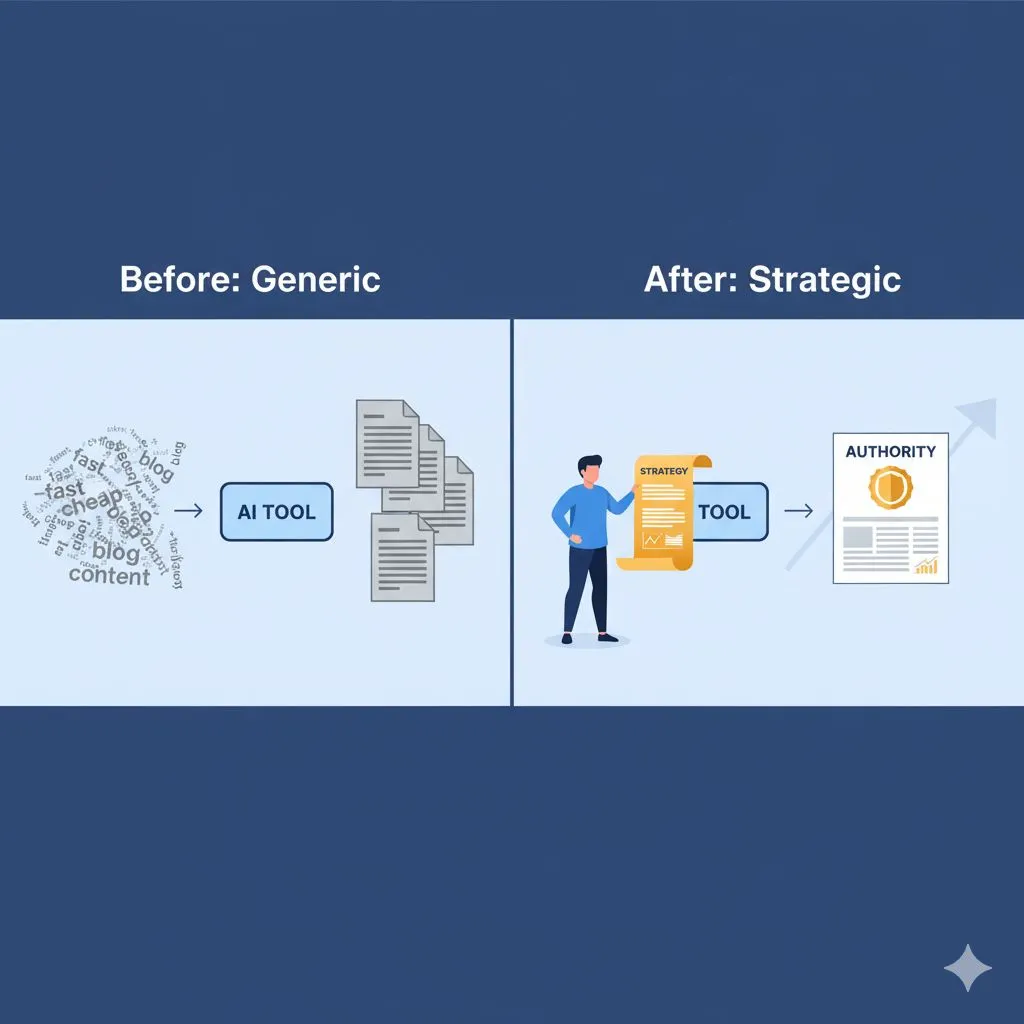
Most entrepreneurs try ChatGPT or similar tools, type in "Write a Facebook ad for my consulting business," and get back a generic, emoji-stuffed wall of text that sounds like a late-night infomercial. They try running it, it flops, and they decide "AI doesn't work for marketing."
The truth is, AI works incredibly well—if you treat it like a junior copywriter rather than a magic wand. This guide is about moving you from an overworked operator to a strategic director. We are going to stop guessing, stop wasting money on bad copy, and start using precision prompts to generate high-converting assets that scale your business.
Why Most AI Copy Fails (and How to Fix It)
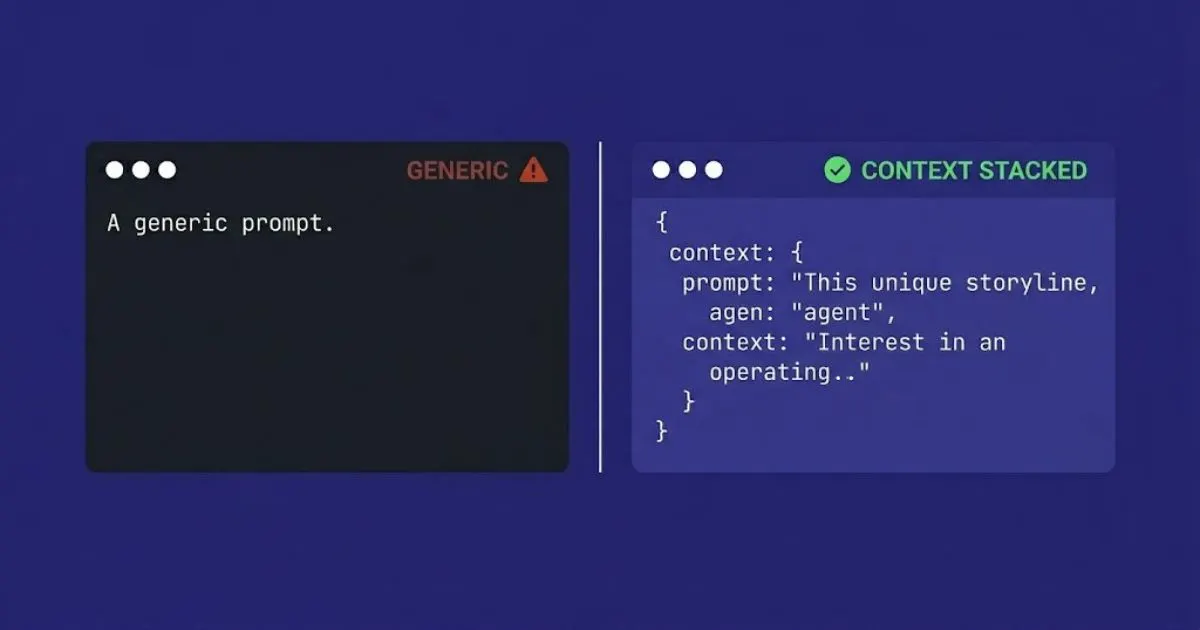
The reason most AI-generated copy fails to convert is simple: Lack of Context.
Large Language Models (LLMs) are prediction engines. If you give them a generic request, they predict the most average, statistically probable response. In marketing, "average" is invisible. "Average" gets scrolled past. To get a return on your ad spend, you need to be specific, incisive, and emotionally resonant.
The "Garbage In, Garbage Out" Principle
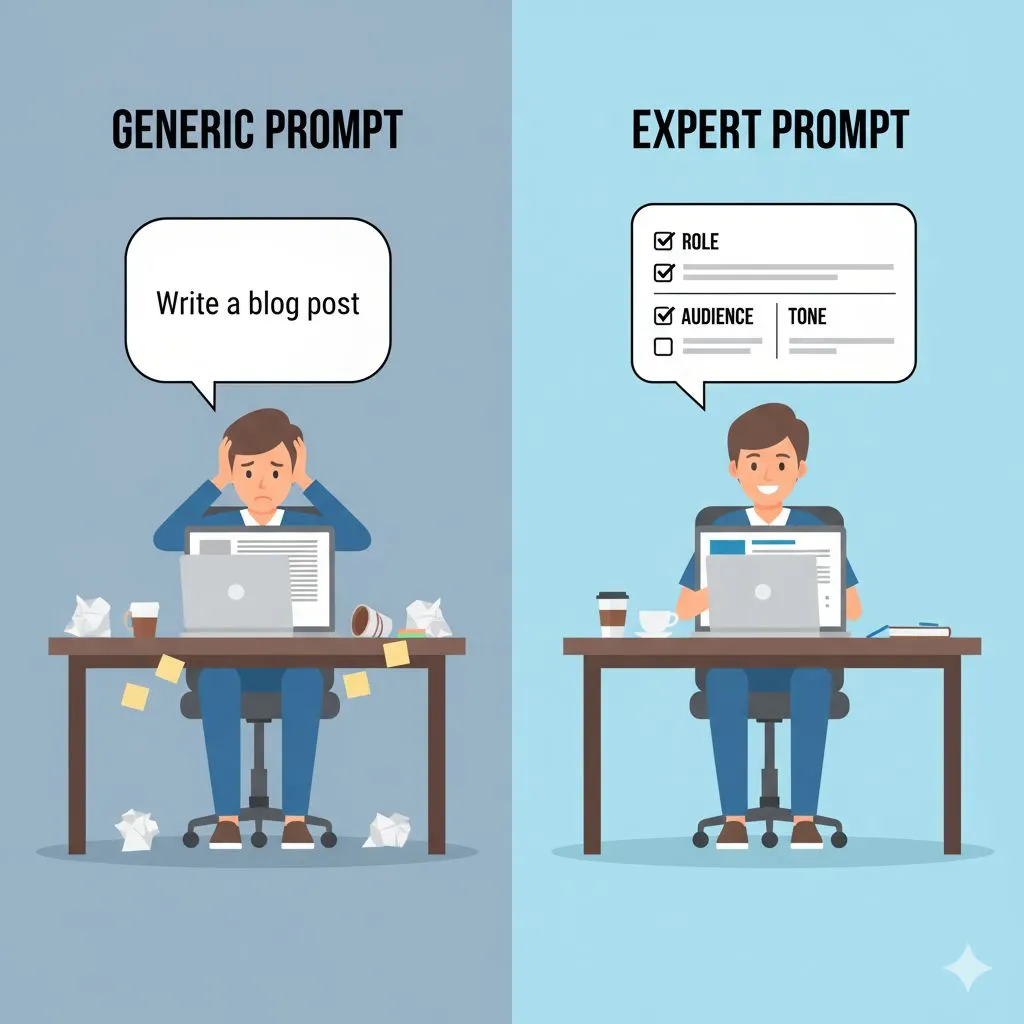
If you prompt an AI with: "Sell my coffee beans."
The AI thinks: "Coffee is a beverage. People drink it in the morning. I will use words like 'delicious' and 'energy'."
The result is fluff. It lacks the "teeth" needed to stop a scrolling thumb.
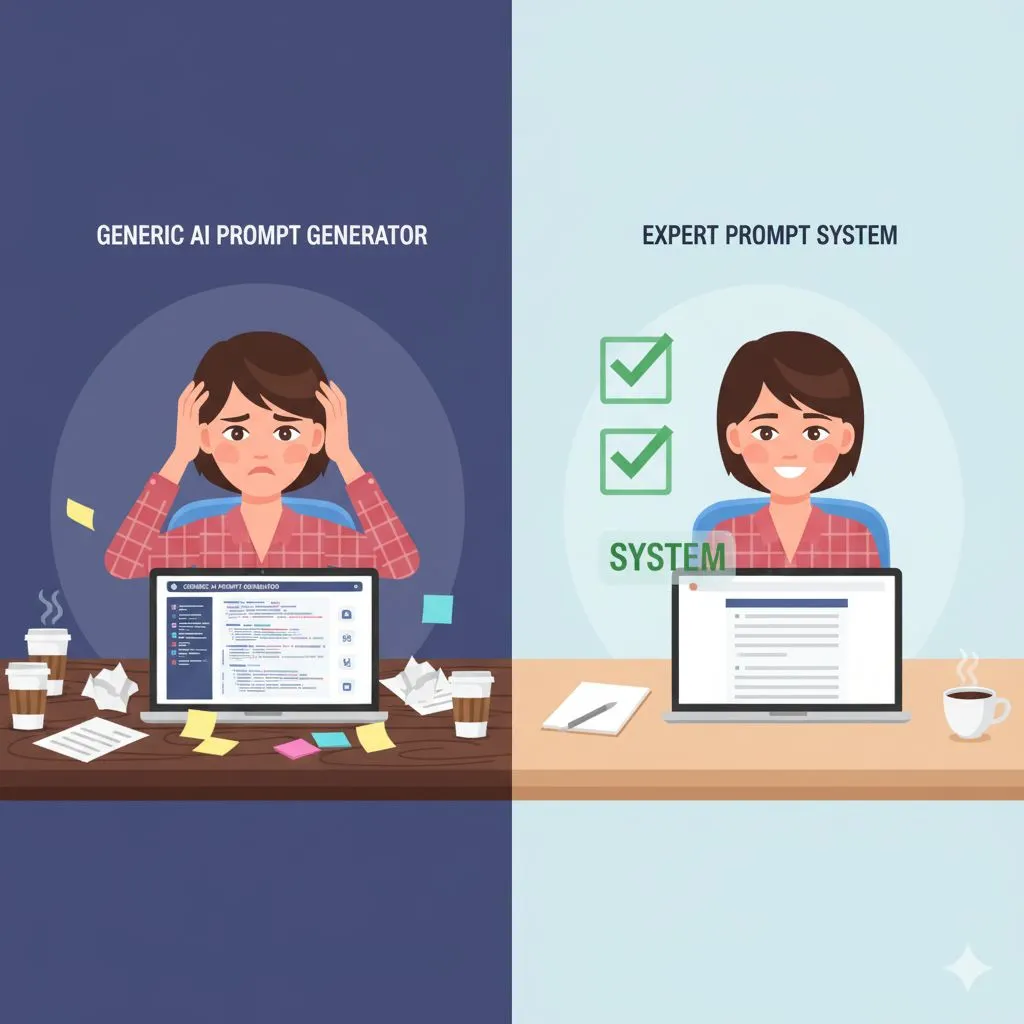
However, if you prompt with specific constraints—brand voice, target audience fears, and unique selling propositions—the AI shifts gears. It stops guessing and starts executing a strategy.
Overcoming the "Robot Voice"
One of the biggest fears business owners like Alex Rivers have is that using AI will damage their brand credibility. "Will my audience know a robot wrote this?"
They will only know if you let the AI dictate the tone. The secret to high-ROI copy is defining your Brand DNA within the prompt. You must explicitly tell the AI to avoid jargon, to speak in an "ambitious yet grounded" tone, and to focus on tangible benefits rather than vague features. The step-by-step process for this is covered in train your AI to match your brand voice.
When you master this, AI doesn't replace your voice; it amplifies it. It allows you to produce expert-level content at the same volume as agencies with teams of ten writers.
The Anatomy of a High-ROI Ad Prompt
To turn your AI tool into a high-performance copywriter, you need to structure your prompts with the precision of a computer code. A casual conversation won't cut it. You need a framework.
A high-ROI prompt generally consists of four critical components: Role, Context, Task, and Constraints.
To see these principles in action, explore 10 perfect prompt examples for marketing copy and the 5 expert AI prompt examples for copywriting on the Expert AI Prompts resource site.
1. Role Definition
Start by telling the AI who it is. This sets the baseline for the vocabulary and psychological triggers it will use.
- Weak: "Write an ad."
- Strong: "Act as a senior Direct Response Copywriter with 10 years of experience in B2B SaaS marketing. Your specialty is high-converting Facebook ad copy that prioritizes clarity over cleverness."
2. Context ( The "Alex Rivers" Factor)
You must upload your customer persona into the prompt. The AI needs to know who it is talking to.
- Input: "Target Audience: Small business owners aged 30-50. They are overworked, skeptical of hype, and value efficiency. They are tired of 'get rich quick' schemes and want practical solutions."
3. The Task (Specifics)
Be granular about what you want. Don't just ask for "copy." Ask for a headline, primary text, and a headline description.
- Input: "Write 5 variations of Facebook Ad Primary Text (under 125 words each) focusing on the pain point of time management."
4. Constraints (The Guardrails)
This is where you save money. By setting constraints, you prevent the AI from generating unusable fluff.
- Input: "Do not use hashtags. Do not use words like 'unleash,' 'unlock,' or 'revolutionize.' Keep sentences short and punchy. Focus on the negative impact of inaction."
Comparison: Low-ROI vs. High-ROI Prompt
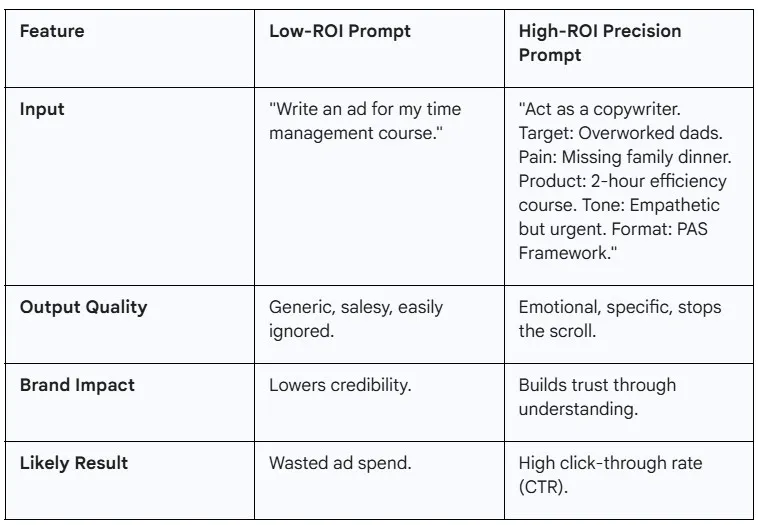
By mastering the anatomy of the prompt, you essentially hire a world-class copywriter for free. You move from staring at a blank cursor to editing five strong options in seconds.
3 Proven Frameworks to Automate with AI
Copywriting isn't magic; it's structure. For a ready-to-use toolkit of over 50 structured frameworks like these, see the Sales Prompt Playbook for AI Copywriting. The best ads in history follow specific psychological frameworks that guide the reader from a state of indifference to a state of action. The beauty of ai for ad copy is that LLMs are incredibly good at following these patterns—if you tell them which one to use.
Here are three frameworks you can deploy immediately to stop wasting ad spend.
Framework 1: PAS (Pain - Agitate - Solution)
This is the gold standard for stopping the scroll. It works by acknowledging a problem the user has, making them feel the weight of that problem, and then offering relief.
The Prompt Structure:
"Write a Facebook ad using the PAS (Pain-Agitate-Solution) framework.
Pain: The target audience is drowning in admin work and can't focus on strategy.
Agitate: If they don't fix this, they will burn out and their competitors will steal their market share.
Solution: Our AI Prompt Pack automates the busy work so they can scale."
Why this works for ROI: It filters out people who don't have the problem (saving you clicks) and deeply resonates with those who do.
Before deploying the PAS framework, it helps to understand why AI-generated ads fail (and how to fix them) — a deep-dive that reinforces exactly why precision in the 'Agitate' phase is so important.
Framework 2: AIDA (Attention - Interest - Desire - Action)
AIDA is excellent for longer-form copy, such as LinkedIn ads or email newsletters that lead to a sales page.
The Prompt Strategy:
Ask the AI specifically to focus on the "Attention" phase.
"Generate 10 'Attention' hooks for the AIDA framework. The goal is to startle the reader with a contrarian fact about small business failure rates. Then, complete the Interest, Desire, and Action sections for the top hook."
Why this works for ROI: The "Attention" line is responsible for 80% of your ad's success. Using AI to brainstorm ten hooks allows you to A/B test the most powerful element of your ad.
Framework 3: The "Objection Crusher" (Before - After - Bridge)
Skepticism is the conversion killer. Your audience, specifically people like Alex who have been burned by digital products before, are looking for reasons to say "no." This framework addresses that head-on.
The Prompt Structure:
"Write an ad using the Before-After-Bridge framework.
Before: Current state is skepticism. They think AI is just hype and produces low-quality junk.
After: Future state is running a streamlined, efficient business where AI acts as a reliable partner.
Bridge: Our 'Expert AI Prompts' are rigorously tested and industry-specific, bridging the gap between toy tools and business assets."
Why this works for ROI: It builds credibility instantly. By calling out the objection (AI is hype), you validate their feelings and position your product as the logical exception.
From Generation to Validation: The Testing Phase
The difference between an amateur and a pro isn't just writing good copy; it's testing it.
In the old days, testing ten different headlines meant writing ten different headlines—a task that could take all morning. With ai for ad copy, you can generate volume instantly. But volume without validation is just noise.
The "Volume is Victory" Strategy
To get the highest ROI, you should never launch a campaign with just one ad.
- Generate: Use your precision prompts to create 10 Headline variations and 5 Primary Text variations.
- Curate: This is where you, the business owner, step in. You are no longer the writer; you are the Editor-in-Chief. discard the 5 headlines that feel "off." Keep the 3 that make you feel something.
- Test: Load these variations into your ad manager (Facebook/Meta calls this "Dynamic Creative"). Let the platform match the best headline with the best text.
The Human-in-the-Loop
AI is a tool for leverage, not abdication. You cannot blindly copy-paste output and expect millions. You must review the copy for:
- Fact-checking: Did the AI hallucinate a feature you don't offer?
- Tone consistency: Does it sound like you?
- Formatting: AI loves long paragraphs. Break them up. People scan; they don't read.
Iterative Prompting
If the first batch of copy isn't great, don't blame the AI. Blame the prompt. Refine your instructions.
- Correction: "That was too formal. Rewrite the top 3 options to sound more conversational, like a mentor talking to a student."
- Correction: "Make the 'Pain' section more visceral. Focus on the physical feeling of stress."
If you want to see the raw numbers on time saved versus cost, the manual writing vs AI prompting: time-to-value analysis breaks down exactly where the ROI lives. And for the actual copy mechanics, writing sales pages that convert using the PAS Framework and AI is a natural companion read.
Conclusion: From Operator to Strategist
The goal of using AI in your business isn't just to "write ads fast." It is to free you from the weeds.
Every hour you spend staring at a blinking cursor is an hour you aren't spending on business strategy, partnership development, or spending time with your family. By mastering ai for ad copy, you reclaim that time.
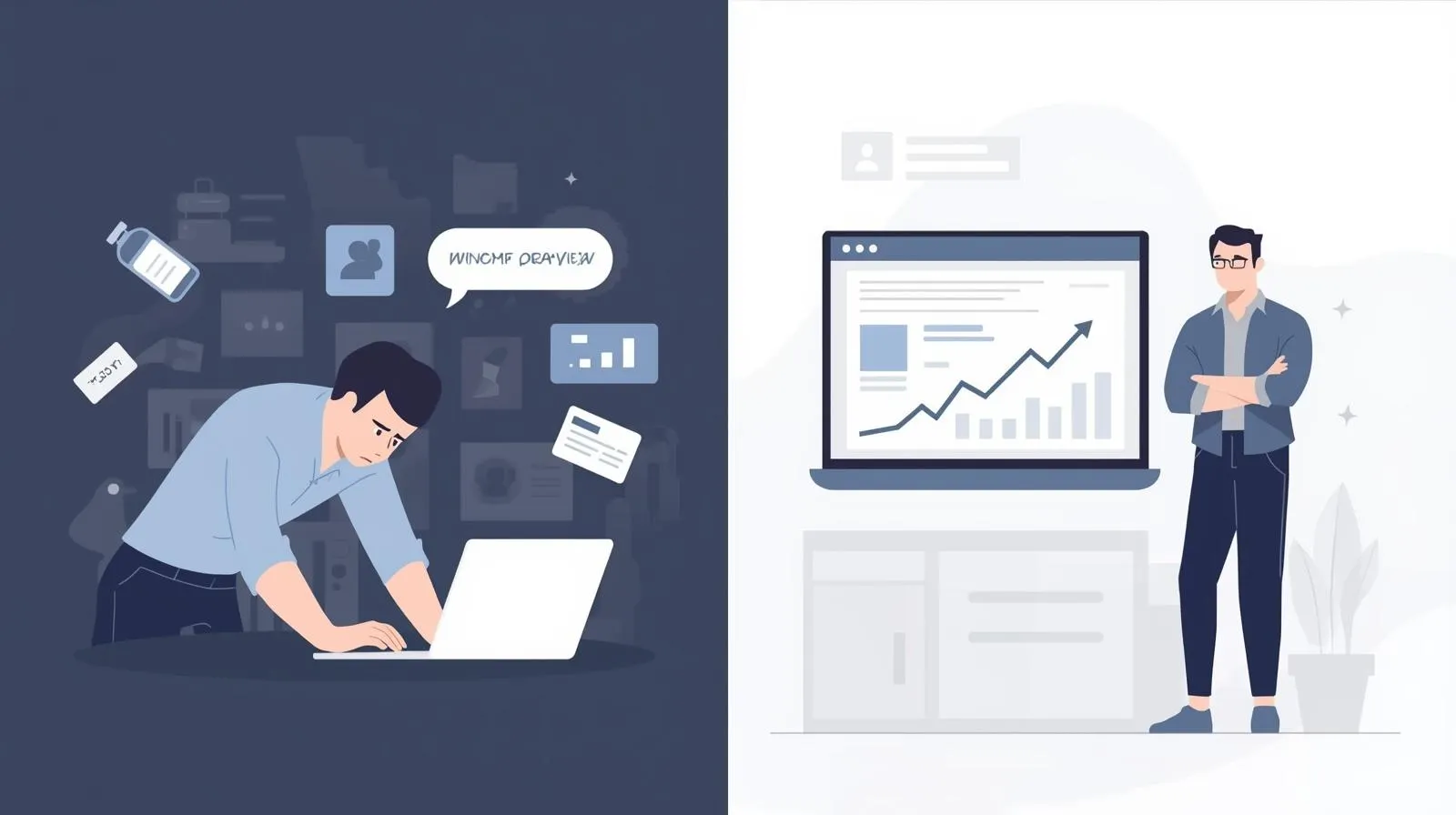
You move from the stressed operator, frantically trying to churn out content, to the confident strategist who directs a system to do the heavy lifting. You gain the ability to compete with larger agencies because you can produce the same volume of high-quality creative without the overhead. Boutique agencies are already doing this at scale — see how boutique agencies are competing with big firms using AI prompts.
You have the ambition. You have the business model. Now, you have the tool to scale it.
Stop guessing. Stop wasting ad spend. Start prompting with precision.
Ready to Scale?
You don't need to learn prompt engineering from scratch. We have done the heavy lifting for you.
Get the toolkit that turns "generic AI" into your best employee. Unlock 50+ industry-specific, high-ROI prompts designed to streamline your workflow and fill your funnel.
Stop Spinning Your Wheels — Get Expert AI Prompts Here
Not ready to buy yet? Start with a free resource: get free AI prompts — save 5 hours this week and see what precision prompting can do for your workflow before you invest a cent.
Ready to go all in? View the full prompt packs pricing catalog — 30 industry-specific packs, one-time investment.
Further Reading
• The Complete Guide to AI in Advertising and Sales — the full strategic framework behind every technique in this post
• 7 AI Prompts for High-Converting Ad Copy — ready-to-use prompt templates for your next campaign
• Why AI-Generated Ads Fail (And How to Fix Them) — the mistakes to avoid before you launch
• Manual Writing vs AI Prompting: Time-to-Value Analysis — the numbers that make the ROI case
• ROI, Pricing & Economic Value — tools and calculators to quantify the value of AI-powered copy