Optimizing for Voice Search in a Screenless Future
Optimizing for Voice Search in a Screenless Future
Feb 03, 2026

Are you ready for a world where your customers stop looking at screens and start talking to the air?
It sounds like science fiction, but for the busy parent cooking dinner, the commuter in traffic, or the multitasker (like you) juggling a dozen responsibilities, it is the current reality. We are rapidly entering a "screenless future," where the primary interface between a customer and a business isn’t a keyboard—it’s a voice.
For small business owners like Alex Rivers—ambitious, overextended, and wearing every hat from CEO to janitor—this shift might feel like just another thing to add to an overflowing to-do list. You might be thinking, "I barely have time to optimize my website for Google; now I have to optimize it for Siri and Alexa too?"
Here is the truth: Voice search optimization isn't about doing more work; it's about ensuring the work you’ve already done actually gets found.
Voice search is the great equalizer. Large corporations with massive marketing budgets often dominate the top of the search results page with paid ads. But voice assistants like Siri, Google Assistant, and Alexa typically provide one answer—the best answer. That means a nimble, strategic small business with high-quality content has a legitimate shot at stealing market share from the giants.
This guide is your strategic roadmap. We aren't going to bog you down with complex code or academic theory. Instead, we will focus on high-impact, efficiency-driven strategies to ensure your business is the one answering when your customers ask, "Who is the best...?"
If you're new to using AI as a strategic business tool, start with the ultimate guide to AI for small business — it covers how to integrate AI across every function without adding to your workload.
The Psychology of Voice: Intent vs. Keywords
To win at voice search, you have to stop thinking like a computer and start thinking like a human.
For the last decade, we have been trained to speak "robot." When we sit at a desktop, we type efficiently. We might type: “Italian restaurant Jimboomba.”
But when we use voice search, we revert to our natural, conversational habits. We ask: “Hey Google, where’s a good place to get authentic pasta near me that’s open right now?”
Do you see the difference?
1. The Rise of Conversational Search
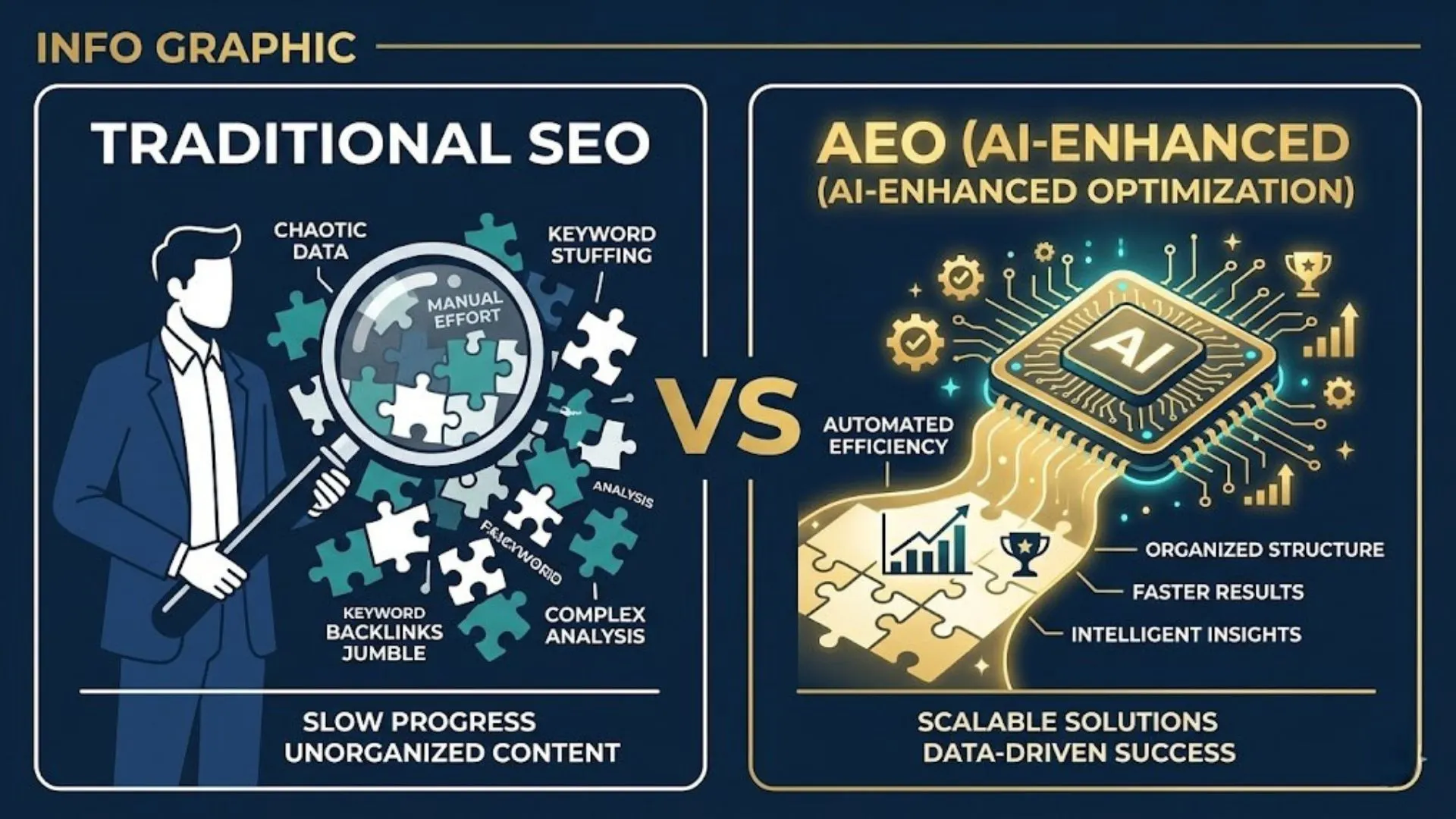
Traditional SEO focuses on short-tail keywords (2-3 words). Voice search optimization relies on Natural Language Processing (NLP). Voice queries are longer, more specific, and phrased as full sentences.
If your website content is stuffed with robotic keywords, it won't sound natural when read aloud by a digital assistant. To compete, your content needs to mirror the way your customers actually speak. It needs to be conversational, authoritative, and direct.
2. Capturing the "Micro-Moment"
Voice searches are rarely idle browsing. They are high-intent. When someone asks a voice assistant a question, they are usually in a "Micro-Moment." Google defines these as:
- I want to know: Informational queries (e.g., "How do I fix a leaking tap?").
- I want to go: Navigational queries (e.g., "Find a hardware store near me.").
- I want to do: Instructional queries (e.g., "How to install a WordPress plugin.").
- I want to buy: Transactional queries (e.g., "Order toner cartridges for HP printer.").
For a small business owner, this is gold. A user typing on a desktop might be 10 clicks away from buying. A user asking a voice question on their phone is often ready to act immediately.
3. The Long-Tail Strategy
This is where you can stop hustling and start scaling. You cannot compete with Amazon for the keyword "Shoes." But you can compete for "Best ergonomic running shoes for flat feet in [Your City]."
Voice search queries are naturally "long-tail"—meaning they contain 5+ words. These keywords have lower search volume, but much higher conversion rates. By shifting your content strategy to answer specific, complex questions, you attract visitors who know exactly what they want and are ready to do business with you.
For a complete breakdown of how to build this strategy, see the ROI-driven guide to AI for SEO — the strategic framework that connects voice search, long-tail keywords, and AI-powered content production.
Strategy Pillar 1: Owning the "Near Me" Market
If there is one area where small businesses can absolutely dominate larger competitors, it is Local SEO. And here is the secret: Local SEO and voice search are practically the same thing.
To build the right foundation, review the best AI SEO tools for small business — a curated review that cuts through the noise so you invest in tools that actually move the needle.
Data suggests that a massive percentage of voice searches are local in nature. People are driving, walking, or deciding where to eat, shop, or hire immediately. They are asking for "the best X near me" or "X open now." If your business isn't optimized for these local signals, you are essentially invisible to the voice ecosystem.
Google Business Profile: Your Digital Storefront
If you do only one thing after reading this guide, make it this: Claim, verify, and optimize your Google Business Profile (GBP).
For voice assistants (especially Google Assistant), your GBP is the primary source of truth. When someone asks, "Is there a marketing consultant near me?" Google looks at your profile before it looks at your website.
To optimize this for voice:
- Complete Every Field: Don't leave anything blank. Description, categories, services, opening date.
- Introduction: Write a natural, conversational business description that includes your key services and location.
- Q&A Section: This is a hidden gem. You can populate your own Q&A section on your profile. Post questions your customers actually ask ("Do you offer free consultations?") and answer them clearly. This directly feeds voice search algorithms.
NAP Consistency (Name, Address, Phone)
Voice assistants crave certainty. If your website says your office is on "Main St," but your Facebook page says "Main Street," and a directory listing says "Main St, Suite 4," the AI gets confused. Confused AI does not recommend you.
You must ensure your NAP (Name, Address, Phone number) is identical across every platform: your website footer, social media, Google Maps, Yelp, and industry directories. This builds the trust required for a voice assistant to confidently say, "Here is a result for you..."
The Power of Reviews
"Hey Siri, find me a highly-rated web designer."
Voice search qualifiers often include words like "best," "top-rated," or "great." How does the AI know who is best? It looks at your star rating and the sentiment of your reviews.
You need a proactive system for gathering reviews. But more importantly, you need to respond to them. Responding to reviews shows activity and relevance. Furthermore, customers often use natural language in reviews ("Alex helped me scale my business quickly"). These user-generated keywords are SEO gold that helps match your business to future voice queries.
Strategy Pillar 2: Structuring Content for the Ear
Once you have the local signals sorted, you need to look at your actual content—your blog posts, service pages, and landing pages. You aren't writing for eyes anymore; you are writing for ears.
The Holy Grail: Position Zero
In traditional desktop search, being #1 is great. In voice search, being #1 is the only thing that matters. Voice assistants usually read the "Featured Snippet"—that boxed answer at the very top of Google results. This is often called "Position Zero."
To capture this spot, you don't need to be a giant corporation; you just need to be concise.
- The Strategy: Identify a common question in your industry.
- The Tactic: Immediately after the heading, provide a direct, bold answer that is 40 to 60 words long.
- The Logic: This "definitional style" is perfectly bite-sized for Siri or Alexa to read back to a user.
Example:
Heading: What is voice search optimization?
Body: Voice search optimization is the process of upgrading your website content to appear in voice search results. It involves using conversational keywords, improving page speed, and focusing on local SEO to answer direct questions from users.
FAQ Pages: The Ultimate Voice Search Weapon
If you are looking for a high-ROI activity that saves time and boosts your SEO, look no further than the Frequently Asked Questions (FAQ) page.
FAQ pages are naturally conversational. They literally mimic the Q&A format of a voice search.
- User asks: "How much does business coaching cost?"
- Your FAQ: "How much does business coaching cost?" followed by a concise answer.
Pro Tip: Don't just guess what people ask. Use tools like AnswerThePublic or simply look at your "Sent" emails to see what clients ask you repeatedly. Group these questions onto a dedicated page. This creates a repository of "voice-ready" answers that search engines love to pull from.
Creating consistent, audience-ready content at this level takes a system — not just a single page. The small business playbook for AI content creation shows you how to build that system end to end.
Readability: Write for an 8th Grader
As an expert in your field, you might be tempted to use jargon to prove your authority. Resist that urge.
Voice assistants prefer simple, clear language. Complex sentence structures are difficult for text-to-speech software to parse naturally.
- Keep sentences short.
- Avoid big blocks of text.
- Use transition words (first, next, finally).
Writing at an 8th-grade reading level doesn't make you look unprofessional; it makes you accessible. It ensures that when your content is read aloud, the listener understands it immediately without having to hit "rewind."
Strategy Pillar 3: Technical Essentials for the Non-Techie
You don't need to be a developer to understand the technical side of voice SEO, but you do need to understand the basics to ensure your website isn't disqualifying itself.
Speed is Survival
Voice searchers are usually on the go. They want answers now. If your site takes 5 seconds to load, Google isn't going to pull an answer from it, because the voice assistant can't wait that long.
- Action Step: Run your site through Google’s PageSpeed Insights.
- The Fix: You might need to compress your images (a common culprit for slow sites) or upgrade your hosting. This is a one-time fix that pays dividends forever.
Mobile Optimization is Non-Negotiable
Most voice searches happen on mobile devices. If your site isn't "Mobile-Friendly," Google effectively ignores it for mobile queries. Your text needs to be readable without pinching and zooming, and buttons need to be clickable.
Google operates on "Mobile-First Indexing." This means Google predominantly uses the mobile version of the content for indexing and ranking. If your desktop site looks great but your mobile site is broken, your SEO is broken.
Schema Markup: Labeling for Robots
This sounds the most intimidating, but stick with me. Schema Markup is simply a piece of code (a "tag") you put on your website that helps search engines understand what your content is.
Think of it like a sticky note you put on a document for a filing clerk.
- Without Schema, Google sees a string of numbers: "555-0199." It thinks it's a phone number.
- With Schema, you explicitly tell Google: "This is the Customer Service telephone number."
For voice search, "Speakable" Schema is a game-changer. It tells Google Assistant exactly which part of a page is best suited for text-to-speech playback. If you use WordPress, plugins like RankMath or Yoast SEO can handle 90% of this for you without you touching a line of code.
VI. Execution: Integrating Voice Strategy into Your Workflow
We know what you’re thinking: “This makes sense, but when am I supposed to do all of this?”
Alex, we know you are already handling client delivery, finances, and marketing. The goal here isn't to overhaul your entire digital presence overnight. It’s to integrate voice optimization into your existing workflow so you can scale smarter, not harder.
Step 1: The "Low-Hanging Fruit" Audit
Don’t rewrite your whole website. Start with your top 5 performing pages.
- Read the headings aloud. Do they sound like questions a human would ask?
- Look at your introduction paragraphs. Can you add a "Position Zero" definition (40-60 words) right at the top?
- Check your Contact page. Is your NAP (Name, Address, Phone) perfectly accurate?
Step 2: Leverage AI for Conversational Research
This is where you gain leverage. You don't have to brainstorm conversational queries yourself. Use AI to do the heavy lifting.
- The Prompt: Ask an AI tool: "Generate 20 conversational questions that a potential client would ask Siri or Alexa when looking for [Your Service]. Focus on 'how-to' and 'best' queries."
- The Output: You now have a content calendar of blog posts and FAQ entries that are pre-optimized for voice.
To get started immediately, grab the free AI prompts that save 5 hours this week — a no-cost download packed with ready-to-use prompts you can drop straight into this workflow.
Step 3: Stop "Creating," Start "Answering"
Shift your content mindset. Instead of writing generic "thought leadership" pieces that wander, structure your content as direct answers to these questions. This is faster to write and performs better in search. It positions you as the expert who solves problems—which is exactly what your customers are looking for.
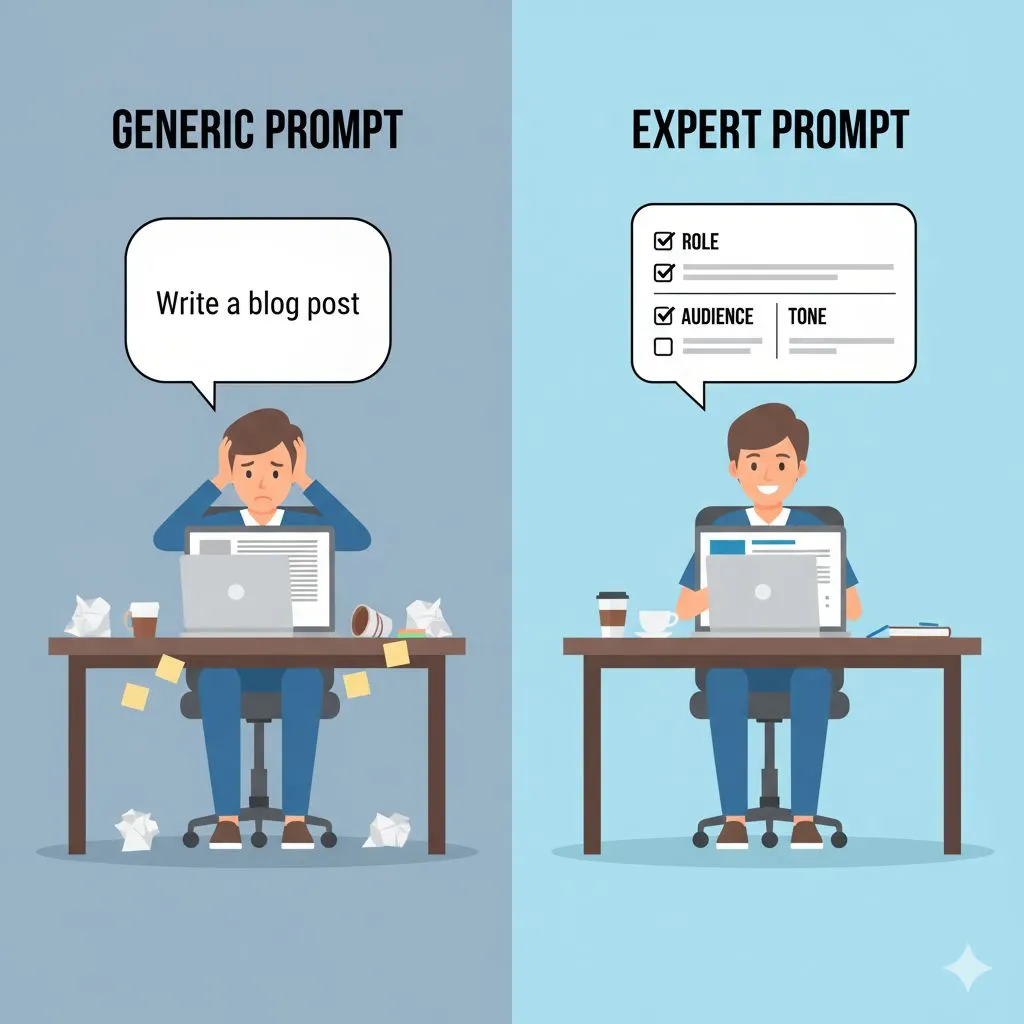
Developing that expert positioning starts with your prompts — the Entrepreneur's Playbook for Prompt Engineering is the definitive guide to building the skill that powers every strategy in this article.
VII. Conclusion: Future-Proofing Your Brand
The move toward a screenless future isn't a threat to small business; it is an invitation.
It is an invitation to stop competing on volume and start competing on relevance. It is an invitation to move away from robotic keyword stuffing and back toward what matters most: helping your customers solve their problems in the moment they need you.
By optimizing for voice search, you are doing more than just pleasing an algorithm. You are:
- Respecting your customer's time by providing fast, direct answers.
- Building trust by appearing as the "best" recommendation from a trusted voice assistant.
- Scaling your reach by capturing high-intent leads without having to be glued to your own screen 24/7.
You have the ambition. You have the expertise. Now, you have the strategy. The only thing left is to execute efficiently.
Creating conversational, expert-level content for 30 different industry nuances takes time—time you might not have. But what if you could generate high-ranking, voice-optimized content in seconds?
Ready to stop hustling and start scaling?
Not sure where to start? Access free AI tools and prompt resources — 11 free downloads built specifically for small business owners who want to move fast without the overwhelm.
Unlock the power of conversational SEO without the guesswork. Get the tools you need to dominate the screenless future.
Get Your SEO Prompt Power AI Toolkit Here
Ready to explore the full range? Browse all 30 industry-specific prompt packs — one-time investment, lifetime access, built for the industry you're actually in.
Further Reading
• SEO in 2026: Why You Need Strategic Prompts to Rank on Google
• Can AI Write SEO Content That Actually Ranks?