Can AI Write SEO Content That Actually Ranks?
Can AI Write SEO Content That Actually Ranks?
Jan 27, 2026

If you are like most small business owners, your browser has 20 tabs open right now. One is your email, three are competitor sites, and the rest are articles promising that Artificial Intelligence is either going to save your business or destroy the internet.
For entrepreneurs like you—juggling client delivery, payroll, and business development—the promise of AI is seductive. The idea that you could fire your expensive freelance writer or stop spending your Sunday nights writing blog posts is appealing. You want to scale. You want to compete with the big agencies that have ten-person content teams.
But you are also skeptical. You’ve seen the generic, robotic "slop" that floods LinkedIn. You’ve heard rumors of Google penalizing AI content. You are asking the critical question: Can AI actually write SEO content that ranks, or am I just setting my website up for a penalty? Our ROI-Driven Guide to AI for SEO covers the full strategic and technical breakdown — from Google's quality signals to scalable workflows.
This isn't a theoretical question; it’s a business viability question. You don’t have time for trial and error. You need a clear, ROI-driven answer.
The short answer is: Yes, AI content can rank. But there is a massive asterisk attached to that "Yes." It only ranks if you stop treating AI as a "content vending machine" and start using it as a high-speed junior analyst.
This analysis will cut through the hype and the fear-mongering. We will look at what the search engines actually want, where ai seo tools fail, and how you can build a workflow that saves you time without sacrificing your brand’s credibility.
The Google Stance: De-bunking the "AI is Spam" Myth
To understand if AI can rank, we first have to understand the referee of the game: Google.
For a long time, there was a prevailing myth that Google had an algorithmic "kill switch" for AI content—that if their spiders detected non-human patterns, your site would be banished to page 50.
This is false.
Google’s search liaison team has been explicitly clear on this. Their ranking systems reward high-quality content, however it is produced. Google’s primary focus is on the user experience, not the author's biology. If an AI-assisted article provides the best, most accurate, and most concise answer to a searcher's query, it deserves to rank.
The E-E-A-T Framework
However, Google does have a strict quality filter known as E-E-A-T:
- Experience
- Expertise
- Authoritativeness
- Trustworthiness
This is where the nuance lies. Raw AI output often scores high on surface-level "Expertise" (it has access to vast data), but it scores zero on "Experience." ChatGPT has never run a small business. It has never negotiated a contract. It has never felt the stress of a looming deadline.
When Google’s "Helpful Content Update" rolled out, it didn't target AI specifically; it targeted unhelpful content. It targeted content that summarized other articles without adding new value. Unfortunately, that is exactly what 90% of lazy AI users produce.
The "Lazy" AI Problem
If you prompt an AI with, "Write me a 1,000-word article on digital marketing trends," it will scrape the internet for the most common consensus and spit out a vanilla, repetitive article. Avoid the most expensive AI content mistakes — the Common Pitfalls and Anti-Patterns guide shows small business owners exactly what to sidestep when using AI for content. This content won't rank—not because it’s AI, but because it’s average.
Google wants unique insights. If your ai seo tools are just regurgitating what is already on the first page of Google, you have no competitive advantage.
So, the takeaway is clear: Google won't penalize you for using AI. They will penalize you for publishing low-value content. The goal isn't to hide the fact that you used AI; the goal is to use AI to create something so good that it doesn't matter.
The "Vanilla" Trap: Where AI SEO Tools Struggle
If Google rewards uniqueness and experience, we must confront the inherent limitations of Large Language Models (LLMs) like GPT-4, Claude, or Gemini. Understanding these flaws is the only way to safeguard your brand reputation and ensure your content actually converts readers into clients.
AI models operate on probability. They are designed to predict the next most likely word in a sentence based on the massive dataset they were trained on. By definition, AI aims for the average. It aims for the consensus.
For a creative entrepreneur trying to stand out in a crowded market, "average" is a death sentence.
1. The Hallucination Hazard
AI doesn't "know" facts; it knows patterns. This leads to "hallucinations," where the tool confidently asserts facts, statistics, or quotes that do not exist. For a business owner valuing credibility, this is a massive risk. Publishing an article with fake data can destroy trust instantly. You cannot automate fact-checking.
2. The Lack of Brand Voice
You have spent years building your business. You have a specific tone—perhaps it’s professional yet approachable, or witty and direct. Raw AI output usually sounds like a corporate press release or an enthusiastic intern. Train AI to write in your brand voice so every output reflects your business identity, not a generic template. It uses crutch words like "delve," "uncover," and "landscape" excessively. If your content sounds like everyone else's, you become a commodity.
3. The "Copy-Cat" Effect
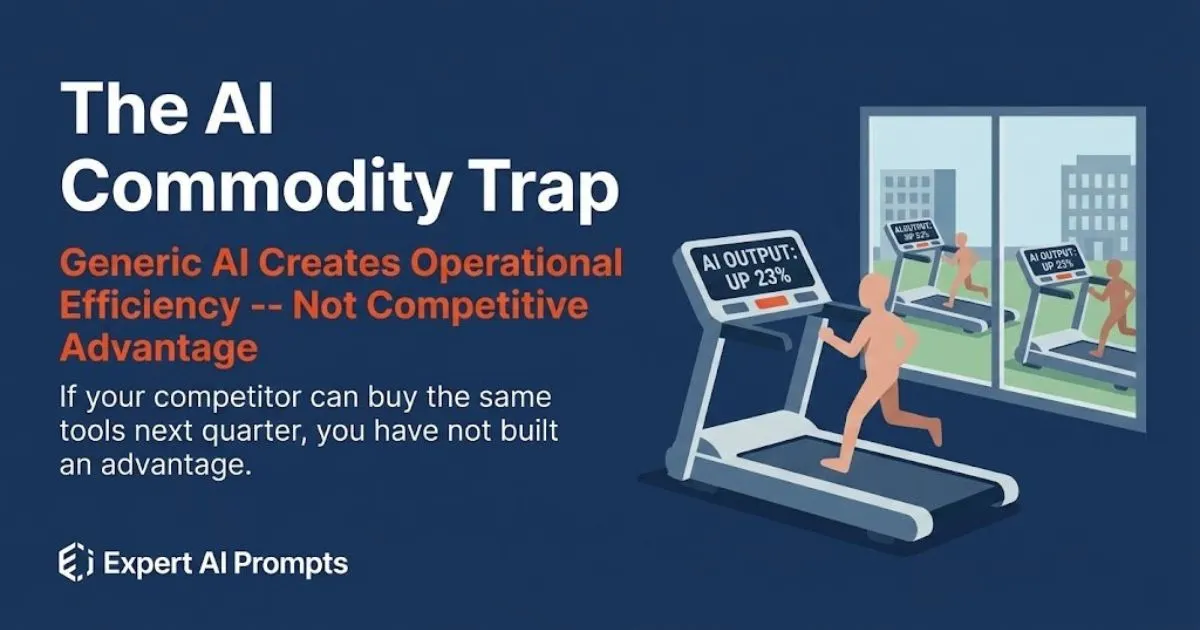
Here is the uncomfortable truth: Your competitors have access to the exact same ai seo tools you do. If you both type in "Write a blog post about small business accounting tips," you will get nearly identical outlines. If you publish that raw output, you aren't competing; you're echoing. To rank, you need differentiation.
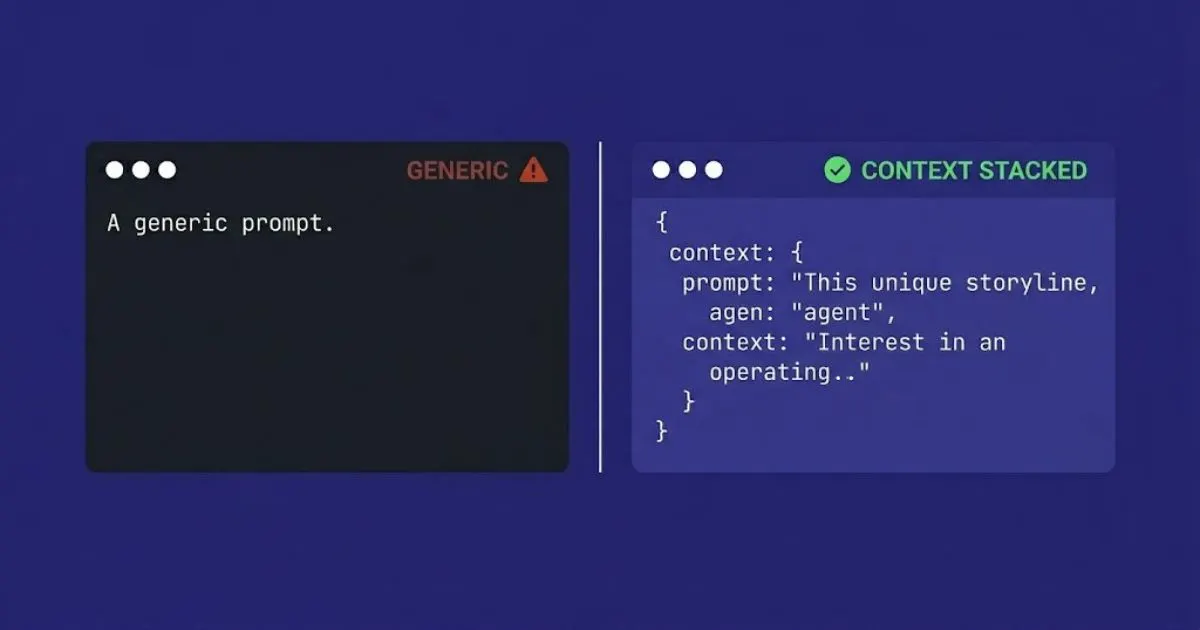
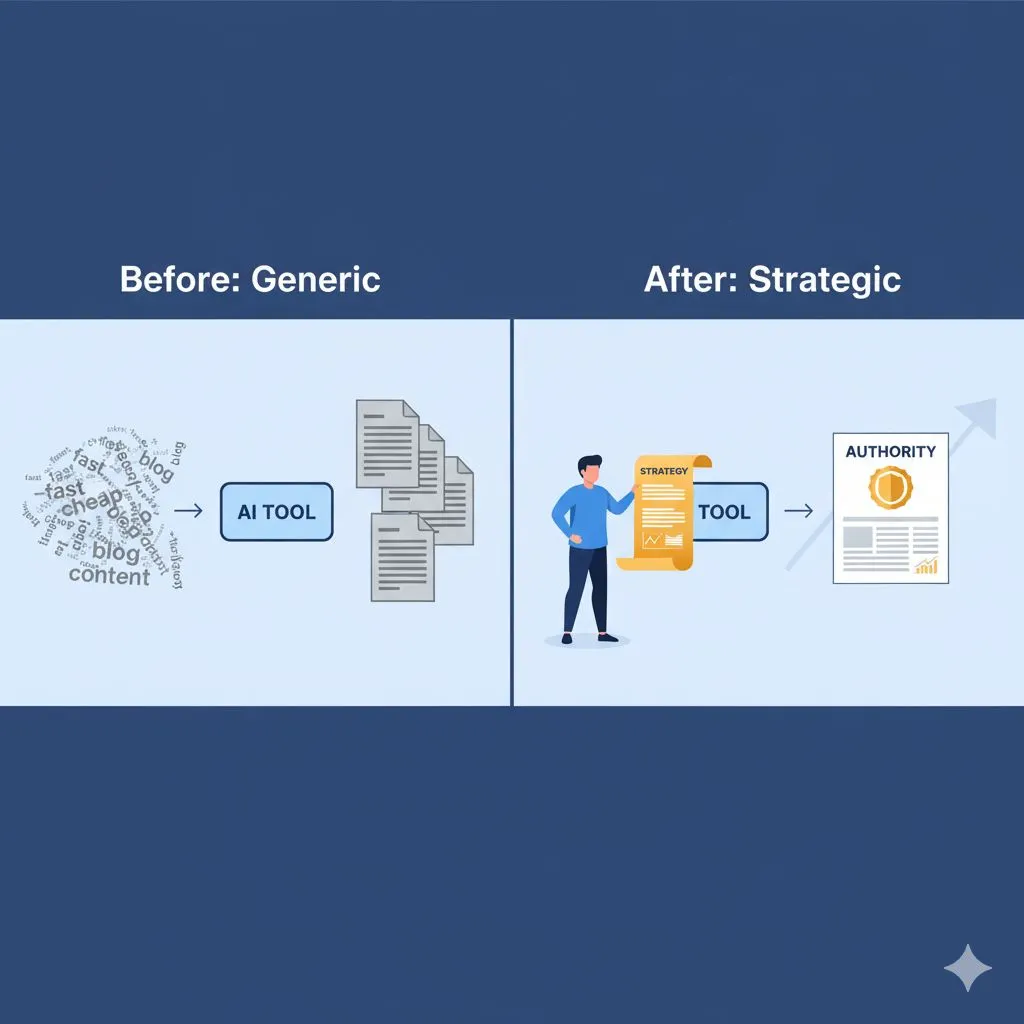
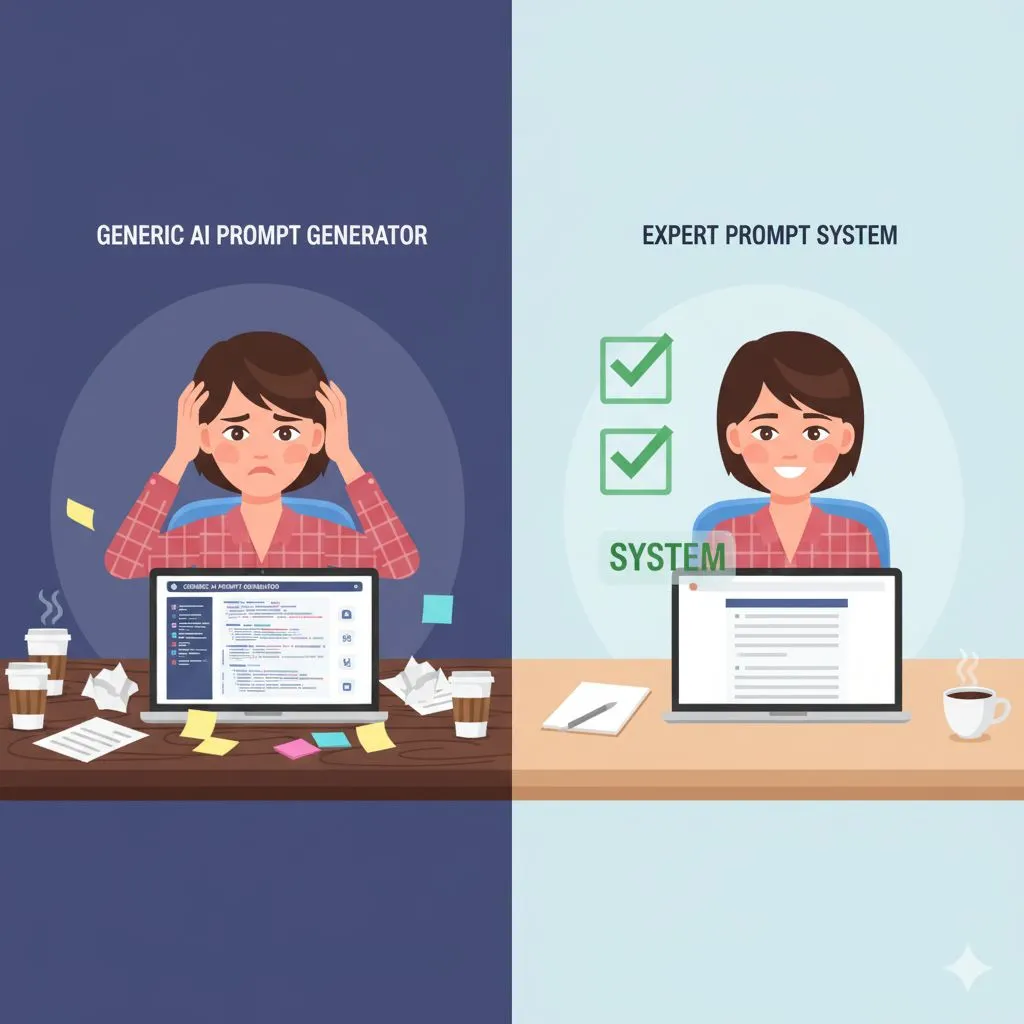
The difference between ranking and blending in comes down to strategy — generic vs. strategic AI prompts is the gap that separates businesses that rank from businesses that echo.
Run your existing AI content through our free Generic-to-Expert AI Content Audit Checklist to identify exactly where your posts are losing authority — before you publish another one.
The Hybrid Model: The ROI-Driven Approach to AI SEO
So, how do you solve the "Vanilla" problem without going back to writing everything from scratch? You adopt the Hybrid Model.
This approach treats AI not as the author, but as the architect and the builder. The Entrepreneur's Playbook for Prompt Engineering expands this model into a complete business-wide framework for output quality, speed, and brand differentiation. You remain the architect and the interior designer.
The 80/20 Rule of AI SEO:
- 80% of the work (The Grunt Work): Keyword research, outlining, drafting structure, meta descriptions, and formatting. AI handles this instantly.
- 20% of the work (The Magic): Strategy, personal anecdotes, contrarian opinions, case studies, and tone of voice. You handle this.
This shift changes everything. Instead of staring at a blinking cursor for two hours (a bottleneck that costs you money), you are now editing a well-structured draft.
Step 1: AI as the Researcher (The Architect)
Don't ask AI to "write." Ask it to think. Use prompts to analyze top-ranking competitors for your keywords. Ask AI to identify "content gaps"—what are your competitors not talking about?
- Prompt Concept: "Analyze the search intent for 'sustainable packaging for small biz.' What questions are users asking that aren't being answered by the top 3 results?"
Step 2: AI as the Drafter (The Builder)
Once you have a unique angle, let the AI build the frame. Feed it a detailed outline.
- The Key: Give the AI constraints. Tell it not to use fluff. Download the free 1-Page Perfect Prompt Framework Guide — a single-page cheat sheet that applies exactly this structure to any content brief, with tested constraints built in. Tell it to use short sentences. Tell it to format with H2s and bullet points for readability.
Step 3: The Human Injection (The Designer)
This is where you earn your ranking. You must inject E-E-A-T.
- Experience: Add a sentence starting with, "In my experience with client X..."
- Opinion: AI is neutral; you shouldn't be. "Most people say X, but I believe Y because..."
- Voice: Rewrite the intro and conclusion to sound like you.
By using this Hybrid Model, you produce content that has the structural perfection of a machine and the insightful nuance of a human expert. This is the content that ranks.
Analysis of the Toolkit: Categorizing AI SEO Tools
To execute the Hybrid Model effectively, you need the right tech stack. For a small business owner, the market is overwhelming. There are thousands of tools promising page-one results. We've benchmarked the most relevant options in our Best AI Tools for Business 2025 Toolkit — use it as your filter before committing to any monthly subscription. But relying on the wrong tool—or paying for features you don't need—kills your ROI.
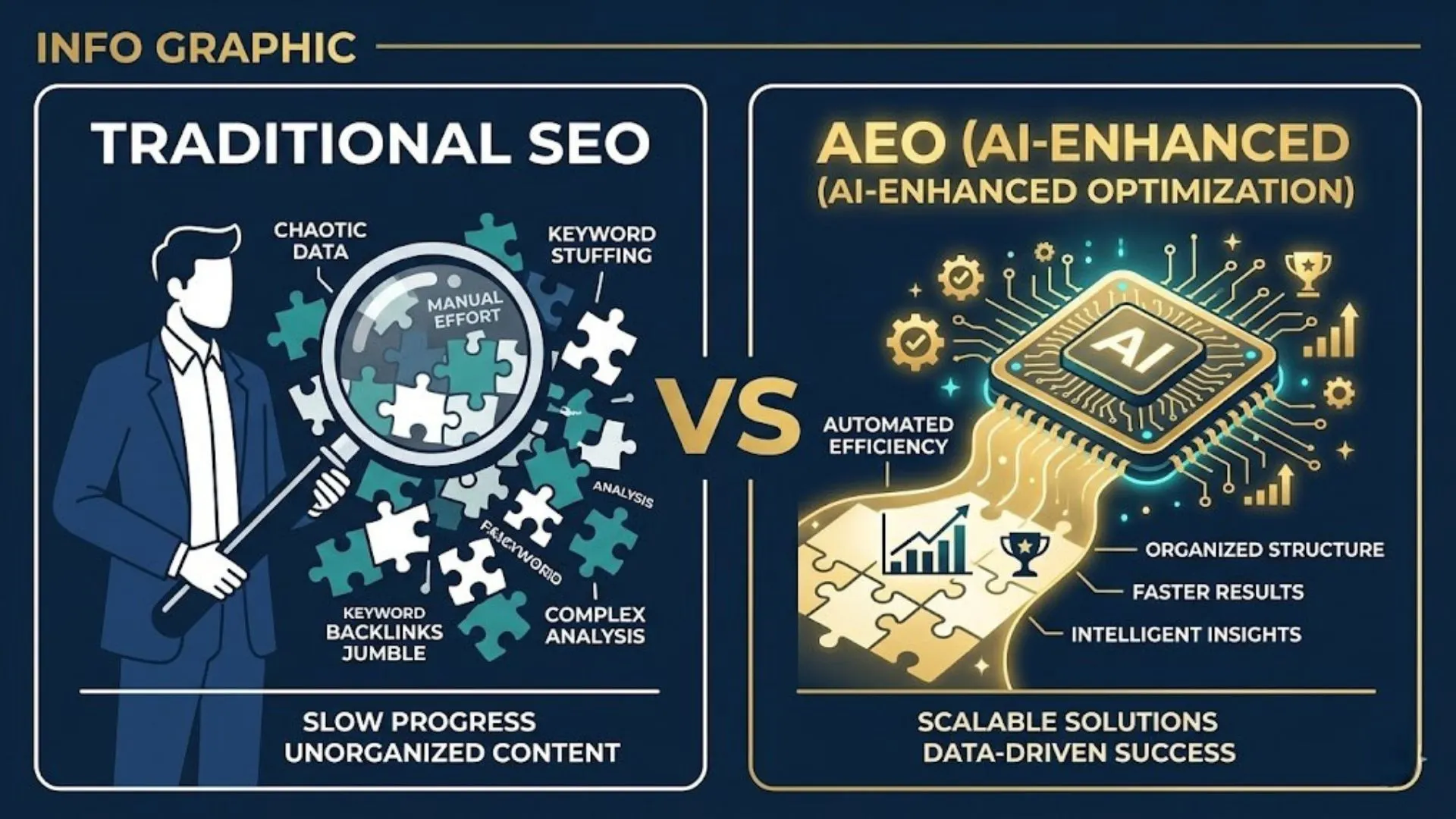
We can categorize the essential ai seo tools into three buckets: Generators, Optimizers, and Detectors.
1. The Content Generators (The Draftsmen)
- Examples: ChatGPT (OpenAI), Claude (Anthropic), Gemini (Google).
- The Role: These are your general-purpose engines. They are unbeatable for brainstorming, outlining, and creating the "clay" you will later mold.
- Pros: Extremely affordable (often free or $20/month), versatile, and conversational.
- Cons: They have no knowledge of real-time SEO data (unless connected to the web via plugins) and struggle with keyword density optimization.
- Verdict for Alex Rivers: Essential. ChatGPT Plus or Claude is the baseline requirement for the Hybrid Model. Claude generally produces more human-sounding prose, while ChatGPT is better at following complex structural logic.
2. The Optimizers (The Analysts)
- Examples: Surfer SEO, Frase, MarketMuse.
- The Role: These tools don't just "write"; they analyze the search engine results page (SERP). They tell you exactly which keywords your competitors are using, how long their articles are, and what topics they cover.
- Pros: They provide a data-backed roadmap to ranking. They remove the guesswork. Our Best AI SEO Tools for Small Business review compares Surfer, Frase, and MarketMuse side by side on cost, learning curve, and ROI for solopreneurs. "Green lighting" a score in Surfer SEO significantly increases your probability of ranking.
- Cons: They can be expensive ($60–$100+/month). They can also encourage "over-optimization," making content read robotically just to hit a keyword score.
- Verdict for Alex Rivers: High ROI if you are serious about organic traffic. If you can only afford one paid tool beyond ChatGPT, make it an optimizer like Frase (which is often more budget-friendly for solopreneurs) or Surfer. It bridges the gap between "good writing" and "algorithm-friendly writing."
3. The Detectors (The False Hope)
- Examples: Originality.ai, GPTZero.
- The Role: These tools claim to tell you if content was written by AI.
- The Reality: They are notoriously unreliable. They frequently flag human writing (especially the Bible and the US Constitution) as AI, and they can be tricked by simply asking an AI to "write more informally."
- Verdict for Alex Rivers: Ignore them. If you are following the Hybrid Model and injecting your own experience, you don't need to fear an AI detector. Your audience cares about value, not a percentage score on a detector tool.
Cost-Benefit Analysis for the Small Team
You don't need an enterprise stack to compete.
- The Lean Stack: ChatGPT Plus ($20/mo) + Free Google Keyword Planner.
- Result: Good content, requires more manual SEO research.
- The Growth Stack: ChatGPT Plus ($20/mo) + Surfer SEO or Frase ($59/mo).
- Result: Expert-level optimization, massive time savings on research.
For a business owner valuing time, the Growth Stack costs less than one hour of your billable time but saves you 10+ hours of work per month. That is leverage.
Use the AI ROI Calculator for Small Business to calculate your exact break-even point and projected monthly time savings based on your hourly rate.
A Scalable Workflow for the Time-Poor Entrepreneur

Theory is useless without execution. You need a system that fits into your chaotic schedule—a way to go from a blank page to a published, ranking asset in under 60 minutes.
Our Implementation Workflows and How-To Guides go deeper on each phase — with industry-specific rollout plans and step-by-step instructions for small teams.
Here is the exact workflow to utilize ai seo tools without losing your soul (or your rankings).
Phase 1: The Setup (10 Minutes)
- Select a Low-Competition Keyword: Use a tool (or even Google Auto-suggest) to find a question your customers are asking.
- Competitor Recon: Paste the top 3 ranking URLs into ChatGPT.
- Prompt: "Analyze these three articles. What structure do they share? What key information are they missing? Create an outline that covers their points but adds more value."
- For a complete AI-powered SEO workflow from keyword discovery to publishing, see Streamlining Your Entire SEO Workflow with AI.
Phase 2: The Draft (10 Minutes)
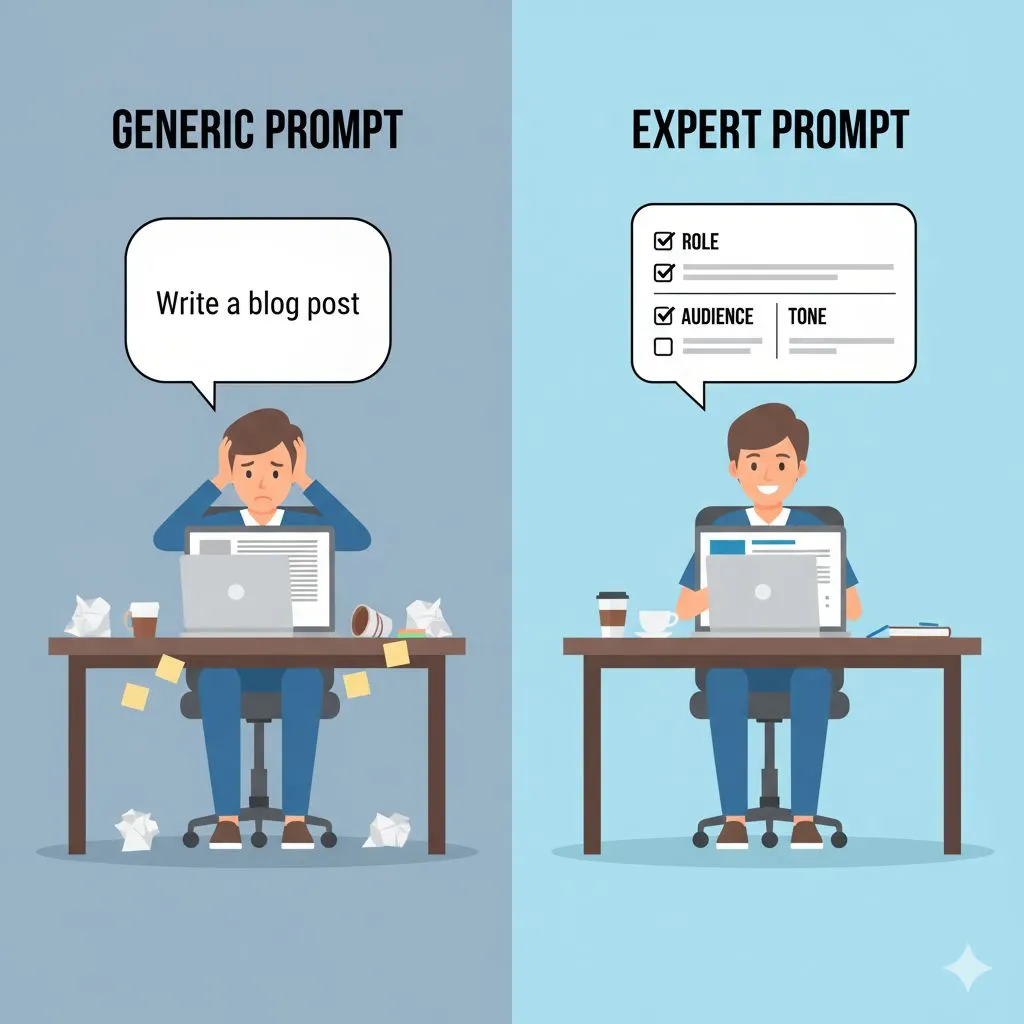
- Prompt with Context: Do not say "Write an article."
- Better Prompt: "Act as an expert [Your Industry] Consultant. Write a 1,200-word blog post based on the outline above. Tone: Professional, authoritative, but conversational. Use short paragraphs. Include a 'Key Takeaways' section at the top."
- Generate Section by Section: For longer content, ask the AI to write one section at a time. This keeps the AI focused and prevents it from rushing the ending.
Phase 3: The Human Polish (30 Minutes)
This is the core of Human Strategy + AI Execution: The Winning SEO Formula — the approach that consistently separates ranking content from content that vanishes on page four.
This is the most critical step. Do not skip it.
- The "BS" Check: Read through to ensure facts are accurate.
- Inject "I": Find three places to insert a personal story, a client example, or a strong opinion. This signals E-E-A-T to Google.
- Break the Patterns: If the AI starts every sentence with "Furthermore" or "Additionally," delete them.
- Internal Linking: Link this new post to your services page or other relevant blog posts. AI cannot do this effectively for you.
Phase 4: Optimization (10 Minutes)
- The Scan: If you have a tool like Surfer or Frase, paste your draft in. Add the missing semantic keywords it suggests.
- The Meta: Ask ChatGPT: "Write 3 click-worthy meta titles and descriptions for this article, focusing on the keyword [Insert Keyword]."
Conclusion: From Overworked to Outstanding
Can AI write SEO content that actually ranks? Yes.
Can lazy AI write SEO content that ranks? No.
The difference between the two is you.
As a small business owner, you have an advantage that big corporations don't have: agility and authentic expertise. Large companies are terrified of using AI because of legal red tape. Spammers use AI to generate trash. You sit in the sweet spot.
You can use ai seo tools to bypass the blank page syndrome and handle the heavy lifting of research and structure. But your personal experience, your voice, and your strategic oversight are the distinct markers that Google—and your customers—are looking for.
Don't let the fear of technology paralyze you. The risk isn't in using AI; the risk is ignoring a tool that can give you the output of a ten-person team for $20 a month.
It is time to stop hustling harder and start scaling smarter. You have the expertise. Now you have the engine.
If you're ready to replace guesswork prompts with battle-tested SEO prompt sequences built for small business growth, the SEO Prompt Power AI Toolkit delivers 50 precision-engineered prompts for your exact content and ranking workflow.
Ready to stop guessing and start ranking?
Ready to stop guessing and start ranking? Grab free AI prompt resources built for ROI-focused entrepreneurs — no credit card, no commitment.
The ROI-Driven Guide to AI for SEO
Already clear on the value? See all 30 industry-specific prompt packs and pricing — one-time investment, lifetime access.
Further Reading
• 3 Ways Generative AI Can Destroy Your SEO Rankings
• Best AI SEO Tools for Small Business: 2025 Review