How "Answer Engines" Are Killing Traditional SEO
How "Answer Engines" Are Killing Traditional SEO
Feb 02, 2026

For the last two decades, the pact between search engines and business owners was simple: You create helpful content, Google crawls it, and in exchange, they send you traffic. It was a symbiotic relationship that built the modern web.
But for entrepreneurs and small business owners like you—juggling client work, marketing, and operations—that pact has fundamentally broken.
We are witnessing the death of the "10 Blue Links" era and the birth of the search generative experience (SGE). If you have noticed your website traffic plateauing despite doing "everything right," you aren't imagining it. The game hasn't just changed; the board has been flipped over.
Traditional SEO—the art of optimizing for clicks—is being replaced by "Answer Engines." These AI-driven systems don't just point users to a website; they digest the internet’s information and serve the answer directly on the results page.
For a massive corporation, this is a hurdle. For an overworked solopreneur, this can feel like a disaster. But it doesn’t have to be. Understanding this shift is the first step to reclaiming your digital presence.
The Anatomy of the Kill: How SGE Changes the Game
To understand why your old SEO tactics are failing, we have to look at the mechanics of the new search landscape.
The Zero-Click Reality
In the past, a user would search "how to write a proposal." They would scan the headlines, click your link, and read your article. That click was your currency. It gave you a chance to capture an email lead or sell a service.
With the search generative experience, Google (and competitors like Perplexity or ChatGPT Search) reads your article, synthesizes the answer, and presents it at the very top of the page. The user gets the value you created, but you never get the visit. This is the "Zero-Click" phenomenon.
Gartner predicts that by 2026, traditional search engine volume will drop by 25%, with search marketing losing market share to AI chatbots and other virtual agents. For a small team relying on organic traffic to fill the funnel, this is a critical threat.
For a practical breakdown of how to rank strategically in this new environment, read SEO in 2026: Why You Need Strategic Prompts to Rank on Google.
The "Walled Garden" Effect
Search engines are businesses. Their goal is to keep users on their platform as long as possible to show them ads. By answering questions directly within the interface using AI, they reduce the need for users to navigate away to the open web (your website).
The interface is becoming a "walled garden." If your content strategy relies entirely on answering simple questions (e.g., "What is a 404 error?"), your business is now competing directly against the smartest AI models in history—and they own the playing field.
From Keywords to Intent
Traditional SEO was often a game of "keyword math." If you repeated a phrase enough times and put it in the right headers, you ranked.
Answer Engines don't care about keyword density. They care about semantic intent. They use Large Language Models (LLMs) to understand the meaning behind a query. They are looking for the best answer, not the page that optimized the best tags. This shifts the power dynamic from those who know technical SEO tricks to those who possess genuine subject matter expertise.
If you are ready to close that gap, the Entrepreneur's Playbook for Prompt Engineering is the definitive starting point for business owners who want to think and write like experts.
The Impact on the "Alex Rivers" of the World
Let’s bring this down to brass tacks. You are running a lean operation. You don't have a five-person SEO team or a $10,000 monthly ad budget. You rely on efficiency. How does the search generative experience impact your day-to-day reality?
The Disappearance of Top-of-Funnel Traffic
For years, the standard advice for small businesses was to blog about "informational" keywords to build awareness. You wrote articles like “Top 10 Tools for Productivity” or “How to Calculate ROI.”
These are exactly the types of queries Answer Engines solve best.
If your traffic analytics show a steep decline in new users, this is likely why. The "easy" traffic—people looking for quick definitions, lists, or simple how-to guides—is being absorbed by AI. The users who do click through are now further down the funnel; they are looking for deep expertise, nuanced opinions, or specific products.
The Reality Check: You will likely see fewer visitors, but the visitors you do get should theoretically be higher quality—if you adapt your content strategy.
The Death of "SEO Fluff"
We’ve all seen it: 2,000-word articles that take five paragraphs to get to the point, stuffed with filler to satisfy word-count requirements.
In the age of SGE, this content is a liability. Answer Engines summarize fluff instantly. If your content doesn't offer a unique perspective, proprietary data, or deep personal experience, the AI has no reason to cite you. It will simply synthesize the generic information from bigger sites (like Forbes or Wikipedia) and ignore your small business entirely.
The hidden risks of using generic AI prompts for business go further still — actively undermining brand authority even when traffic numbers look stable.
The "Skeptical User" Paradox
Your customers—ambitious, time-poor professionals—are also using these AI tools. They are becoming skeptical of generic search results. They know that the top 5 results are often just the companies with the biggest budgets, not necessarily the best solutions.
They are turning to "Answer Engines" to cut through the noise. If your brand doesn't appear as a cited source in these AI summaries, you lose credibility. You aren't just losing a click; you're losing the perception of authority.
This sounds grim, but there is a silver lining. The barrier to entry for mass content has lowered, but the value of expert content has skyrocketed. This is where you, the expert operator, can win.
The Rise of Answer Engine Optimization (AEO)
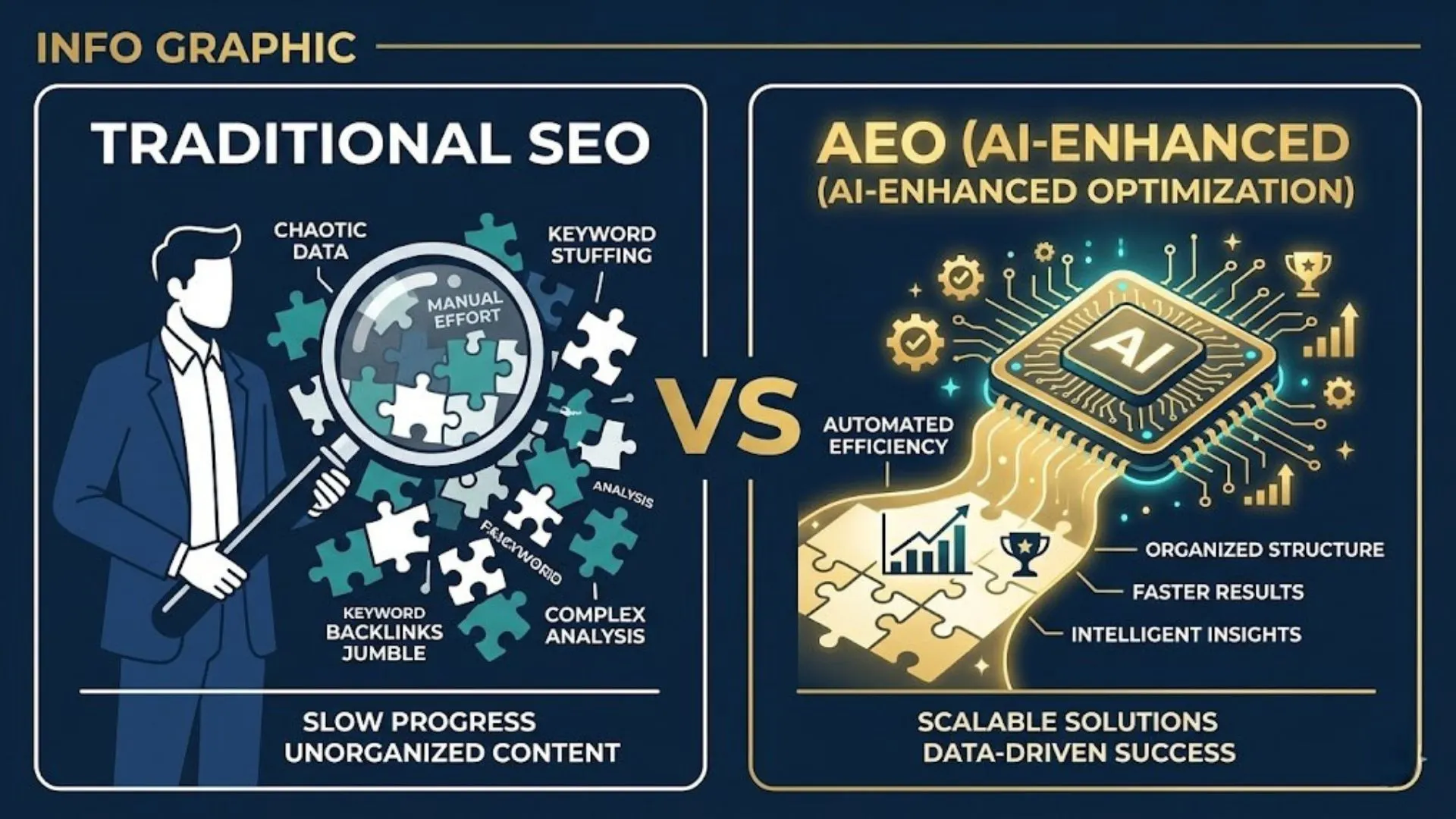
If SEO is about ranking links, AEO (Answer Engine Optimization) is about training the AI to trust you. You need to stop writing for a search crawler and start writing for a Large Language Model.
Here is how you pivot your strategy to survive the search generative experience.
Optimizing for LLMs: Structure is King
AI models digest information better when it is structured logically. They love lists, tables, direct questions followed by direct answers, and clear schemas.
- The "BLUF" Method: Bottom Line Up Front. Don't bury your answer. Start your content with a direct, concise answer to the user's problem. This increases the likelihood of your snippet being picked up by the AI as the "definitive" answer.
- Q&A Formatting: structure your headers as questions users actually ask, and the following paragraph as a clear, standalone answer.
E-E-A-T on Steroids
Google uses a framework called E-E-A-T (Experience, Expertise, Authoritativeness, Trustworthiness) to grade content. In an AI world, this is the only thing that matters.
AI can generate facts, but it cannot generate experience.
- Experience: Did you actually use the product you are reviewing? Did you actually solve the client problem you are discussing? Use "I" statements. Share photos, case studies, and personal anecdotes.
- Expertise: Why should the AI trust you? Your bio page needs to be robust. Link to your LinkedIn, list your credentials, and showcase your history.
- Trustworthiness: Cite your sources. Link to high-authority data. Make sure your site is technically secure.
If you are a consultant, don't just write "How to manage a team." Write "How I managed a team of 10 remotely during a crisis." The AI can synthesize the former from a million other sites; it cannot synthesize your specific story.
Brand as an Entity
Answer Engines think in terms of "Entities." An entity is a known thing—a person, a place, a brand, or a concept.
You need to convince the search engines that You (or your business) are a recognized Entity in your specific niche. This goes beyond keywords. It’s about "Brand mentions."
- Are you being talked about on social media?
- Are you being interviewed on podcasts?
- Do other authoritative sites link to you as a source?
The goal is to move from "ranking for keywords" to "being the answer." When someone asks an AI, "Who is the best consultant for small business scaling?", you want the AI to associate your specific brand name with that topic.
A structured, distinctive brand voice is the foundation of entity building — download the free Competitor-Proof Brand Voice Kit to lock in your brand’s unique voice before the AI flattens it into generic content.
Strategic Pivots: A Survival Guide for Solopreneurs
For Alex Rivers—the ambitious entrepreneur wearing many hats—this shift requires a change in resource allocation. You cannot out-spend the giants, and now you cannot out-content the AI. You must out-maneuver them.
1. Own Your Audience (The Data Sanctuary)
The most dangerous number in business is one. Relying on one source of traffic (Google) is reckless. The primary goal of your SEO traffic should no longer be "read time"—it must be acquisition.
You must aggressively move users from the "rented land" of search results to the "owned land" of your email list or community.
- Create lead magnets that are too valuable to be summarized by AI (e.g., complex templates, proprietary datasets, video courses). Browse the free AI resources at Expert AI Prompts — 11 high-value tools and templates built specifically for small business owners and solopreneurs.
- Your goal is to become a destination, not just a search result.
2. The "Human" Moat
Build a moat around your business using things AI cannot replicate.
- Voice and Opinion: AI is usually neutral. Be opinionated. Take a stand. Contrarian views trigger engagement and are harder for AI to flatten into a generic summary.
- Video and Audio: YouTube is the second largest search engine. AI is getting better at video, but people still connect with human faces. A video embedded in your blog post signals high value to search engines.
- Community: Foster a comment section or a private group. User-generated content (discussions) is a strong signal of a living, breathing brand.
3. Diversify Your Traffic Sources
If your business dies because Google changes an algorithm, you didn't have a business; you had a lead gen tactic.
- LinkedIn & Social: For B2B entrepreneurs, LinkedIn is becoming a primary search engine. Optimize your profile and content there. The AI Prompt System for LinkedIn gives you structured, industry-specific prompts to build authority and generate inbound leads — without spending hours crafting each post from scratch.
- Newsletters: Partner with other creators.
- Podcasting: Be a guest expert.
Conclusion
The search generative experience is not the end of SEO, but it is the end of lazy SEO.
The "Answer Engines" are killing the middleman. They are wiping out the mediocre, the generic, and the aggregators. But they are desperate for true sources of information. They need experts.
For a business owner like you, this is actually good news. It levels the playing field. You don't need a massive content farm to compete anymore. You need deep expertise, clear communication, and a brand that stands for something specific.
The transition from "Overworked Operator" to "Confident Strategist" involves letting go of the vanity metrics. Stop obsessing over raw traffic numbers. Start obsessing over trust, authority, and relationship building.
The future belongs to those who can teach the AI who they are, and convince the humans why they matter.
Are you ready to stop chasing algorithms and start building a future-proof strategy?
Don't let the AI revolution leave you behind. We have curated the exact tools and frameworks you need to turn this disruption into your competitive advantage.
Not ready to commit to a full guide? Access 11 free AI prompt tools and resources — no credit card, no commitment. Start with what works for your business today.
Get The ROI-Driven Guide to AI for SEO
If organic traffic is a business-critical channel for you, the SEO Prompt Power Toolkit gives you the exact prompts to create content that Answer Engines cite and humans trust.
Ready to equip your entire business with industry-specific AI prompts? Browse all 30 prompt packs and pricing — one-time investment, 50 prompts per pack, immediate access.
Further Reading
• SEO in 2026: Why You Need Strategic Prompts to Rank on Google
• Can AI Write SEO Content That Actually Ranks?
• The Hidden Risks of Using Generic AI Prompts for Business
• Beyond ChatGPT: Why You Need Specialized Prompts
Resources
• The ROI-Driven Guide to AI for SEO — Complete pillar guide
• SEO Prompt Power Toolkit — 50 prompts for SEO-ready content
• ROI, Pricing & Economic Value Hub — Calculators and ROI frameworks
• Common Pitfalls: AI Mistakes to Avoid — Decision-stage advisory
• Get Free AI Resources — 11 Tools, No Credit Card — Free Offers Hub