The Hidden Risks of Using Generic AI Prompts for Business
The Hidden Risks of Using Generic AI Prompts for Business
Jan 27, 2026

For the ambitious small business owner, the promise of artificial intelligence in business feels like the ultimate lifeline. You are wearing every hat available—CEO, marketing director, customer support lead, and sales closer. The idea that a tool like ChatGPT or Claude can take the crushing weight of content creation and operational planning off your shoulders is not just appealing; it is necessary for survival. Discover how expert AI prompts are built differently from generic ones in the Entrepreneur's Playbook for Prompt Engineering.
We have all seen the headlines: "Write your entire marketing strategy in 5 minutes" or "Create a month of social media content in 30 seconds." For someone like you, who values efficiency and ROI above all else, this sounds like the breakthrough you have been waiting for. You want to reclaim your time, reduce stress, and finally compete with the larger players who have teams of ten doing what you do alone.
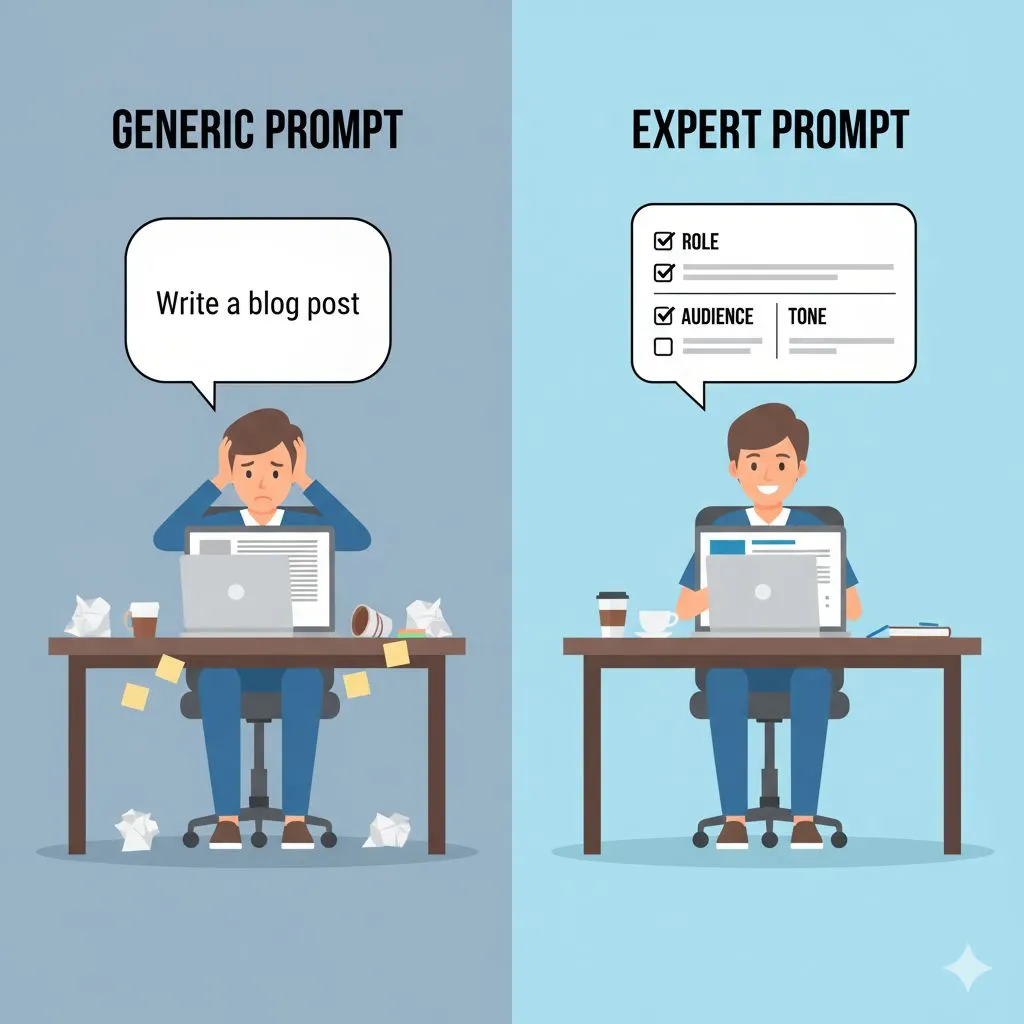
But then reality sets in. You open the chat interface. You type in a command like, "Write a blog post about digital marketing trends." The AI churns out 800 words in seconds. You read it. And your heart sinks.
It is bland. It is repetitive. It uses words like "unleash," "delve," and "tapestry" three times in the first paragraph. It is technically correct English, but it lacks soul, strategy, and the specific expertise your clients pay you for. Instead of saving an hour, you now spend 45 minutes rewriting the text to make it sound human.
This is the hidden trap of the AI revolution. While adoption is high, effective utilization is low. The risk facing small business owners today isn't that they aren't using AI; it's that they are using generic prompts that produce generic results. In a digital world that is rapidly becoming noisy with AI-generated clutter, using "lazy" AI doesn't just waste your time—it actively harms the brand credibility you have worked so hard to build.
To scale your business and truly escape the daily overwhelm, we need to dismantle the myth that AI is a magic wand. It is not. It is a high-performance engine. And if you put low-grade fuel (generic prompts) into a Ferrari, you won't win the race; you’ll ruin the engine.
The "Vanilla Effect": How Generic Prompts Dilute Your Brand

The fundamental design of Large Language Models (LLMs) is probabilistic. When you give them a broad, unspecific instruction, they are programmed to provide the most likely, average, and safe response based on their training data. In essence, they regress to the mean.
If you run a boutique consulting agency or a specialized e-commerce store, your value proposition lies in being different. Your clients choose you because of your unique perspective, your specific methodology, or your distinct voice.
When you use a prompt like "Write an email selling my consulting services," the AI analyzes millions of sales emails in its database. It then constructs a composite of all of them. The result is the "Vanilla Effect"—content that sounds like everyone and no one at the same time.
The Death of Differentiation
Imagine your potential client, let’s call her Sarah. Sarah subscribes to five different industry newsletters. If you and your four competitors all use artificial intelligence in business tools with the same generic prompts, Sarah is going to receive five emails that sound hauntingly similar. They will all start with "I hope this email finds you well," segue into a generic problem statement, and end with a tepid call to action.
In this scenario, you haven’t saved time; you have become invisible.
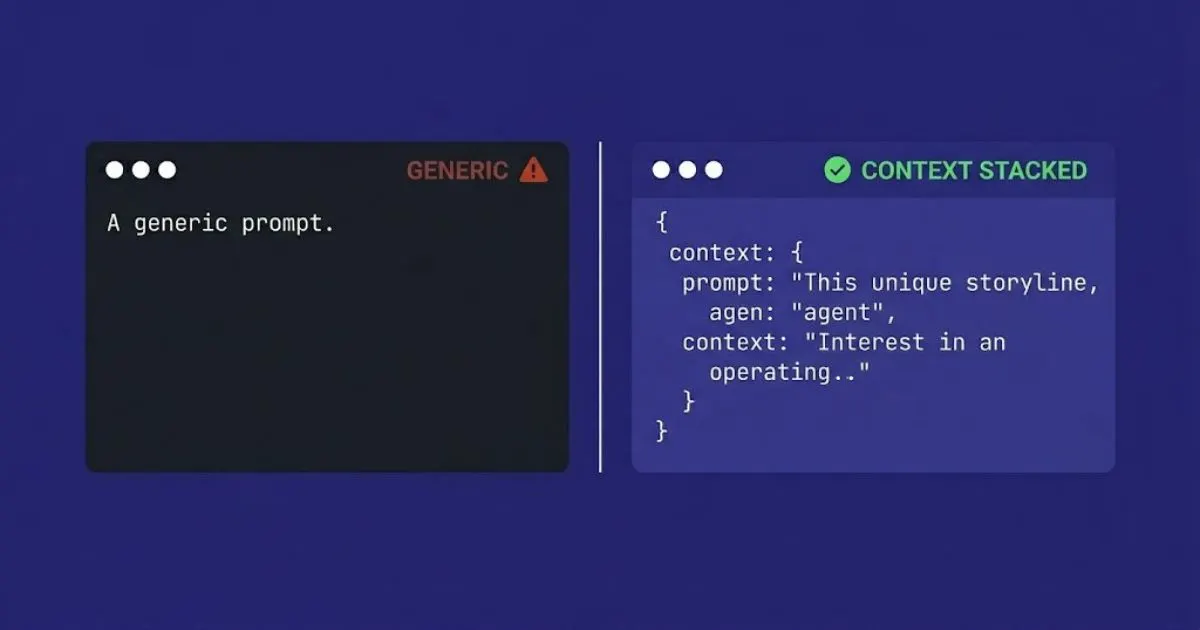
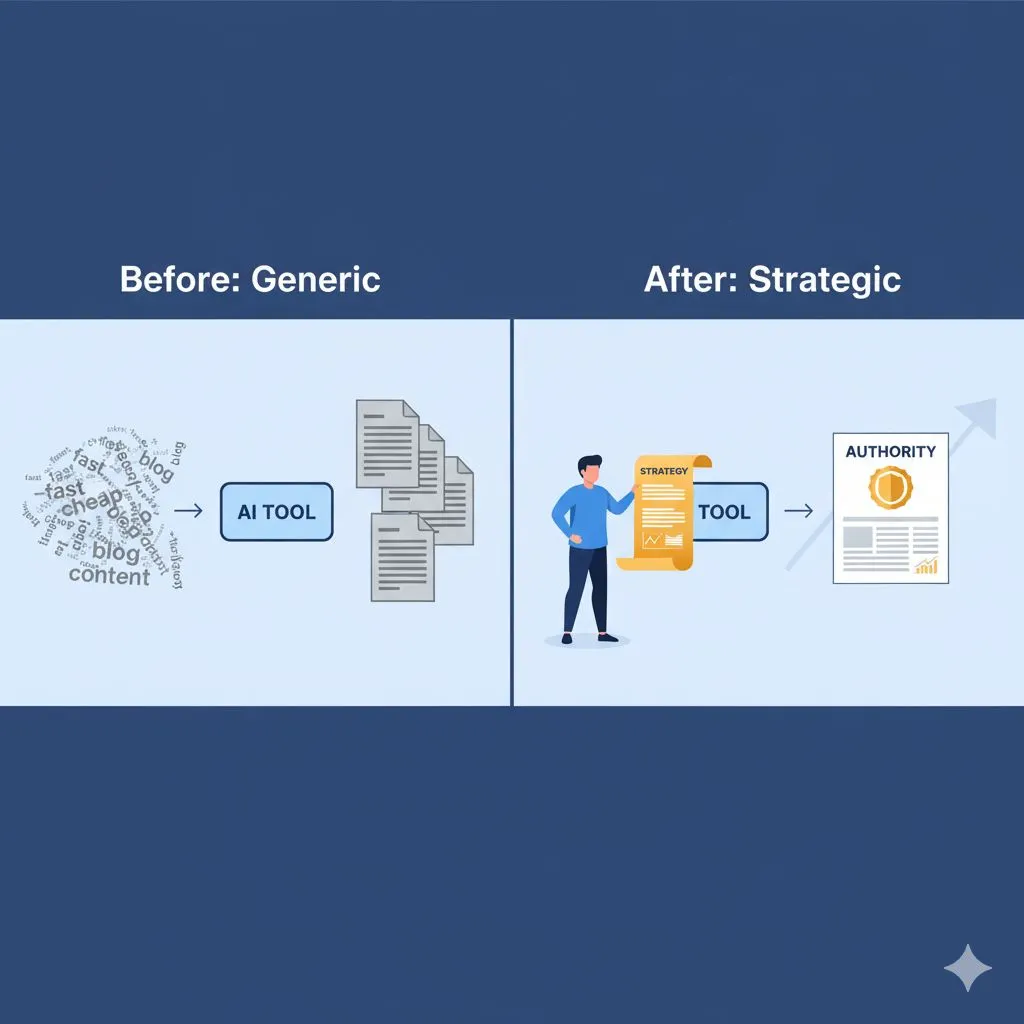
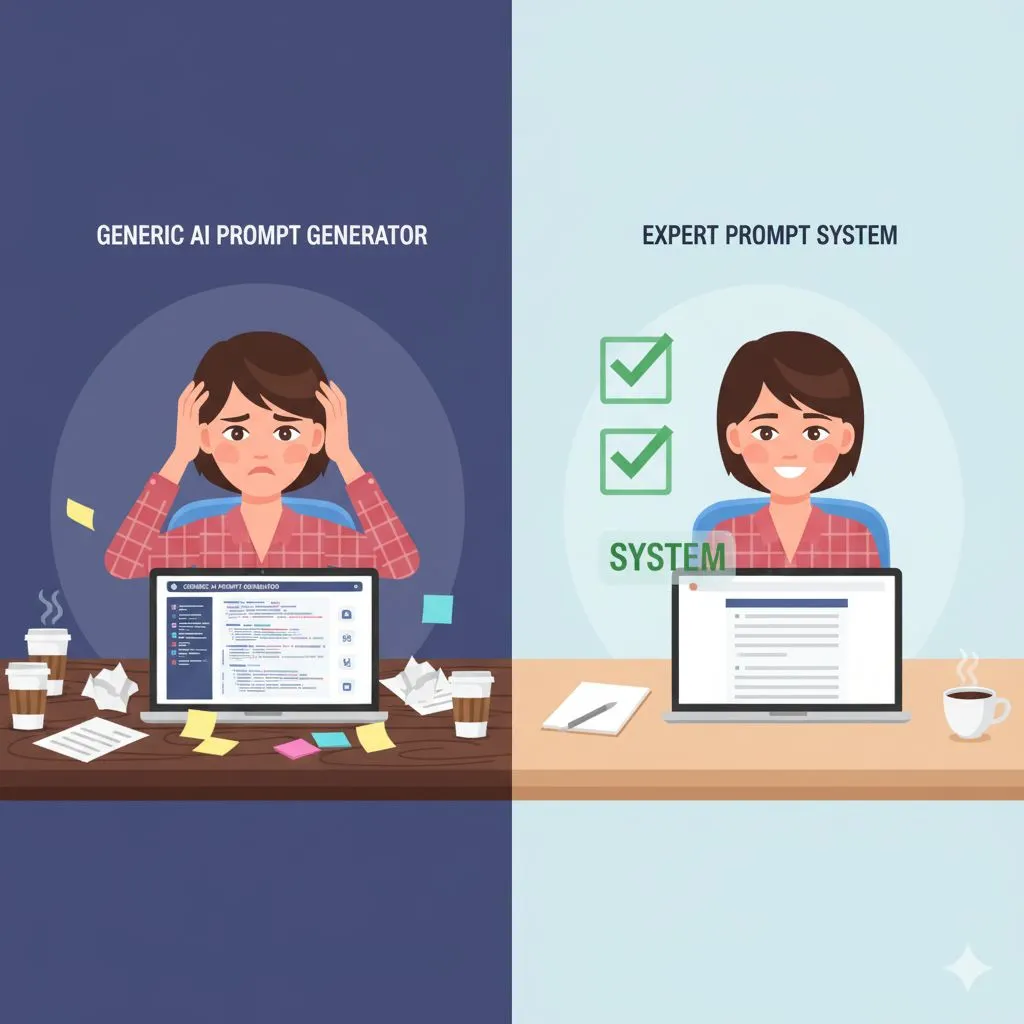
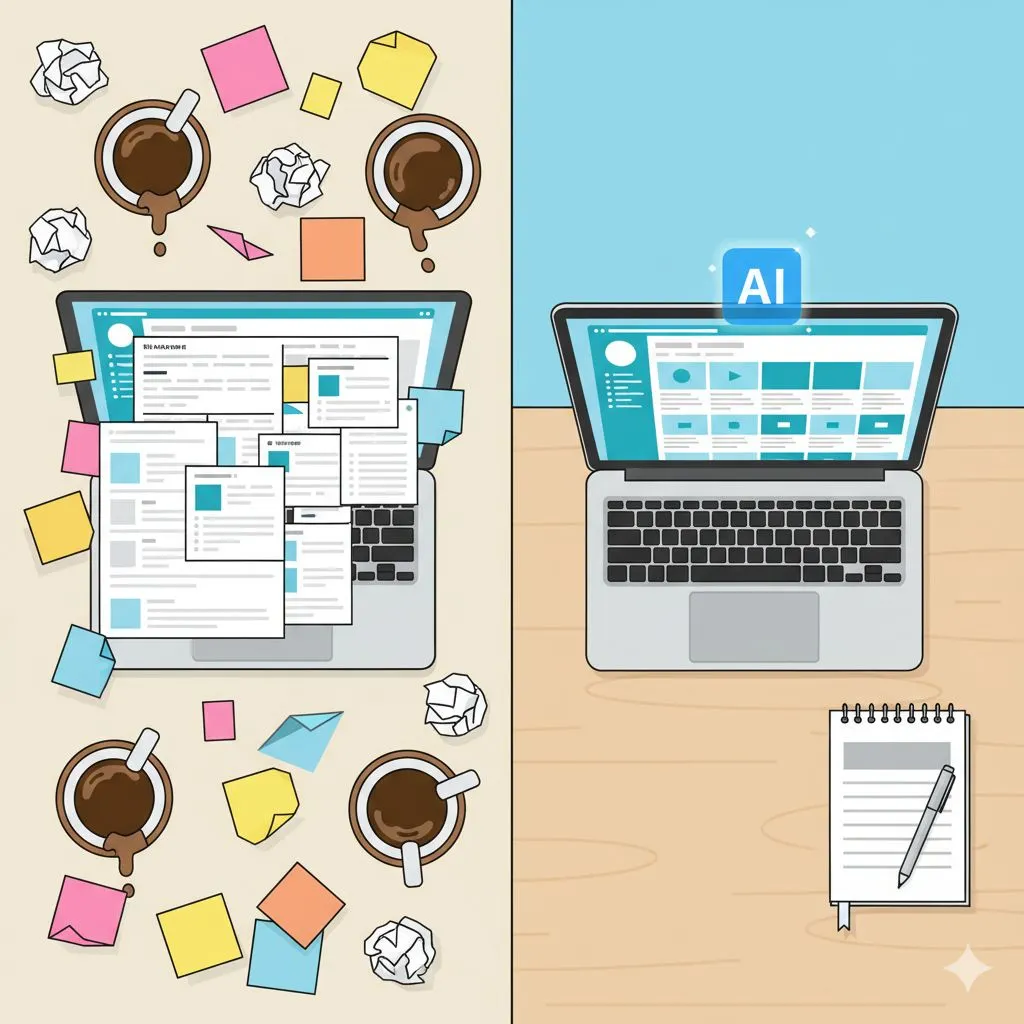
For a solopreneur or small team, your brand voice is your most potent asset. It conveys authority and builds trust. Generic prompts strip away the nuance, the anecdotes, and the "contrarian" takes that prove you are an expert. See how generic versus strategic AI prompts compare in real business outputs. They produce content that is "safe" but entirely forgettable. In an economy where attention is the currency, being forgettable is a fatal business error.
The Efficiency Illusion: The High Cost of the "Edit Loop"
The primary motivation for adopting artificial intelligence in business is usually speed. You want to get out of the weeds. You want to stop staring at a blinking cursor at 9:00 PM on a Tuesday. However, reliance on generic prompts often creates a phenomenon known as the "Efficiency Illusion."
This occurs when the initial act feels fast, but the total process becomes slower.
Let’s break down the math of a typical "bad AI" workflow for a piece of thought leadership content:
- Drafting (The Illusion): You spend 30 seconds typing, "Write an article about supply chain management." The AI generates the text instantly. You feel a dopamine hit of productivity.
- Reviewing (The Realization): You read the output. It misses the nuance of your specific niche. It suggests strategies that are five years out of date. The tone is too academic.
- The Edit Loop (The Reality): You start tweaking sentences. Then you delete paragraphs. Then you have to fact-check a claim. Then you realize the voice is wrong, so you rewrite the intro.
Suddenly, you have spent 45 minutes fixing a piece of content that you could have outlined and dictated in 20 minutes.
The Cost of Context Switching
Beyond the raw minutes lost, there is a psychological toll. As a business owner wearing many hats, your cognitive energy is your most limited resource. Every time you have to wrestle with an AI tool to make it "sound right," you are engaging in high-friction context switching. You aren't operating as a strategist; you are operating as a line editor.
This friction breeds frustration. It leads many entrepreneurs to say, "AI just doesn't work for my industry," or "It’s more trouble than it’s worth." They abandon the tool, retreating to manual work, which leads back to burnout.
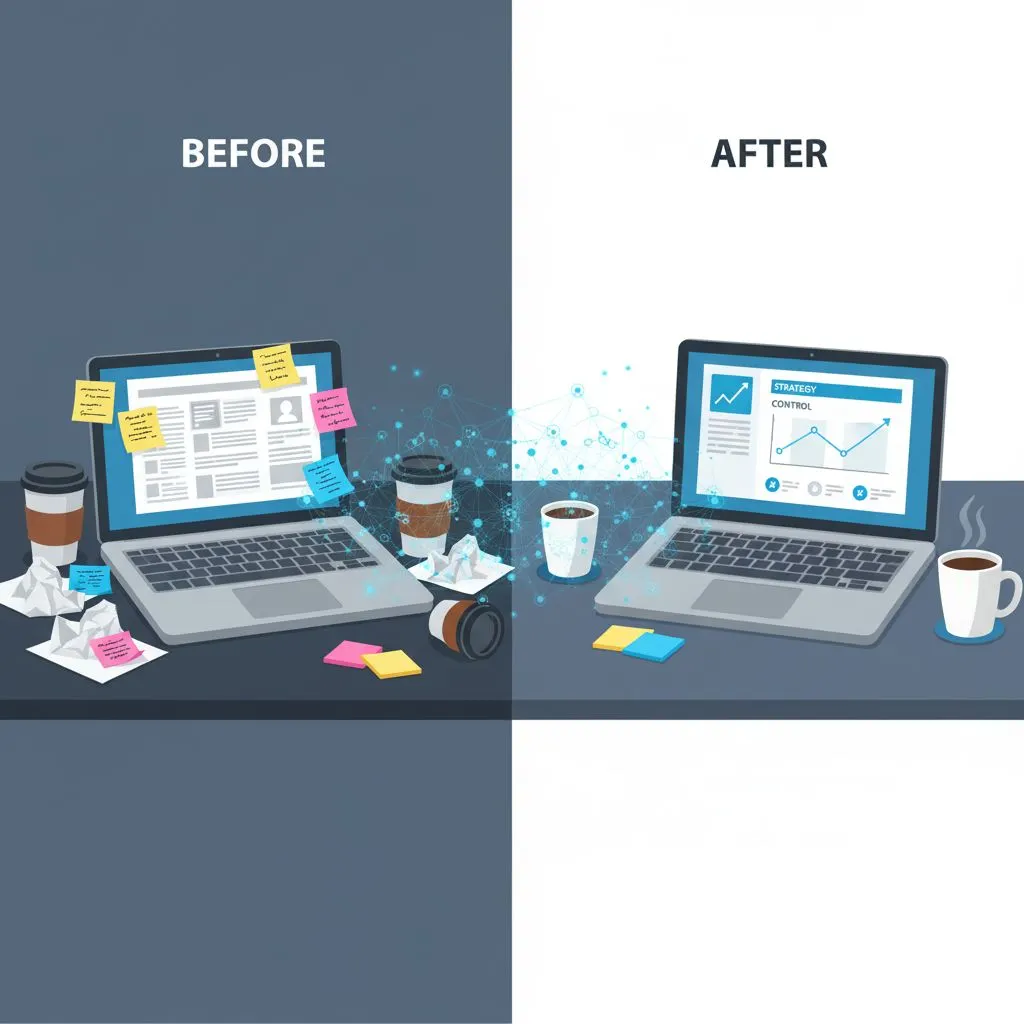
The problem isn't the AI. The problem is the input. Read a direct comparison of structured versus unstructured AI prompts analysed for real business workflows. A generic prompt forces you to do the heavy lifting after the content is generated. A strategic, expert-level prompt forces the AI to do the heavy lifting during generation. The difference between the two is the difference between staying overworked and achieving true scale.
The Credibility Trap: Hallucinations and Strategic Misalignment
If the first risk is blandness and the second is wasted time, the third risk is reputation damage. When utilizing artificial intelligence in business, we must confront the reality of "hallucinations"—instances where the AI confidently presents false information as fact.
Generic prompts are the breeding ground for hallucinations. When you don't provide the AI with specific constraints, data points, or source material, it will fill in the gaps with its own "creative" logic.
The Danger for Professional Services
Consider Alex Rivers, our archetype, running a financial consulting firm. If Alex asks a generic prompt to "Summarize the tax implications of the new federal budget," the AI might pull outdated data or conflate proposed laws with passed legislation. If Alex publishes this content without a rigorous check—because he is rushed and trusts the tool too much—he risks giving his clients incorrect financial advice.
For a small business, trust is fragile. The Common Pitfalls hub maps every way generic AI use damages business credibility — and the steps to course-correct. One significant error can destroy a reputation that took years to build.
Missing the Strategic Mark
Beyond factual errors, there is the issue of strategic misalignment. An AI model does not know your business strategy unless you tell it. It doesn't know you are trying to pivot from low-ticket services to high-ticket retainers. It doesn't know your target audience is skeptical CFOs, not enthusiastic startup founders.
A generic prompt like "Write a sales landing page" will produce a standard "hard sell" format. But if your strategy relies on consultative, relationship-based selling, that landing page will not only fail to convert—it will alienate your sophisticated buyers. The AI has completed the task (writing words), but it has failed the objective (generating revenue).
The Solution: Transitioning from Operator to Architect
The gloom and doom surrounding generic prompts serve a purpose: to highlight that AI is a power tool, not an autopilot button. The good news for entrepreneurs like Alex Rivers is that the gap between "generic failure" and "expert success" is bridgeable. It requires a shift in mindset. You must stop thinking of yourself as an operator of AI and start thinking like an architect of instructions.
This is the essence of prompt engineering for small business owners.
Now, before you roll your eyes at another buzzword, let’s clarify. Prompt engineering for business owners isn't about learning code or complex syntax. It is about communication and delegation. Think of the AI as a brilliant, incredibly fast, but literal-minded intern. If you tell the intern, "Go do some marketing," they will fail. If you tell them, "Write a 300-word LinkedIn post targeting exhausted CTOs, focusing on the pain point of technical debt, using an empathetic but authoritative tone," they will succeed.
The Anatomy of an Expert Prompt
To reclaim your time and produce content that actually competes with larger players, your prompts must move from simple commands to structured briefs. An expert prompt generally contains four critical components:
The Persona (Who is the AI?): Don't just ask for text. Assign a role.
- Generic: "Write a blog post."
- Expert: "Act as a Senior SEO Strategist and Copywriter with 10 years of experience in B2B SaaS."
The Context (What is the situation?): Give the AI the background info it lacks.
- Generic: "About time management."
- Expert: "My audience consists of small business owners who are overwhelmed. They don't need basic tips; they need advanced systems. Our goal is to position my coaching program as the solution."
The Constraints (What are the boundaries?): Stop the "vanilla effect" by setting rules.
- Generic: "Make it good."
- Expert: "Do not use buzzwords like 'synergy' or 'game-changer.' Keep sentences under 20 words. Use a punchy, direct tone."
The Specific Output (What does success look like?):
- Generic: "Write the post."
- Expert: "Output a headline, a hook, 3 bullet points of value, and a CTA leading to my newsletter."
Apply these four components immediately with the free 1-Page Perfect Prompt Framework — a one-page reference guide built for non-technical business owners.
Case Study: The Difference in ROI
Let’s look at a concrete example of how this applies to artificial intelligence in business.
The Generic Approach:
Prompt: "Write a rejection email to a client."
Result: A stiff, overly formal "Dear Sir/Madam" letter that burns the bridge and sounds like a lawyer wrote it.
The Expert Approach:
Prompt: "Act as a relationship-focused agency owner. Write a polite email declining a project because the budget is too low, but keep the door open for future work. The tone should be warm, regretful, but firm on pricing. Suggest a lower-tier referral partner."
Result: A warm, professional email that preserves the relationship, reinforces your premium positioning (by refusing to lower prices), and adds value by referring them elsewhere.
The first result saves you 2 minutes of typing but costs you a potential future referral. For a documented, data-backed example of this ROI gap, read the AI Prompt ROI Analysis Case Study. The second result saves you the typing time and strengthens your brand reputation. That is the difference between a shortcut and a strategy.
Scaling Without burnout: The Ultimate Goal
For the solopreneur or small business owner, the ultimate goal isn't just to write better emails—it is to scale. Scaling requires systems. It requires the ability to produce high-quality output repeatedly, without you being the bottleneck for every single decision.
When you rely on generic prompts, you remain the bottleneck because you have to quality-control every output. You are still trapped in the "operator" role.
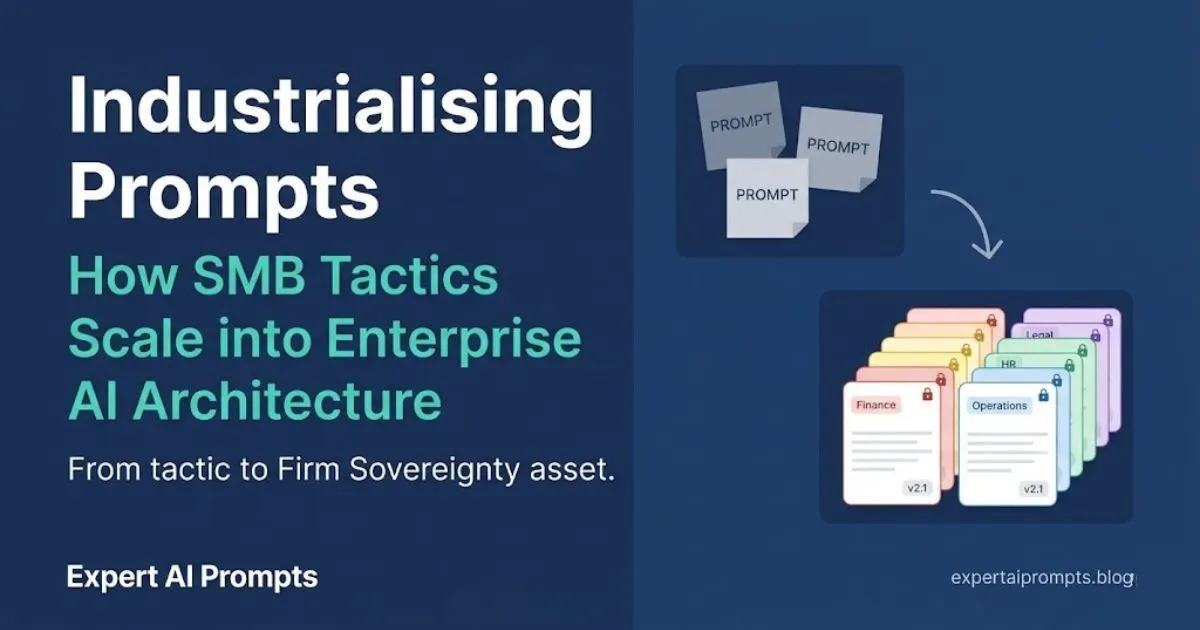
However, when you build (or acquire) a library of industry-specific expert AI prompts—prompts that are pre-engineered with your strategy, industry nuance, and brand voice—you create a reusable asset. You can hand these prompts to a junior team member or a virtual assistant. You can say, "Run prompt #14 for the weekly newsletter," and have 90% confidence that the output will be on-brand.
This is how small teams compete with giants. You don't need a ten-person marketing department. You need a ten-person marketing system powered by AI that follows your specific architectural blueprints.
From Overworked to Outstanding
The journey Alex Rivers is on—from the stressed, "wearing many hats" entrepreneur to the confident business leader—depends on leverage. Artificial intelligence in business provides that leverage, but only if the lever is long enough. Generic prompts are a short lever; they require too much force from you to move the rock. Expert prompts are the long lever; they move mountains with a gentle push.
You have the ambition. You have the expertise in your field. The missing piece has been a way to translate that expertise into content and operations at scale without cloning yourself. The "Hidden Risk" of generic AI is that it promises this scale but delivers mediocrity. The opportunity lies in rejecting the generic and demanding the specific.
Conclusion
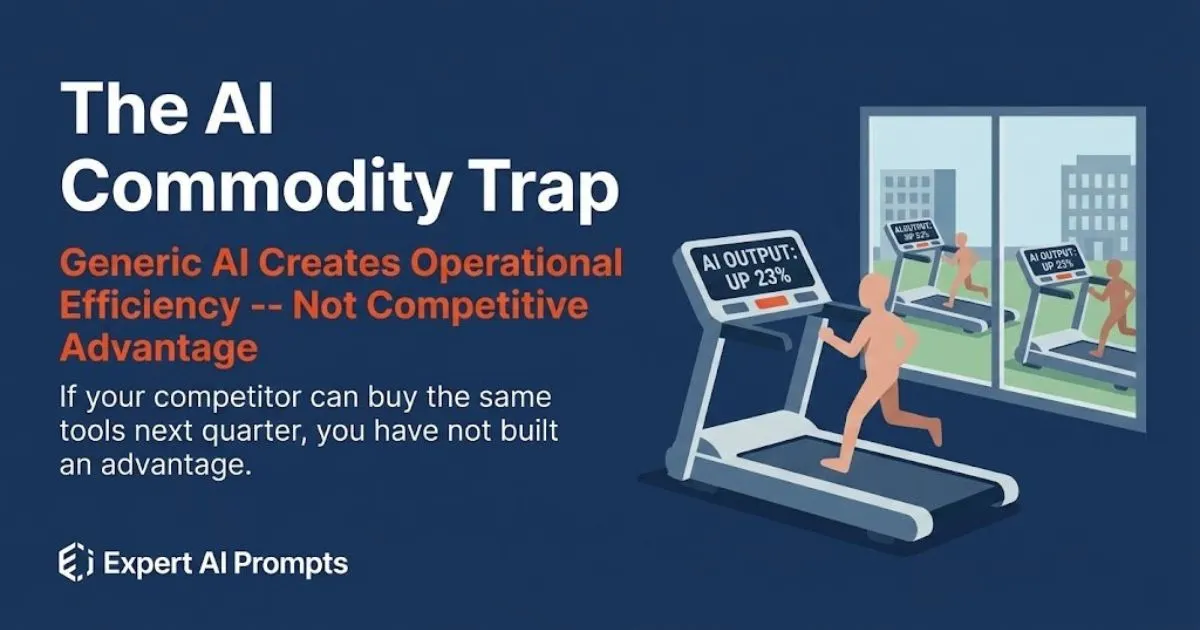
We are in a brief window of time where simply using AI is no longer a competitive advantage. The advantage now belongs to those who use it well.
For the business owner tired of the hustle, the path forward is clear. Stop accepting the "vanilla" defaults that ChatGPT or other tools offer. Stop wasting your evenings in the "Edit Loop," fixing robotic text that doesn't sound like you. Start treating your prompts as business assets—intellectual property that defines how your company speaks, sells, and serves.
You didn't start your business to sound like everyone else. Don't let your AI tools strip away what makes you unique. By shifting from generic inputs to strategic, engineered prompts, you turn a tool that wastes time into a system that generates growth.
Ready to stop guessing and start scaling?
Start with a free resource: access 11 free AI prompt tools for small business owners and begin your move from generic to strategic AI use today.
You don't have to become a prompt engineer overnight to get the benefits. We have done the heavy lifting for you.
Browse the complete Expert AI Prompts pricing catalog to see all 30 industry-specific prompt packs and choose the right fit for your business.
Get the Entrepreneurs Playbook for Prompt Engineering and unlock 50 industry-specific prompts designed to save time and build authority today.
Further Reading
• Expert AI Prompts vs Generic AI: Full Comparison
• The Hidden Cost of Free Generic AI Prompts
• Why Copy-Pasting Free ChatGPT Prompts Is an Expensive Mistake