Enterprise AI Transformation Roadmap 2026: The 90-Day
Framework
Enterprise AI Transformation Roadmap 2026: The 90-Day Framework
May 11, 2026
A new Chief AI Officer has roughly 90 days to establish credibility, deliver a quick win, and set strategic direction. Miss this window -- and the role spends the next year fighting for relevance rather than driving transformation.
The 90-Day Window: Why the First Three Months Define Everything
The 90-day window is not a new idea -- it applies to every executive transition. But it applies with unusual intensity to the Chief AI Officer, because most organisations have never had this role before. The CAIO is defining what the role means while simultaneously doing the job, within a regulatory environment that does not pause for onboarding (EU AI Act Annex III enforces 2 August 2026), and against a competitive landscape where the window to demonstrate value has never been shorter.
The research is consistent. Harvard Business School executive transition studies show that the pattern of activity in the first 30 days is the single strongest predictor of 12-month executive success. The organisations that invest in structured 90-day onboarding produce executives who deliver 40% faster time-to-productivity than those who do not. For a CAIO in 2026 -- with a regulatory deadline inside the first 90 days -- that gap is not academic. It is existential.
The Three Executive Transition Failure Modes
Three failure patterns appear consistently in the research. All three are avoidable. All three are common.
THE ANNOUNCEMENT EXECUTIVE
Arrives on Day 1 with a pre-written strategy document, announces the transformation programme in Week 1, and begins executing before understanding the organisational context. Strategy designed before listening produces technically correct solutions to the wrong problems. C-suite resistance forms by Day 14. Once the political resistance calcifies, it is very difficult to dissolve within 90 days.
THE INDEFINITE LEARNER
Spends 90 days listening, mapping, and assessing without delivering a single visible output. Every week produces another discovery insight; no week produces a production deployment. Board and C-suite lose confidence by Day 60. By Day 90 the CAIO has excellent situational knowledge but no mandate. The window for a decisive early win has closed.
THE TECHNICAL DIVER
Immerses deeply in the AI technical architecture, data systems, and vendor landscape -- and surfaces at Day 60 with excellent technical clarity, no stakeholder relationships, and no board-level mandate. Technical insight without political capital cannot drive transformation. The CAIO has become a very expensive technical analyst.
The correct balance: structured listening in Days 1-30 that produces a specific, evidence-based output -- not indefinite discovery that produces general impressions. The first 30 days are active, disciplined intelligence gathering that culminates in a named deliverable.
The 90-Day Framework: Three Phases, Three Gates, One Board Mandate
Overview: What You Are Trying to Achieve in 90 Days
The 90-day roadmap is not an onboarding programme. It is a governance and delivery programme that begins before Day 1 and ends with a live production AI deployment and a board mandate for continued investment. Every phase produces a specific deliverable. Every phase ends with a named executive gate. No phase begins until the previous gate is passed.
Core principle -- research-validated: Listen first, then lead. The most successful executive transitions follow structured listening in Days 1-30 that produces specific, evidence-based outputs. The listening is not passive -- it is structured intelligence gathering that produces the State of AI Report by Day 30, giving the CAIO a credible, evidence-based platform from which to launch governance and pilot phases. -- Harvard Business School Executive Transition Research
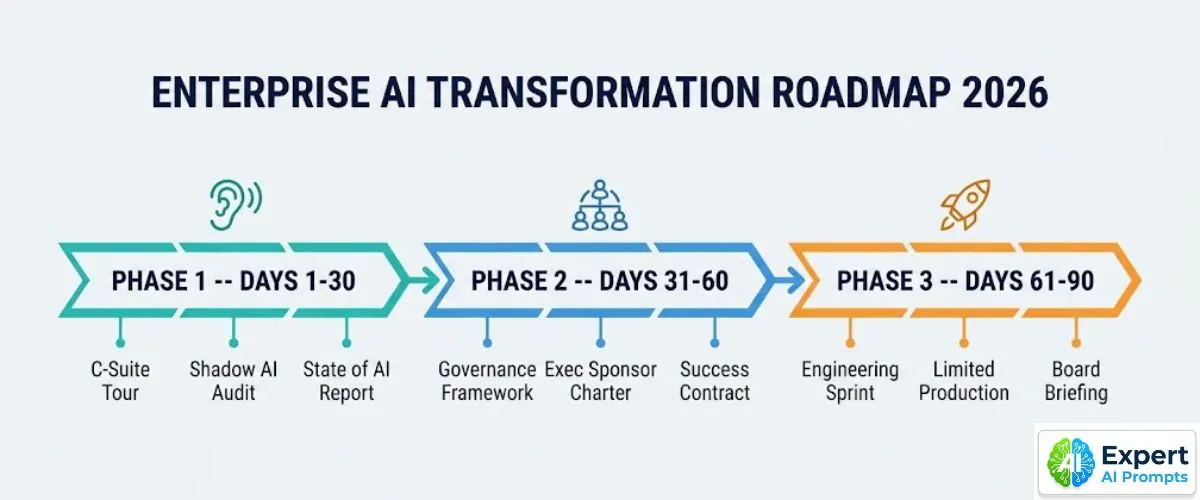
Phase 1 -- Listen and Audit (Days 1 to 30)
Produce the State of AI Report -- the evidence that the CAIO has absorbed the organisation's AI reality, identified the real priorities, and is ready to govern rather than just to observe. It is the transition from orientation to leadership.
Day 1 to 5: Three Actions Before You Do Anything Else
1. Schedule the C-suite listening tour. Every direct peer -- CRO, CPO, CISO, CFO, General Counsel, Head of each major business function -- in 1-on-1 sessions in Week 1. These are not briefings. They are structured listening sessions. The goal is to understand: What problem are you trying to solve with AI? What concerns you about AI? What have you tried that has not worked?
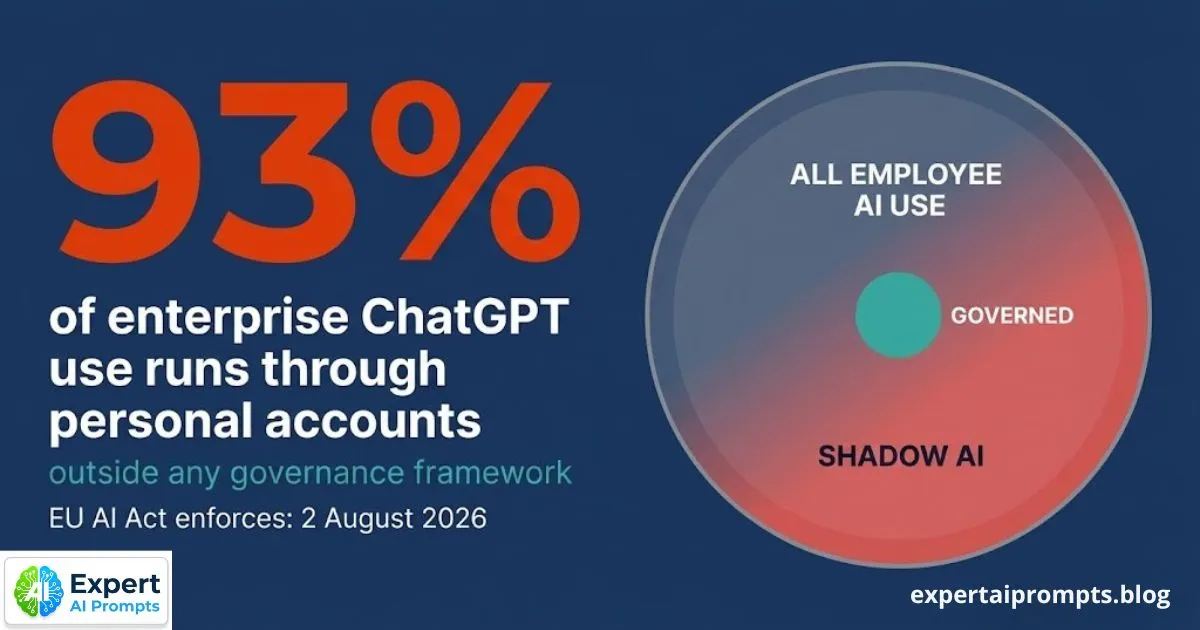
2. Initiate the Shadow AI audit with IT Security. The audit is running in parallel from Day 1 -- not initiated after the listening tour. Shadow AI is not a future risk. 93% of enterprise ChatGPT use runs through personal accounts today. The regulatory exposure (EU AI Act, AU Privacy Act) is live from Day 1 of the CAIO's tenure.
3. Read the last three board AI briefings. Not to learn the strategy -- to understand what the board has been told, what they believe, and where the gap between board perception and organisational reality is likely to be largest. This gap is almost always significant, and closing it is a Day 30 deliverable.
Days 6 to 20: The Intelligence-Gathering Sprint
Conduct deep-dive interviews with the top 10 AI practitioners in the organisation -- the people who are actually doing AI work, building AI systems, or managing AI vendor relationships. These sessions will produce a Reality Report that is almost always more nuanced, more concerning, and more interesting than the executive narrative. Alongside practitioner interviews: complete the shadow AI audit (inventory, risk classification, Tier 1-4 grading), complete the full AI system vendor audit, and map every active and planned AI project against the organisational strategy.
Day 21 to 30: The State of AI Report -- Your First Governance Deliverable
The State of AI Report is a maximum 5-page document that presents: the AI Maturity Assessment (scored across 6 dimensions -- Strategy, Data, Technology, Governance, Talent, Culture), the Shadow AI Risk Inventory with Tier 1-4 classification, the Regulatory Exposure summary (EU AI Act, AU Privacy Act, SOC 2), and the Top-5 Use Case Shortlist with six-dimension scores and business impact quantification. This report is delivered to the board and C-suite before Day 30. It is not a summary of what the CAIO has learned. It is the evidence that the organisation now has a functioning AI governance body.
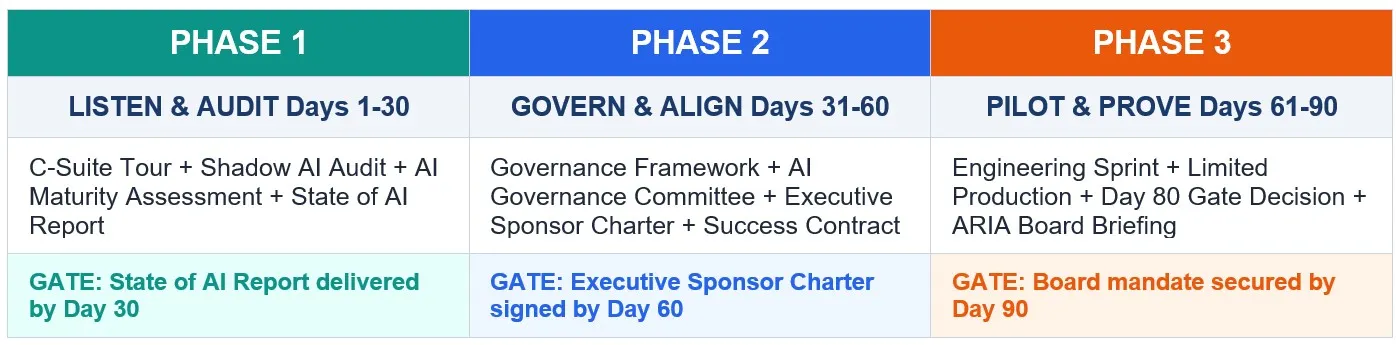
Phase 1 Gate: What Must Be True at Day 30
- AI Maturity Assessment completed across all 6 dimensions with evidence
- All C-suite peers individually interviewed
- Shadow AI Risk Inventory complete with Tier 1-4 classification
- Top-5 Use Case Shortlist with six-dimension scores and dollar business impact
- State of AI Report delivered to board and C-suite -- maximum 5 pages
If the Day 30 report is not delivered: the CAIO has been captured by tactical firefighting. Re-establish listening discipline and accelerate. Late is significantly better than undelivered.
Download the Enterprise AI Readiness Checklist -- the 25-question assessment that maps directly to the Phase 1 audit dimensions.
Phase 2 -- Govern and Align (Days 31 to 60)
Build the governance infrastructure and secure the political alignment that makes Phase 3 possible. Phase 2 produces no production AI deployments -- this is intentional. Every dollar invested in Phase 2 governance reduces the cost of every subsequent deployment. The Executive Sponsor Charter is the most important document in Phase 2. It is the formal transfer of accountability from aspiration to commitment.
Days 31 to 45: Governance Infrastructure and Committee Formation
The AI Governance Framework is published in Days 31-40 -- reviewed by Legal, Privacy, and the CISO before publication. The AI Governance Committee is established with membership from CAIO, CRO, CPO, CISO, General Counsel, and CFO. The first AI Governance Committee meeting is held on Day 45. The Committee is not an advisory body -- it is the approval authority for all high-risk AI systems, the owner of the annual board AI report, and the body that sets the risk appetite that determines what the AI CoE can approve without escalation.
Individual C-suite briefings on the State of AI Report begin in Days 31-40. The goal is not to present conclusions -- it is to achieve alignment on the Top-5 Use Case shortlist before the Executive Sponsor Charter is signed. Every C-suite peer who co-owns the prioritisation decision is a Phase 3 enabler. Every C-suite peer who is surprised by the prioritisation decision is a Phase 3 blocker.
Days 46 to 60: Executive Sponsor Charter and Success Contract
The Executive Sponsor Charter is signed by Day 50. This is not a formality. The Charter defines the sponsor's decision authority (budget approval, cross-functional conflict resolution, production deployment decision), their personal accountability for programme outcomes, and the escalation pathway if that authority is not exercised. A signed Charter changes the political physics of Phase 3. An unsigned Charter at Day 60 is a governance failure -- not a relationship issue.
The Success Contract defines exactly what the Phase 3 Quick Win use case will produce: the business metric it will improve, the pre-AI baseline measurement, the 2x productivity gate threshold, the user cohort size, and the measurement timeline. No engineering sprint begins without a signed Success Contract. A use case that cannot be measured against a pre-agreed threshold is not a Quick Win candidate -- it is a pilot. The Success Contract is what separates the Phase 3 deployment from the Pilot Purgatory pattern.
Phase 2 Gate: What Must Be True at Day 60
- AI Governance Framework published and reviewed by Legal, Privacy, CISO
- AI Governance Committee established -- membership confirmed, Day 45 meeting held
- Executive Sponsor Charter signed by named executive sponsor
- Board chair pre-briefed -- board ready for Day 90 presentation
- Quick Win Success Contract signed -- all 5 elements complete
If the Executive Sponsor Charter is unsigned at Day 60 -- escalate to CEO immediately. This is a governance failure, not a relationship issue. An unsigned Charter means the transformation does not have genuine executive sponsorship. Phase 3 should not proceed without it.
Read the Enterprise AI Governance Framework for the full governance architecture.
Phase 3 -- Pilot and Prove (Days 61 to 90)
Deploy the Quick Win use case in production, validate the 2x productivity gate, and deliver the ARIA Board Briefing on Day 90. Phase 3 is where the governance investment of Phase 2 pays its first dividend -- deployment moves faster because the data pipeline is already cleared, the compliance classification is already done, and the business function champion is already identified.
Days 61 to 70: The Engineering Sprint
The engineering sprint begins with the production architecture already designed, the data pipeline confirmed, and the Success Contract signed. These are not starting conditions -- they are completion criteria for Phase 2. The sprint covers: production architecture build, integration testing at production-volume data, change management preparation with the first user cohort (ADKAR Awareness and Desire stages completed before any user sees the system), and domain-specific prompt library construction. The Expert AI Prompts methodology contributes directly here -- the domain-specific prompt engineering frameworks reduce the testing cycle by 40-60%.
Days 71 to 80: Limited Production -- The Evidence Window
3-5 users from the target business function -- selected for willingness to engage, not for seniority or technical aptitude. The CAIO reviews a sample of AI outputs every day of the limited production window. Metrics accumulate daily against the Success Contract baseline. By Day 80, there are 10+ production user-days of data against the pre-agreed threshold.
The Day 80 Gate Decision: Advance or Kill
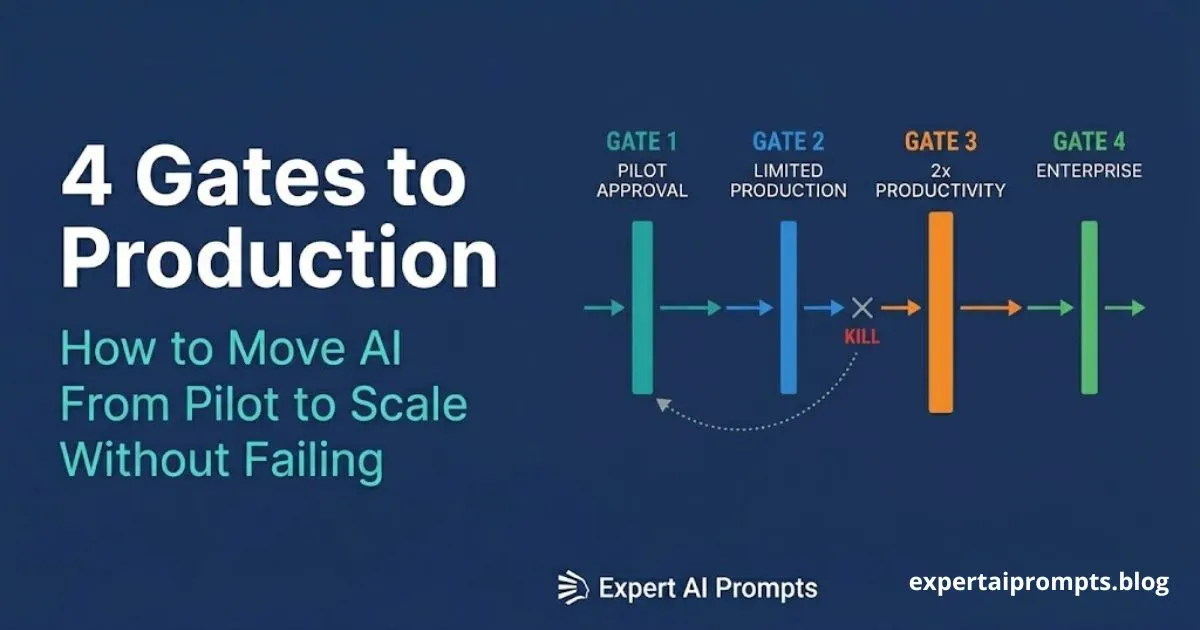
The Day 80 gate is a binary decision against the Success Contract threshold. Pass: the 2x productivity gate is validated -- advance to Day 90 board briefing with full production evidence. Miss: the use case is killed per the contract, and the board briefing is reframed around learnings and the Wave 2 pipeline. The kill decision made with discipline demonstrates more credibility than indefinite extension. A board that sees a CAIO kill a failing pilot with evidence and clarity trusts the next proposal more than a board that sees every pilot extended indefinitely.
Day 90: The ARIA Board Briefing
The ARIA Board Briefing is a maximum 5-page document structured on four elements: AI programme Accountability (what was committed, what was delivered), ROI Evidence (production actuals -- not projections, not forecasts, actuals), Investment Proposal (specific Phase 4 ask: dollar amount, use case count, timeline), and Action Required (a specific named decision from the board -- Approve / Approve with Conditions / Request Further Analysis). Any of these three responses is success. A board that leaves without deciding has not become an AI governance body.
The 30-60-90 Success Gate Checklist
Use this as a working checklist through the 90-day programme. Every item on each gate must be true before advancing to the next phase.
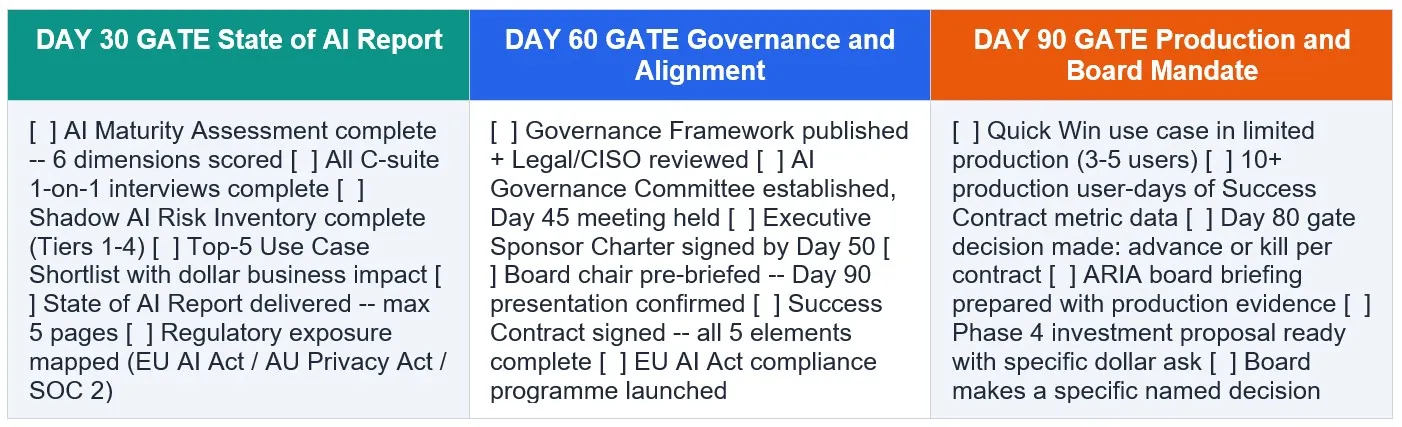
Most important Day 90 metric: The board has made a specific decision about the AI programme. Approve, approve with conditions, or request further analysis -- any of these is success. A board that leaves without deciding has not become an AI governance body. That is the real 90-day objective: not a production deployment. A board that governs AI.
What This Roadmap Looks Like When It Works
Expert AI Prompts is the working demonstration of this framework applied outside the enterprise context. 30 digital products across 30 industries. 1,500+ domain-specific prompts. 15 integrated AI workflow systems. Near-zero daily operational intervention within 60 days of launch. 4x speed with quality validated in production. The same principles apply at enterprise scale -- the governance layers, CoE infrastructure, and regulated access controls are the additions that enterprise deployment requires. The core methodology is identical.
The 90-day roadmap is not a theoretical framework. It is the pattern that research consistently identifies in successful enterprise AI leadership transitions. Listen first. Govern before you deploy. Measure against pre-agreed thresholds. Kill failing pilots quickly. Bring the board a production result, not a pilot promise.
90 days: time from first AI deployment decision to production, validated ROI, and board mandate
Near-zero ops: daily intervention required after 60 days of structured programme operation
4x speed with quality: Phase 5 production benchmark -- validated in Expert AI Prompts live system
15 workflow systems: AI programme scope at 90-day production stage
Proof beats theory. "A live, revenue-generating AI system is the most credible signal an AI Strategy Leader can bring to an executive interview or board briefing." -- Matthew Bulat
Read the Full Expert AI Prompts Case Study
Continue Your Transformation: Free Enterprise AI Resources
Enterprise AI Readiness Checklist (Free PDF) 25 validated questions across 5 dimensions -- the exact assessment framework used in Phase 1 of this roadmap. Instant download. No email required. Download Free
The Enterprise AI Transformation Playbook The full 5-phase transformation framework beyond the 90-day window -- Phases 3-5 in detail. Read the Full Playbook
Explore the Transformation Cluster: Related Deep-Dives
Escaping Pilot Purgatory: Why 70% of Enterprise AI Pilots Never Scale
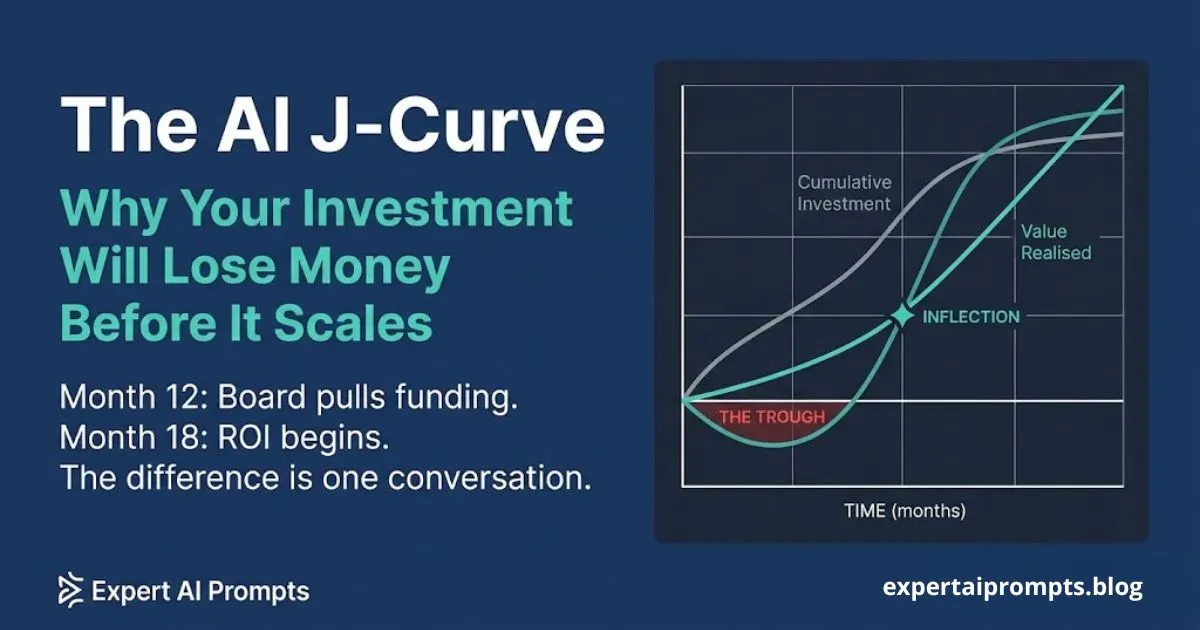
The AI J-Curve: Why Your Investment Will Lose Money Before It Scales
4 Gates to Production: How to Move AI From Pilot to Scale
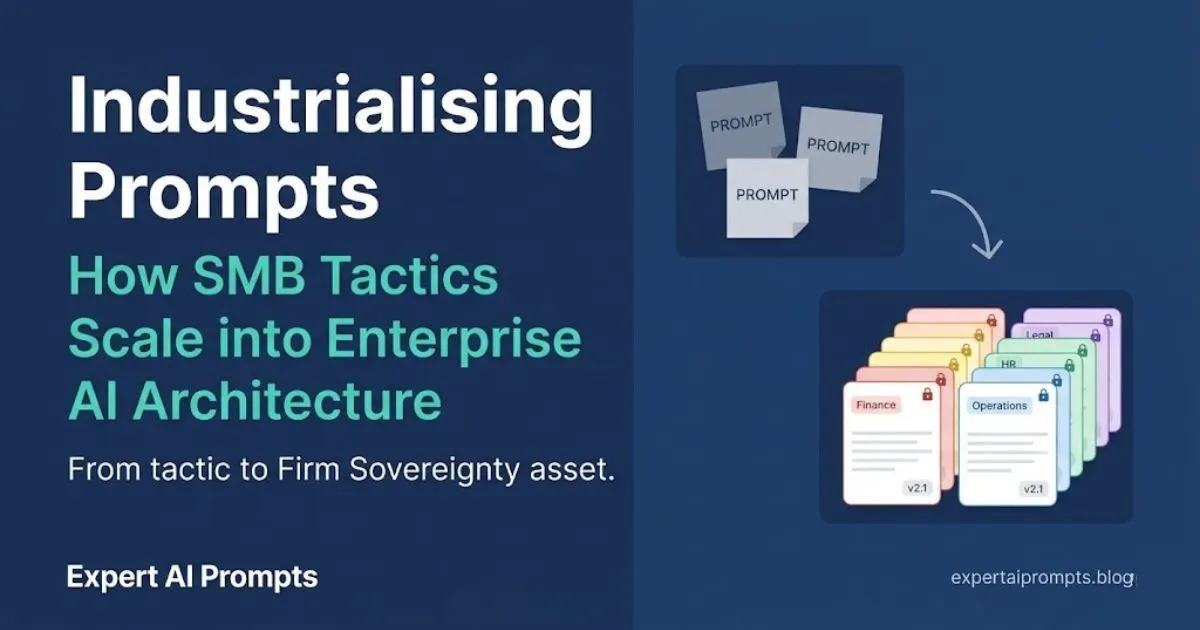
Industrialising Prompts: How SMB Tactics Scale into Enterprise Architecture
Back to Enterprise AI Solutions Hub
Author Bio
Matthew Bulat -- CAIO / AI Strategy Leader / Founder, Expert AI Prompts
Matthew Bulat is the Founder of Expert AI Prompts and a 20+ year technology and AI strategy executive. Former CTO, Federal Government Technical Operations Manager across 20 cities and 4,000 users, and 8+ year University Lecturer in IT and engineering at CQUniversity. The 90-day roadmap in this article is the framework applied to the Expert AI Prompts live platform -- 30 industries, 1,500+ prompts, 15 AI workflow systems, near-zero daily operations.
Former CTO · Technical Operations Manager, Federal Government
University Lecturer, IT & Engineering -- CQUniversity (8+ years)
Founder, Expert AI Prompts -- 30 industries · 1,500+ prompts · 15 AI workflows
Inbound executive interest: AI Strategy Leader, $300K+ USD base