LinkedIn Personal Branding: How to Write Authentic Posts with AI
LinkedIn Personal Branding: How to Write Authentic Posts with AI
Jan 24, 2026

If you are like most small business owners, your relationship with LinkedIn is likely complicated. You know it is the single most powerful platform for B2B growth, networking, and establishing authority. For a full strategic framework, read the complete guide to AI for social media — covering every platform, content type, and prompt workflow for small business owners. You see your competitors—some with less experience than you—posting daily, racking up engagement, and landing clients.
But then you look at your own schedule. Between managing client deliverables, putting out operational fires, and trying to keep the lights on, the idea of sitting down for an hour to craft a "thought leadership" piece feels impossible. You are an expert in your field, but you are also an overworked operator. You don't have a marketing department, and you certainly don't have time to stare at a blinking cursor.
Enter Artificial Intelligence.
For many, AI is a tempting solution, but it comes with a heavy dose of skepticism. You have likely seen the result of lazy AI usage in your own feed: posts that use words like "delve," "landscape," and "tapestry," offering generic advice that sounds like it was written by a committee of robots. As someone who values credibility and quality, you cannot afford to sound like a bot. You need to sound like you—just a more efficient, scalable version of you.
The good news? It is entirely possible to write LinkedIn AI posts that are authentic, engaging, and indistinguishable from content you sweat over for hours. The secret isn't in the tool itself; it's in how you wield it.
This guide will move you from being an AI skeptic to a strategic user. We will strip away the hype and focus on a practical workflow that saves you time, protects your brand voice, and helps you compete with the big players without hiring a massive team.
The "Uncanny Valley" of AI: Why Most LinkedIn AI Posts Fail
To write great content with AI, you first have to understand what bad content looks like. We call this the "Uncanny Valley" of LinkedIn—posts that look professional at a glance but feel empty and soulless upon reading.
As a business owner, your brand's greatest asset is trust. When you post content that feels synthetic, you erode that trust. Here is why most entrepreneurs fail when they first try to use AI for personal branding:
1. The "Tapestry" Problem
Large Language Models (LLMs) are trained to be safe, neutral, and agreeable. Left to their own devices, they default to flowery, academic language that no human actually speaks in a business context. If your post starts with "In the rapidly evolving landscape of today’s digital world," your audience immediately tunes out. They know you didn't write it. They know you didn't care enough to talk to them, so why should they listen to you?
2. Missing Context
AI is brilliant at processing data, but it has zero real-world experience. It doesn't know about that difficult client meeting you navigated last Tuesday. It doesn't know the specific nuances of your local market or the late nights you spent building your business. When you ask AI to "write a post about marketing," it gives you the average of everything the internet knows about marketing. It gives you the "what," but it completely misses the "so what?"—which is where your expertise lives.
3. The Reputation Risk
For a solopreneur or small team leader, your reputation is your currency. If you are trying to convince a client that you offer bespoke, high-touch consulting, but your LinkedIn feed is full of generic, mass-produced content, there is a disconnect. Clients are savvy. They want to know what Alex Rivers thinks, not what ChatGPT predicts is the next probable word in a sentence.
The antidote is a documented brand voice system — see the step-by-step guide on how to train AI to write in your brand voice so every output sounds authentically like you.
The goal, therefore, is not to let AI take the wheel, but to use it as a navigator. You need a system that eliminates the blank page and handles the heavy lifting of structure, while ensuring your unique insights remain the star of the show.
The "Cyborg" Method: Blending Human Strategy with AI Speed
To solve the problem of robotic content, we need to adopt a "Cyborg" mindset. This isn't about replacing the human; it's about mechanically enhancing the human's capacity.
Think of it this way: You are the Architect; the AI is the Builder. The Architect provides the vision, the blueprints, and the specific materials. The Builder lays the bricks. If the Architect never shows up to the site, the Builder will just put up a generic box.
Here is the strategic framework for maintaining authenticity while scaling your output.
Strategy First, Prompts Second
Before you type a single prompt, you must know your pillars. AI cannot define your brand strategy for you. As a business owner, you likely have 3-5 core topics you want to be known for (e.g., "Operational Efficiency," "Remote Team Culture," "Sustainable Supply Chains").
If you treat AI like a slot machine—pulling the lever and hoping for a jackpot—you will lose. But if you treat it like a junior copywriter who needs a creative brief, you will win. Your strategy defines the boundaries within which the AI operates.
The 80/20 Rule
In the traditional writing process, you might spend:
- 20% of your time coming up with the idea.
- 40% drafting and structuring.
- 40% editing and polishing.
With the Cyborg Method, we flip the script.
- You (10%): Provide the raw insight, the "nugget" of wisdom, or the specific story.
- AI (80%): Drafts the structure, fixes the grammar, adds formatting (bullet points, line breaks), and offers variations.
- You (10%): The final polish. You inject your specific tone, remove the "robot words," and ensure the call-to-action (CTA) sounds like you.
This shift allows you to produce expert-level content in a fraction of the time because you are only doing the high-value work.
Training Your Digital Twin
One of the biggest time-wasters is having to explain who you are in every single prompt. To fix this, you need to "train" the AI on your persona.
Create a "Context Document" or a "Brand Voice Guide" that you can paste into the AI before you start working. This should include:
- Your Role: "I am Alex, a consultant for small businesses."
- Your Tone: "Direct, empathetic, no-nonsense, professional but casual."
- Your Audience: "Overwhelmed business owners aged 30-50."
- Forbidden Words: "Do not use words like: delve, unlock, unleash, tapestry, elevate."
To build yours in minutes, download the free Brand Voice Kit — a ready-to-use template that captures your tone, audience, and forbidden words in one shareable document.
By feeding this context to the AI first, you ensure that the first draft is already 70% closer to your actual voice, saving you from heavy editing later.
Step-by-Step: How to Construct an Authentic AI Post
Now that we have the mindset, let’s look at the actual workflow. How do you go from a fleeting thought in the shower to a published, high-performing LinkedIn post in under 15 minutes?
Step 1: The Brain Dump (The Raw Input)
The biggest block to consistency is the pressure to write "perfectly" from the start. Stop doing that.
Open your phone's voice memo app or a blank document. Dictate or type your thought exactly as it comes to you. Do not worry about grammar, flow, or spelling. Just get the raw data out.
Example Raw Input:
"I was talking to a client today who is drowning in admin work. They think they need to hire a COO, but really they just need better systems. It reminded me of when I started out. You can't hire your way out of a broken process. Automation should come before delegation. That’s the lesson."
This is the gold. This is the human experience. No AI could invent that specific client interaction.
Step 2: The Structural Prompt
Now, we hand this raw material to the AI with a specific instruction on how to present it. We don't say "Write a post about this." We say:
"Act as an expert business consultant. Take the following raw thought and turn it into a LinkedIn post.
Structure:
- A punchy hook (under 1 sentence) that calls out the problem.
- Short, readable paragraphs.
- A bulleted list of why 'hiring before systems' is a mistake.
- A conclusion that offers hope.
- A question to the audience.
Tone: Empathetic but firm.
Raw Thought: [Paste your brain dump here]"
By dictating the structure, you force the AI to organize your messy thoughts into a logical argument that fits the LinkedIn algorithm's preference for readability (known as "broetry" formatting, but used professionally).
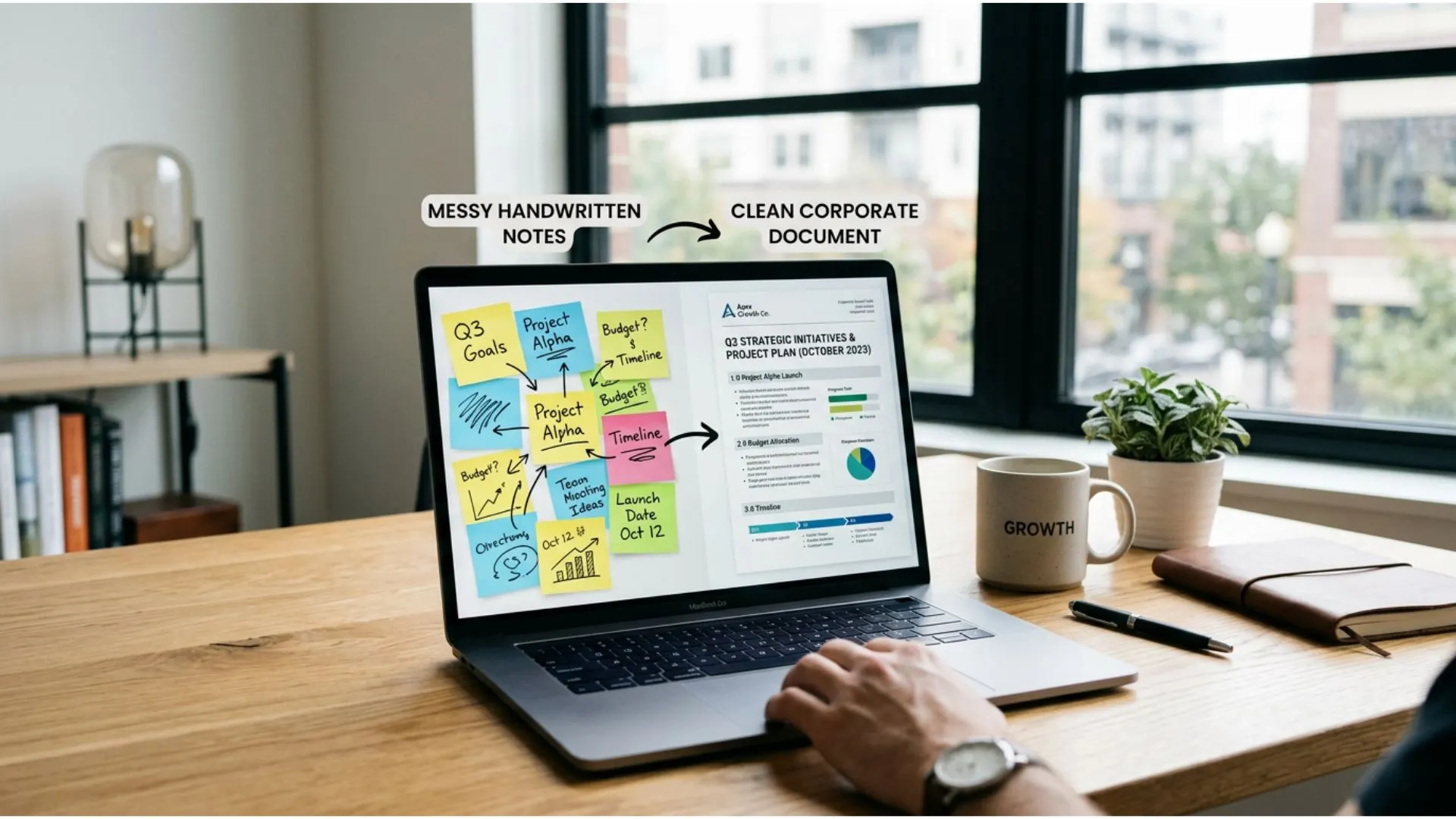
Step 3: The "De-Robotizing" Edit
The AI will generate a draft based on your structured prompt. It will be good, but it likely won't be perfect. This is where your expertise shines. You need to spend 3-5 minutes refining the output. This is the "authenticity pass."
The Authenticity Checklist:
- Kill the Adverbs: AI loves words like "seamlessly," "effortlessly," and "meticulously." Delete them. Real experts speak with nouns and verbs, not fluff.
- Check the Hook: Did the AI write a cheesy question like "Have you ever wondered about hiring?" Change it to a statement of conviction: "Stop hiring people to fix broken systems."
- Inject Personal Pronouns: Ensure the story is told from your perspective. Change "Business owners often feel..." to "I see business owners every day who feel..."
- Verify the Insight: Does the advice align with your actual experience? If the AI suggested a tool you don't like, delete it. You are the expert; the AI is just the typist.
By following this Brain Dump --> Structure --> Refine workflow, you ensure that every post is rooted in your actual thoughts, preventing the "generic content" trap while saving hours of staring at a blank screen.
Advanced Prompt Engineering for LinkedIn Authority
Once you master the basics, you can start using advanced prompting techniques to not just write posts, but to build authority. The quality of your output is directly correlated to the quality of your input. This is where mastering the entrepreneurs' playbook for prompt engineering becomes a high-ROI skill — one of the highest-leverage investments any business owner can make right now.
Beyond "Write a Post"
Most people treat AI prompts like a Google search. To get expert results, you need to provide expert constraints.
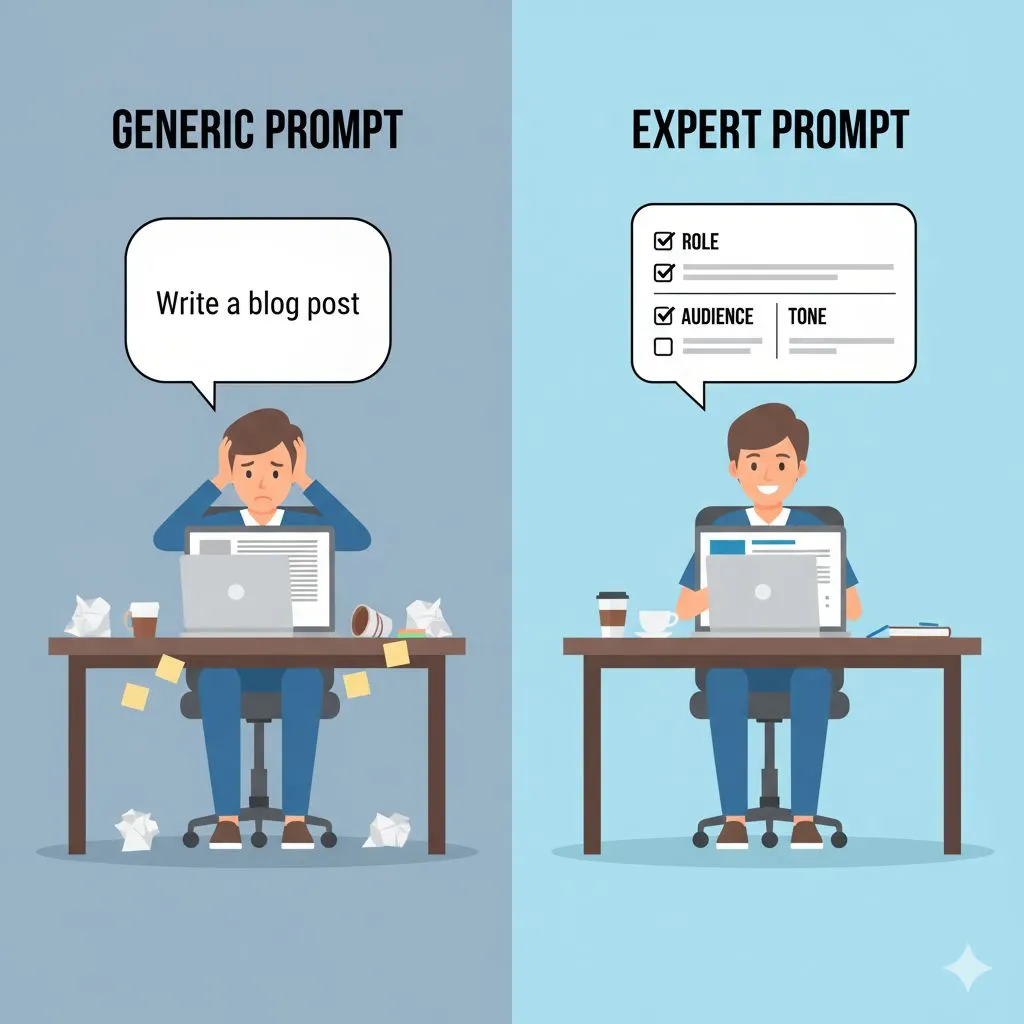
- The Amateur Prompt:
- "Write a LinkedIn post about time management for entrepreneurs."
- Result: A generic list of tips like "wake up early" and "use a calendar."
- The Expert Prompt:
- "Act as a productivity strategist for scaling agencies. Write a contrarian LinkedIn post arguing that 'waking up at 5 AM' is not the secret to productivity—'energy management' is. Use a tone that is provocative but backed by logic. Target an audience of burned-out agency owners. Include a specific example of how managing energy blocks works better than a strict schedule."
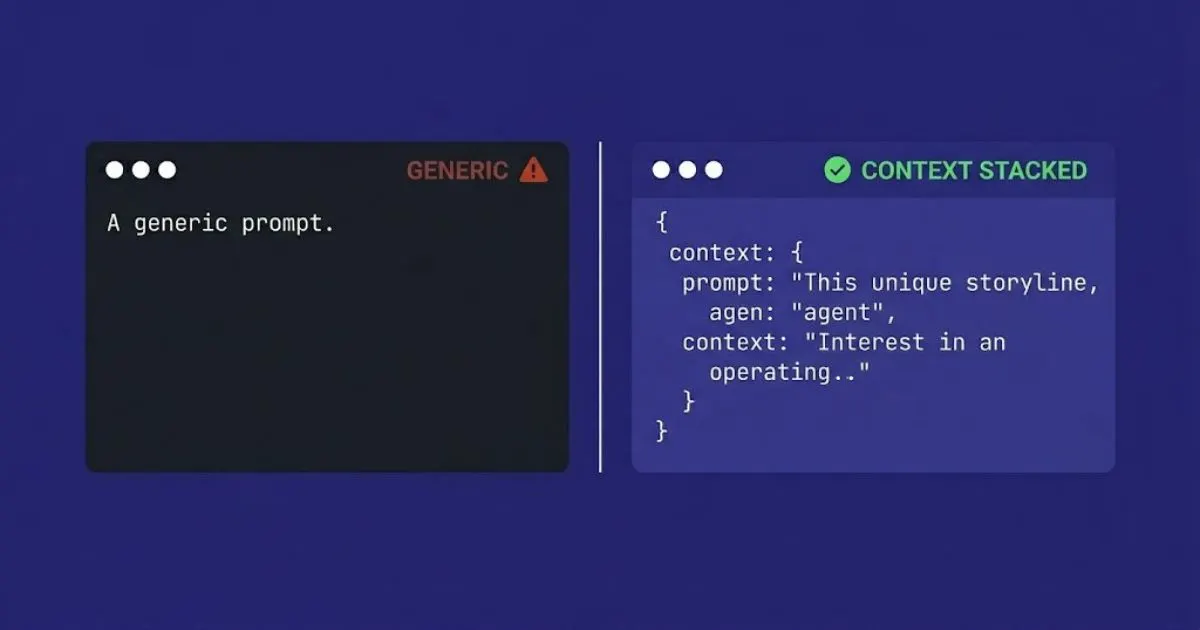
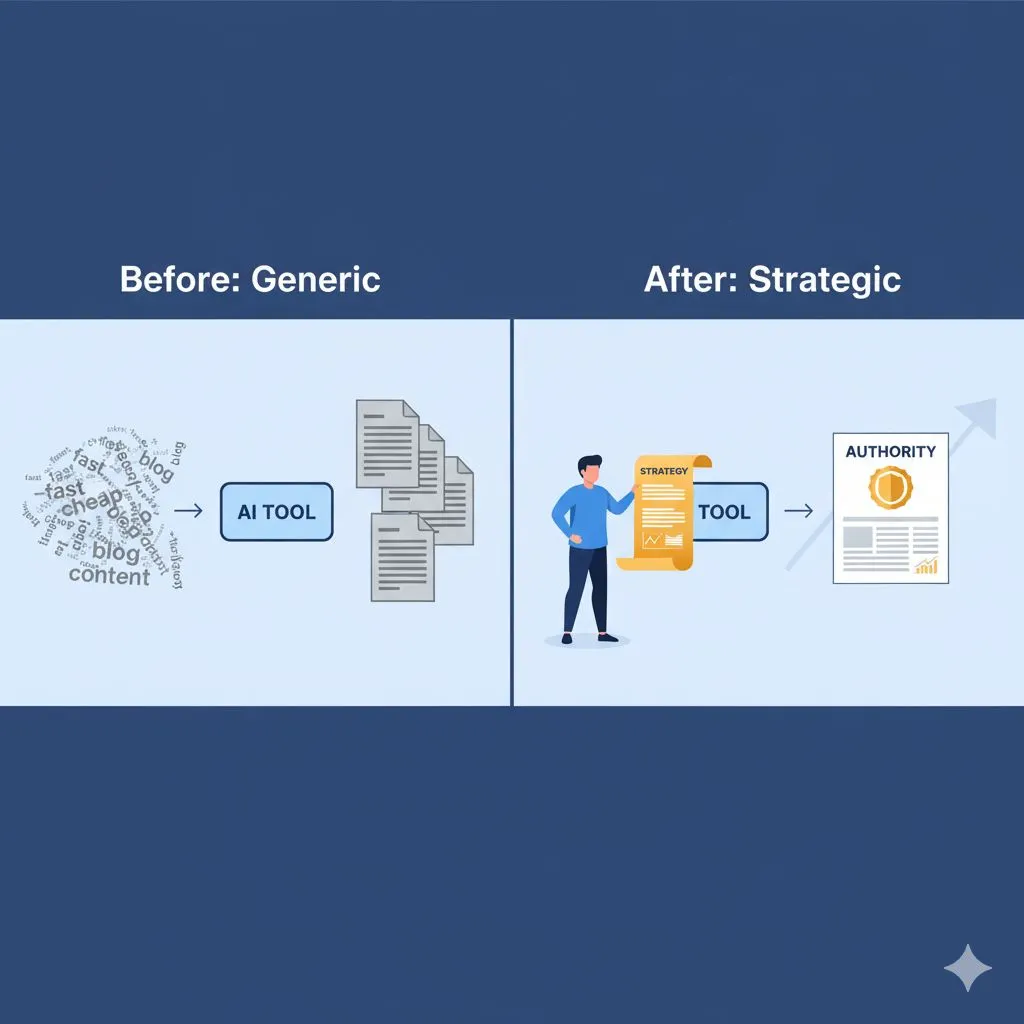
Notice the difference? The Expert Prompt defines the Role, the Angle (contrarian), the Tone, the Target Audience, and a Specific Requirement (example). For a deeper breakdown of why prompt structure determines output quality, read the full analysis of the difference between generic and strategic AI prompts — and why most business owners start at the wrong level. This yields content that positions you as a thought leader, not just a content creator.
Context Stacking
"Context Stacking" is a technique where you layer multiple pieces of information to create highly specific content. This is perfect for when you want to comment on industry news or trends.
You can prompt the AI with:
- Context A: A recent article or statistic about your industry (paste the text).
- Context B: Your company's unique value proposition or methodology.
- The Task: "Write a LinkedIn post analyzing this news article (Context A) through the lens of my methodology (Context B). Explain why the popular opinion in the article might be wrong based on my approach."
This positions you as someone who doesn't just read the news, but analyzes it. It builds immediate authority and shows potential clients that you have a unique perspective on the market.
Repurposing Engines
One of the smartest ways to scale your business presence is to stop creating new content from scratch and start repurposing what you already have. You have likely written proposals, emails to clients, or internal memos that contain brilliance.
You can use AI as a "Repurposing Engine."
- Input: Paste a successful client proposal or a case study.
- Prompt: "Turn this case study into 3 distinct LinkedIn posts:
- A storytelling post focusing on the client's emotional journey.
- A data-driven post focusing on the ROI and numbers.
- A 'how-to' post teaching the audience one specific tactic we used."
Suddenly, one piece of work becomes a week's worth of content. This is how you reclaim your time. You aren't creating more; you are distributing better.
Conclusion
The goal of using AI for your personal brand is not to trick your audience. It is to free your expertise from the bottleneck of your busy schedule.
For too long, small business owners like Alex Rivers—ambitious, talented, but overextended—have let their LinkedIn presence slide because they simply didn't have the time to write. They watched as larger competitors with dedicated marketing teams dominated the conversation.
AI levels the playing field. But only if you use it with intention.
By adopting the "Cyborg" method—blending your strategic "why" with the AI's structural "how"—you can produce authentic, expert-level content in minutes rather than hours. You can move from being an operator who is stuck in the weeds to a recognized authority who leads the conversation.
Remember:
- Avoid the generic: Never publish raw AI output without a "human pass."
- Start with strategy: Define your pillars before you prompt.
- Prompt like a boss: Use specific roles, constraints, and contexts to get high-quality results.
You have the expertise. You have the stories. Now, you have the tool to amplify them. Stop hustling to write, and start scaling your authority.
Not sure where to start? Grab one of our free AI prompts and tools for entrepreneurs — eleven free resources including the Brand Voice Kit, 5-Hour Saver Prompts, and the Perfect Prompt Framework. Already ready to commit? See all 30 industry-specific prompt packs and find the one built for your business.
Ready to Scale Your LinkedIn Presence?
You now know the theory, but the real power lies in execution. Writing the perfect prompt takes time—time you might not have.
Why spend hours testing and refining prompts when we have already done the heavy lifting for you?
We have developed a comprehensive system designed specifically for entrepreneurs who need ROI, not just "content."
Unlock the Sales Page AI Prompt System for LinkedIn.
Get access to 50 expert-engineered prompts across 30 industries. These aren't just "write a post" commands; they are strategic tools built to generate leads, build authority, and save you 10+ hours a week.
Stop spinning your wheels. Start winning clients.
Get Your Prompt Pack Today
Further Reading
The Solopreneur's Guide to Personal Branding at Scale
Building Authority When You Don't Have Time to Network
AI Prompt System for LinkedIn — 50 Expert-Engineered Prompts