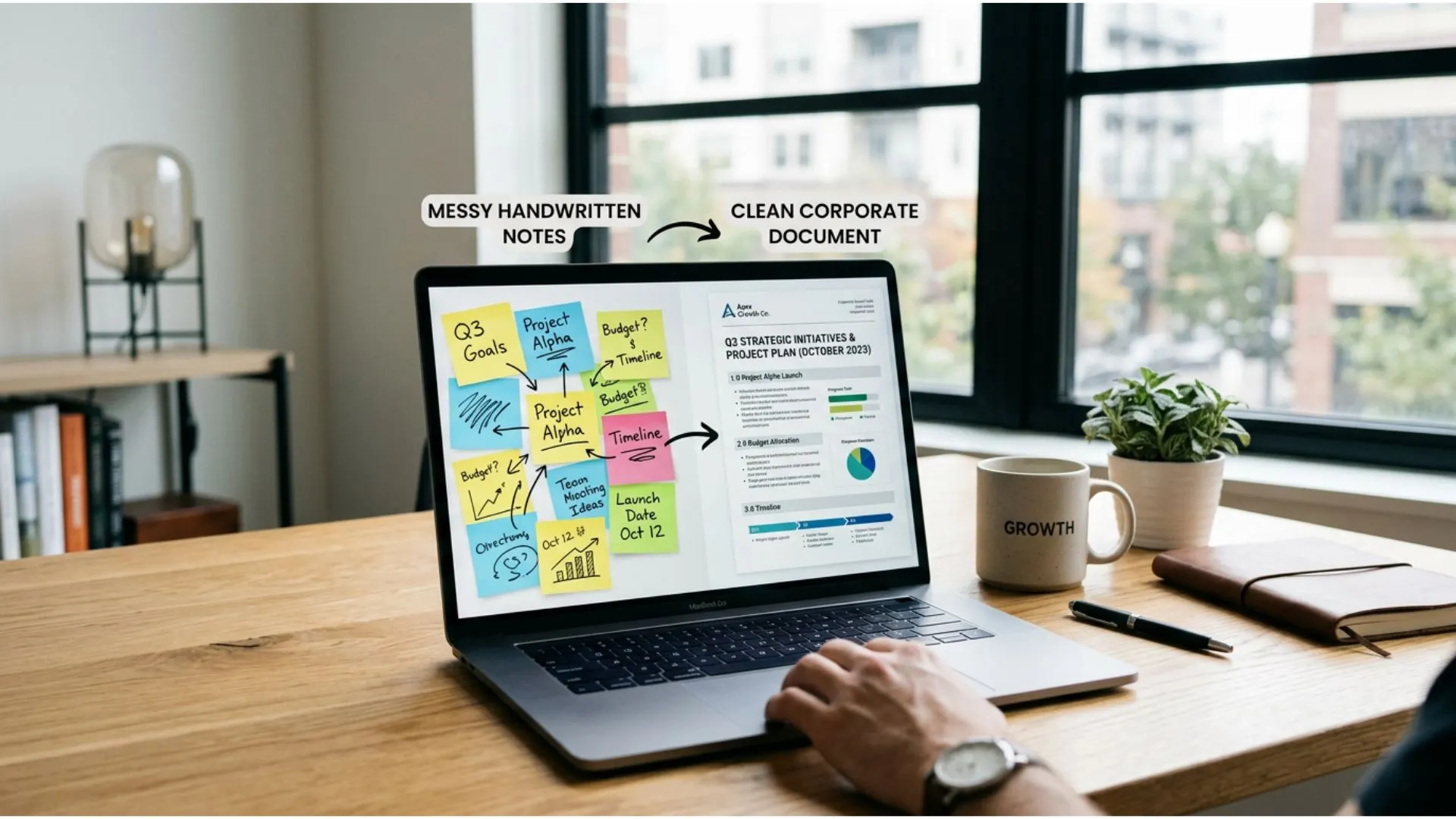
Automating the Boring Stuff: A Practical Guide to AI Workflows
Automating the Boring Stuff: A Practical Guide to AI Workflows
Jan 27, 2026

It’s 2:00 PM on a Tuesday. You have three client deliverables due, an inbox with 47 unread messages, and you haven’t posted on LinkedIn in a week. You know you need to be "strategic" to grow your business, but right now, you’re just trying to survive the day.
If you are like most small business owners, you are wearing every hat available: CEO, CMO, customer support lead, and occasional IT support. You are ambitious, and you know your work is high quality—but you are stuck in the weeds.
This is the bottleneck that keeps small businesses small. It isn't a lack of talent; it is a lack of time.
Enter AI marketing automation.
Our complete AI marketing strategy guide maps the full automation ecosystem — from mindset shift to tech stack — for growth-focused entrepreneurs.
For many, the term "AI" conjures images of robotic, soulless content or complex coding that requires a computer science degree. But for the pragmatic entrepreneur, AI is something much simpler: it is the most affordable, tireless digital intern you will ever hire.
This guide isn't about hype. It isn't about generating a million generic blog posts that no one reads. It is about automating the boring stuff—the repetitive, administrative, and low-leverage tasks that steal your energy—so you can reclaim your time and focus on what actually grows your revenue.
The Mindset Shift: From Operator to Strategist
Before you sign up for a dozen new software tools, you need to change how you view your workload.
As a business owner, you likely suffer from "Super-Helper Syndrome." You believe that for something to be done right, you must do it yourself. This was true five years ago. Today, however, AI tools—when guided by expert strategy—can execute tasks at 90% of your quality level in 1% of the time.
To scale, you must move from being the Operator (the one turning the crank) to the Strategist (the one designing the machine).
Overcoming the "Generic" Fear
The biggest objection to AI marketing automation is quality. You have seen the spammy, robotic comments on LinkedIn. You have read the hallucinations in bad blog posts. You worry that using AI will dilute the brand credibility you have worked so hard to build.
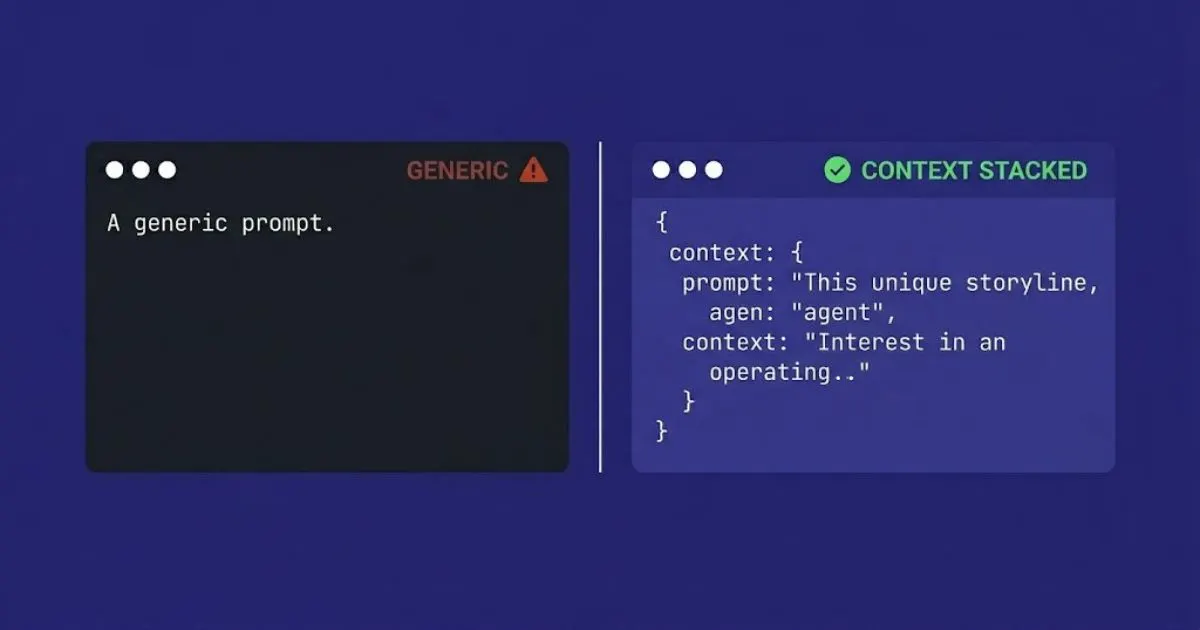
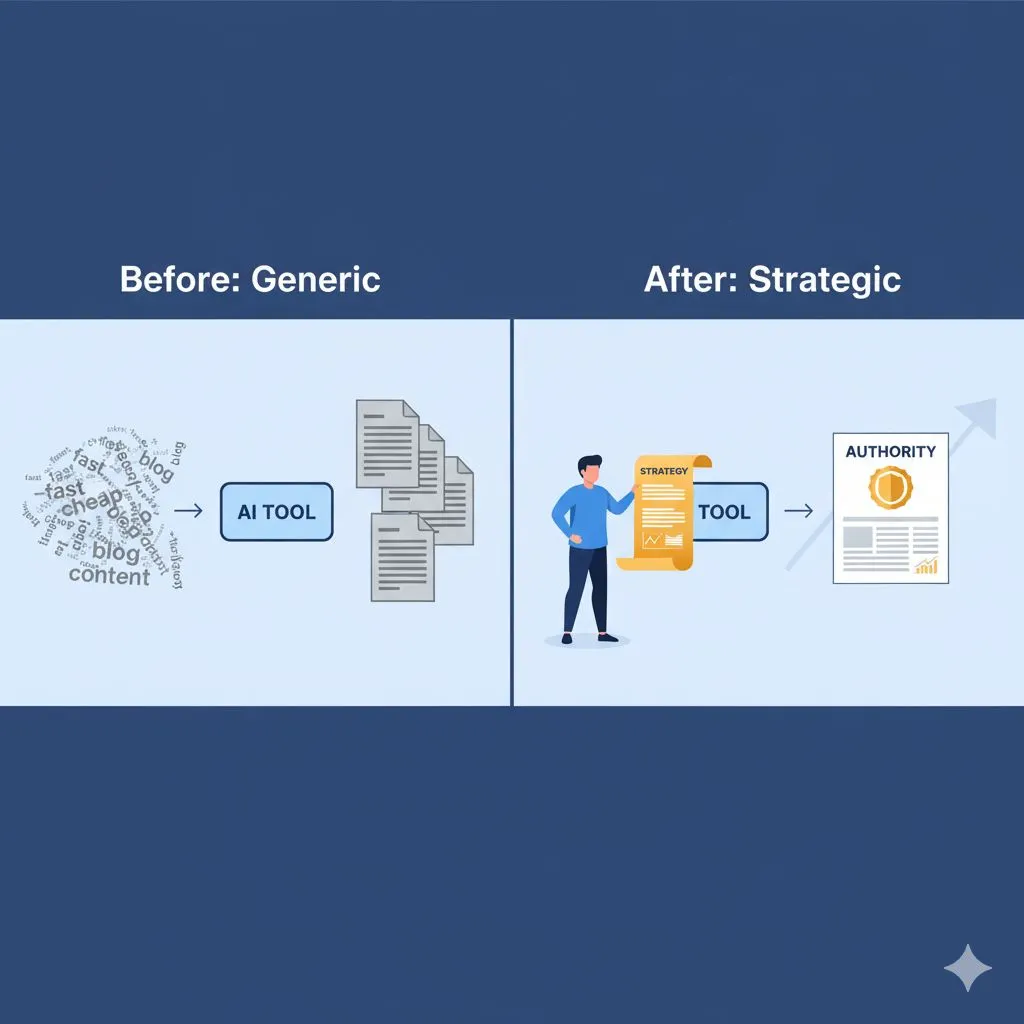
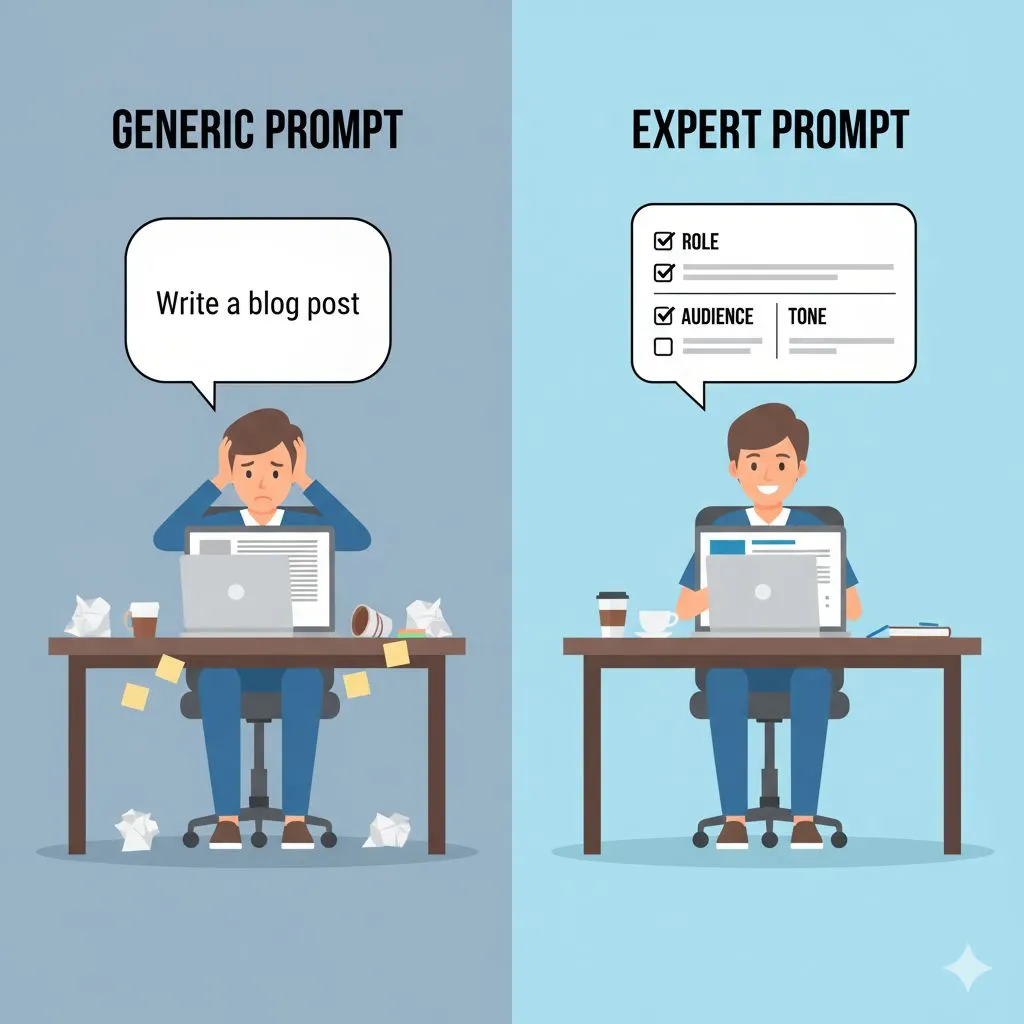
Here is the truth: AI is a mirror. If you give it generic instructions, you get generic results. But if you provide it with structured, expert-level context—what we call "prompt engineering"—it becomes a force multiplier for your unique voice.
The 80/20 Rule of AI Automation
Successful automation follows the Pareto Principle.
- The 80%: AI handles the research, the outlining, the first drafts, the data sorting, and the scheduling.
- The 20%: You handle the final polish, the strategic direction, and the emotional connection.
For a practical breakdown of how to structure this in your business, see our guide on AI-driven marketing automation done right.
By automating the "boring" 80%, you double the energy you have available for the high-impact 20%. This is how one-person teams compete with agencies of ten.
Step 1: The Audit – Identifying the "Boring Stuff"
You cannot automate what you cannot see. The first step to reclaiming your time is a brutally honest Task Audit.
For the next three days, keep a notepad on your desk. Every time you switch tasks, write down what you are doing. At the end of the audit, review the list using the R.R.R. Framework. Look for tasks that are:
- Repetitive: Do you do this more than once a week?
- Rules-based: Does this task follow a logical pattern (e.g., "If X happens, then send email Y")?
- Reliable: Does the input data usually look the same?
The "Time Vampire" List
Common candidates for AI marketing automation in a small business usually include:
- Formatting blog posts for social media.
- Answering "What are your rates?" emails.
- Summarizing meeting notes.
- Categorizing expenses.
- Keyword research.
Before you begin automating, use our small business AI implementation checklist to confirm your workflows are structured enough for AI to execute reliably.
Note: Do not try to automate high-stakes relationship building, crisis management, or high-level strategy formulation. Those require your human intuition.
Step 2: Core Workflows to Automate Now
Once you have your list, it is time to build your systems. We aren't just talking about using ChatGPT to write a poem; we are talking about workflows that move data and content through your business automatically.

Workflow A: The Content Repurposing Engine
This is the "Holy Grail" for the overworked marketer. You likely produce one "hero" piece of content regularly—a client case study, a YouTube video, or a newsletter. The problem is that once it’s published, you move on.
The Old Way:
Write a newsletter. Post it. Hope people see it.
The Automated Way:
- Input: Feed your finished newsletter into an AI tool (like ChatGPT or Claude).
- The Prompt: Use a structured prompt that says: "Act as a senior social media strategist. Take this newsletter text and generate: 3 LinkedIn text-only posts, 2 Twitter threads, 1 script for a 60-second Instagram Reel, and 1 summary email for my leads list."
- Output: You instantly have a week’s worth of content.
- Automation: Use a tool like Zapier to automatically add these drafts to your social media scheduler (like Buffer or Hootsuite) for your review.
This turns one hour of writing into one week of visibility. You are no longer creating content daily; you are creating assets that the AI distributes for you.
The AI Prompts for Social Media Managers Toolkit gives you pre-built platform-specific prompts so your repurposing engine runs on autopilot from day one.
Workflow B: The Inbox Triage & Support
Nothing kills momentum like a cluttered inbox. While you shouldn't let AI answer sensitive client complaints unsupervised, it is excellent at "Triage."
The Automated Way:
Set up an AI workflow where incoming emails are analyzed for sentiment and intent.
- Scenario 1: The email asks about pricing. The AI drafts a reply using your standard pricing sheet and saves it as a "Draft" in your inbox. All you have to do is review and hit send.
- Scenario 2: The email is a newsletter or spam. The AI archives it or labels it "Read Later."
- Scenario 3: The email is from a VIP client. The AI sends a notification to your Slack or phone: "Priority email from [Client Name]."
This reduces the cognitive load of "clearing the inbox" by 50% or more.
For a step-by-step setup, read our guide on how to delegate tasks to your AI assistant effectively.
Workflow C: Lead Nurturing Sequence
When a potential client downloads a lead magnet from your site, what happens? If the answer is "nothing" or "a generic generic PDF delivery email," you are leaving money on the table.
The Automated Way:
- Trigger: A user downloads your guide. If you don't yet have a lead magnet in place, our Free Offers Hub includes 11 ready-to-deploy AI resources you can activate immediately — no design or copywriting required.
- AI Action: Your marketing automation platform triggers a 5-email sequence.
- Personalization: Instead of sending the exact same email to everyone, sophisticated AI tools can now insert dynamic content based on the user's industry (if they filled that out in the form).
- Outcome: The lead is "warmed up" and educated on your methodology before you ever get on a call with them. By the time you speak, they already view you as an authority.
Step 3: The Toolkit (Keeping It Simple)
A common mistake is "App Overload." You do not need a $5,000/month enterprise tech stack. For the Alex Rivers of the world—the small business owners—you need agility.
The "Less is More" Tech Stack
Here is a lean, powerful stack for AI marketing automation:
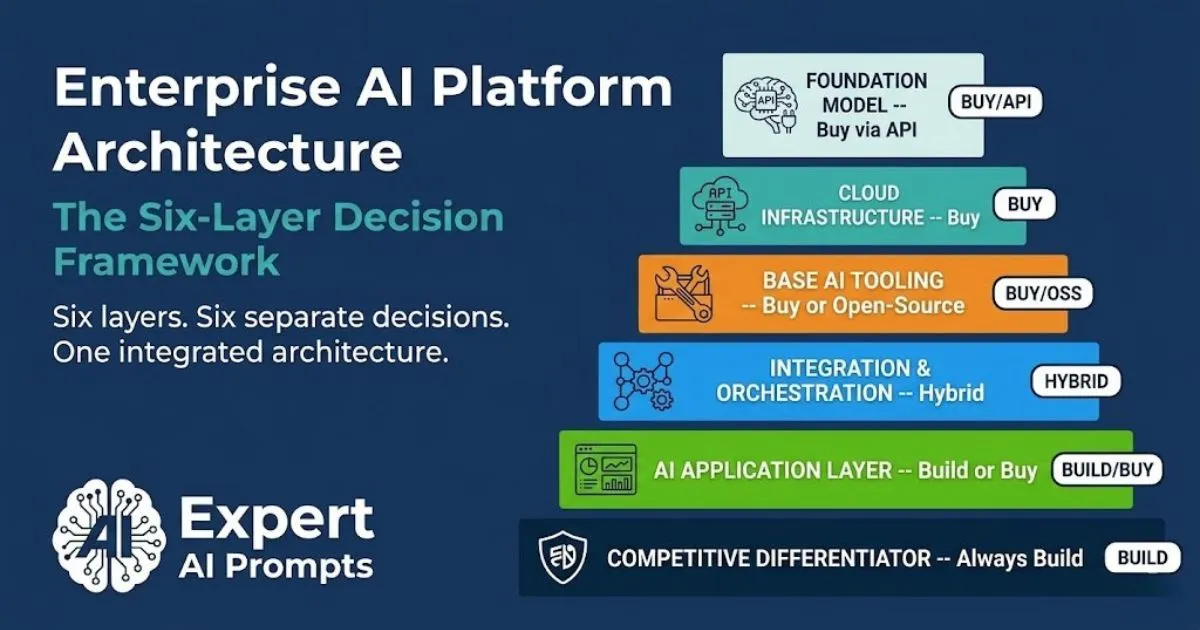
- The Brain (Generative AI): ChatGPT Plus, Google Gemini or Claude 3. This is where you generate text, strategy, and code.
- The Connector (Automation): Zapier or Make (formerly Integromat). These tools act as the "glue," moving data between apps without you clicking buttons.
- The Scheduler (Distribution): Buffer, Metricool, or Hootsuite.
- The CRM (Data): HubSpot or generic email tools like ConvertKit/ActiveCampaign.
The Secret Weapon: Structured Prompts
The software is useless without the right instructions. This is where Expert AI Prompts differentiates your results.
Most people type: "Write a blog post about SEO."
The result: Generic fluff.
An automated strategist types: "Act as an SEO expert with 10 years of experience in B2B SaaS. Write a 1,000-word guide on technical SEO auditing. Use a professional but conversational tone. Address the pain point of 'dropping traffic.' Structure the post with H2s and bullet points for scannability."
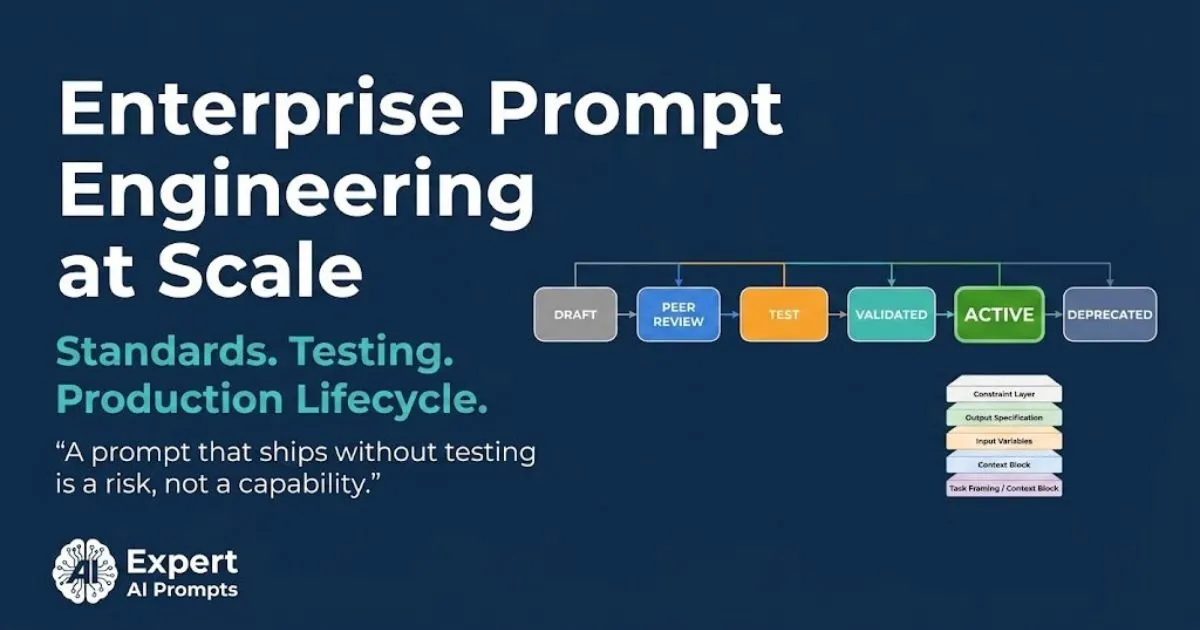
Your "tech stack" is only as good as the prompts you feed it. Building a library of reliable, reusable prompts is the highest-ROI activity you can do today.
Start with the Entrepreneurs' Playbook for Prompt Engineering — a complete framework for building, testing, and refining your prompt library.
VI. Quality Control: The Human-in-the-Loop
Automating the boring stuff does not mean abdicating responsibility. The goal is efficiency, not negligence. To ensure your brand maintains its credibility, you must implement a "Human-in-the-Loop" (HITL) system.
The Editor’s Eye
Treat your AI outputs as the work of a junior intern. You would never let an intern publish directly to your company LinkedIn page without a manager reviewing it first.
- Fact Check: AI can hallucinate data. Always verify stats and quotes.
- Tone Check: Does this sound like you? AI tends to be overly enthusiastic or use words like "unleash," "unlock," and "delve." Edit these out to sound more human. Our guide on how to use an AI content writer and still sound human gives you a practical editing framework to apply to every AI output before publishing.
- Strategic Alignment: Does this content actually serve a business goal, or is it just noise?
Iterative Refinement
Your AI workflows should get better over time. If you consistently find that the AI drafts are too formal, update your prompt library. Add a constraint: "Use simple language. Avoid corporate jargon."
By refining your prompts based on the outputs, you are effectively "training" your digital workforce to understand your specific business DNA.
Conclusion: Stop Hustling, Start Scaling
The narrative of the "hustle" is dangerous. It suggests that if you just work more hours, you will eventually succeed. But you have a limit. There are only 24 hours in a day, and you need to sleep for some of them.
AI marketing automation breaks the link between your time and your output.
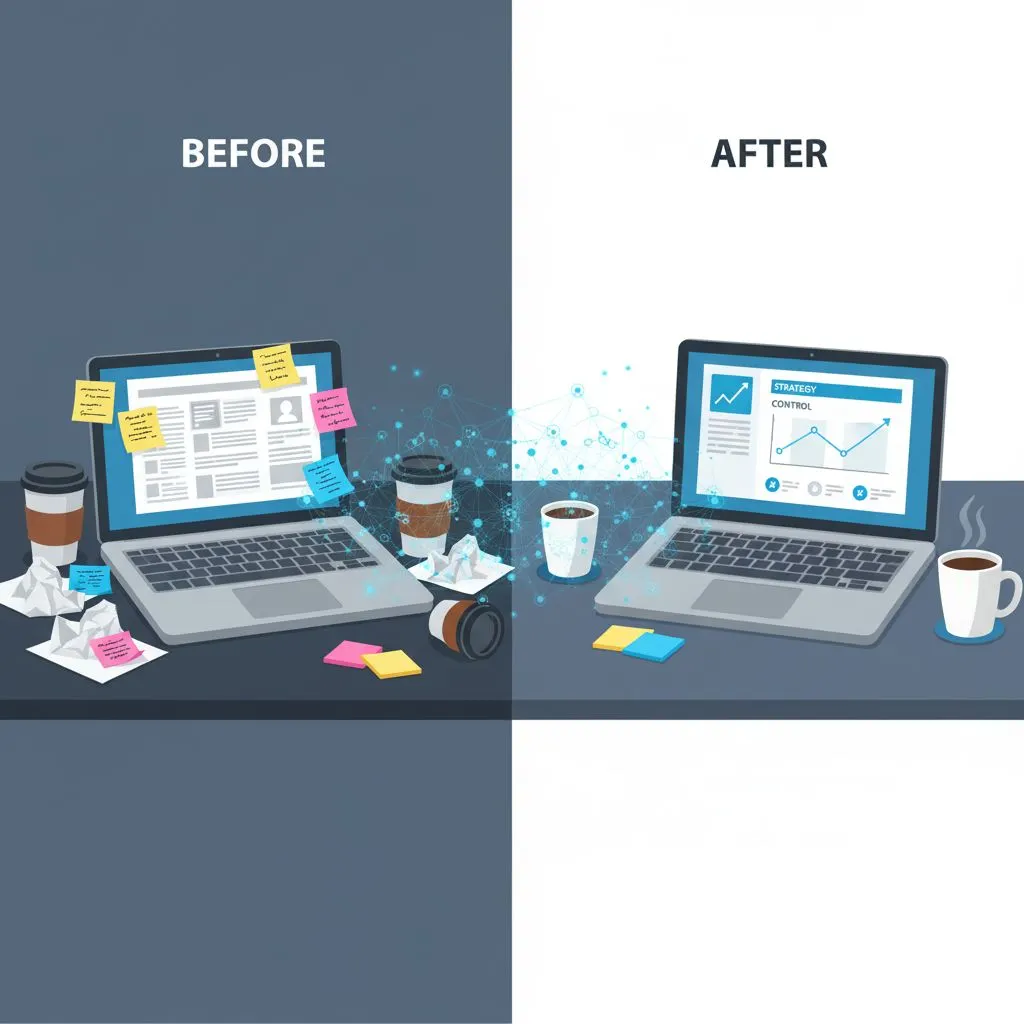
By automating the boring stuff—the scheduling, the drafting, the sorting, the data entry—you free yourself from the operational quicksand. You transform from the stressed-out business owner trying to keep the lights on, into the visionary leader who has the mental space to look at the horizon.
You have the ambition. You have the expertise. Now, you need the leverage.
Don't let the technical jargon scare you. Start small. Pick one workflow—like the Content Repurposing Engine—and implement it this week. Once you feel the relief of having a week’s worth of content done in an hour, you will never go back to the old way.
Not ready to commit yet? Download one of our 11 free AI resources — no credit card required — and see the Expert AI Prompts difference for yourself before you invest.
Ready to build your system?
You don't need to guess which prompts work. We have done the heavy lifting for you. We have compiled the essential frameworks, workflows, and copy-paste prompts that allow small business owners to compete with the giants.
Get the Ultimate Guide to AI for Small Business & Start Scaling Today
Already scaling? Browse all 30 industry-specific prompt packs and pricing to find the right toolkit for your business stage.
Further Reading
How I Saved 10 Hours This Week Using These 3 Prompts
Developing an AI Marketing Strategy That Actually Drives ROI
Bottlenecks Be Gone: Identifying Workflow Gaps AI Can Fix
5 Boring Tasks You Should Never Do Manually Again