Generative AI vs. Predictive AI: What Marketers Need to Know
Generative AI vs. Predictive AI: What Marketers Need to Know
Jan 29, 2026
If you are like most small business owners, your inbox and news feeds are likely flooded with headlines about Artificial Intelligence. It promises to save you time, double your revenue, and essentially run your business while you sleep. But for the overworked entrepreneur juggling client delivery, sales, and administration, this "AI Revolution" often feels less like a lifeline and more like another item on an overflowing to-do list.
The skepticism is valid. You don't have the resources to test fifty different tools just to find one that actually works. However, ignoring AI isn't an option if you want to compete with larger agencies and scale your operations. The secret to cutting through the noise isn't learning everything about AI—it’s understanding the two specific types that matter most to your bottom line: Predictive AI and Generative AI. Our complete AI marketing strategy guide breaks down how to integrate both into your business for maximum ROI.
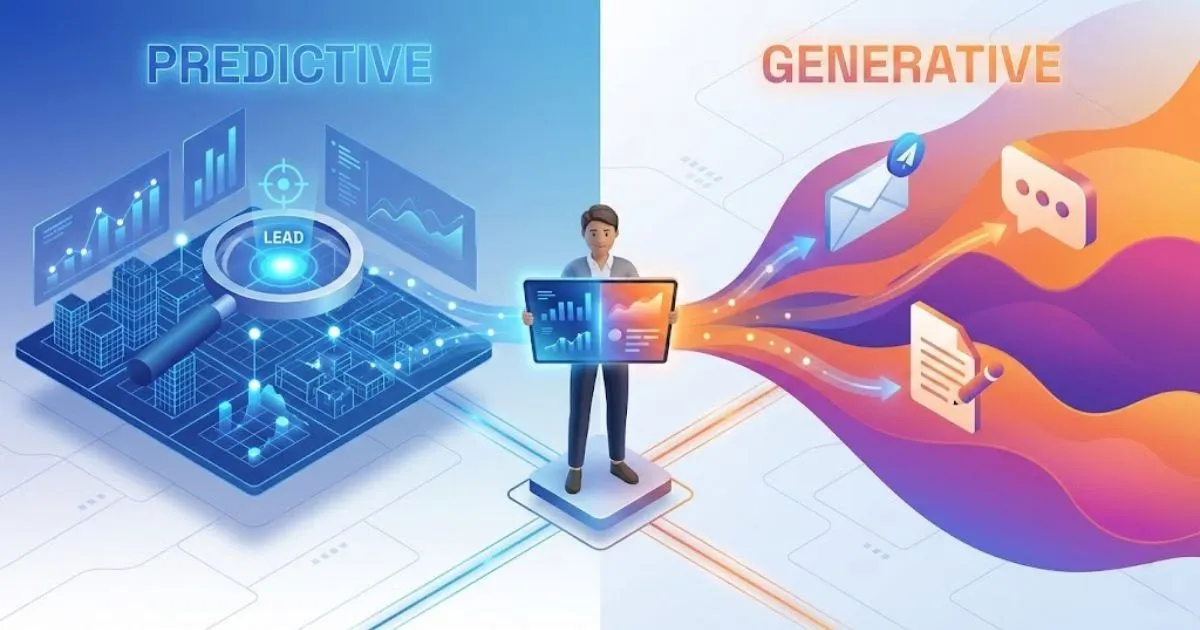
While they are often grouped together under the marketing umbrella, they serve entirely different functions. One is your strategist; the other is your creator. Understanding the difference is the key to moving from an overwhelmed operator to a confident strategist.
Predictive AI: The Strategic Analyst
Think of Predictive AI as the most data-savvy business partner you could ever hire. It doesn’t create new content; it analyzes what has already happened to tell you what is likely to happen next.
For decades, this technology was the secret weapon of Fortune 500 companies with massive data science teams. Today, it is accessible to small business owners and solopreneurs, often built directly into the CRMs and marketing platforms you already use. See exactly how solopreneurs use AI to compete with larger teams without enterprise budgets.
How It Works
Predictive AI uses machine learning to sift through historical data—past sales, website clicks, email open rates, and customer demographics. It identifies patterns that the human eye would miss and projects those patterns into the future. It’s not magic; it’s probability.
Why It Matters for the Small Team
When you are wearing every hat in the business, you cannot afford to waste time on leads that will never convert or marketing channels that don't deliver ROI. Predictive AI solves the efficiency problem.
- Smarter Lead Scoring: Instead of calling every person who downloaded your ebook, Predictive AI can rank those leads based on their likelihood to buy. It might notice that prospects who visit your pricing page twice and open three emails are 80% more likely to close. You stop chasing ghosts and focus only on the hottest prospects.
- Anticipating Customer Needs: Predictive tools can analyze buying cycles. If you sell consumables or subscription services, the AI can flag exactly when a client is due for a re-order, allowing you to reach out at the precise moment of need.
- Reducing Churn: For agencies and service providers, losing a client is costly. Predictive AI can flag "at-risk" behaviors—like a drop in platform usage or lower email engagement—alerting you to intervene before they cancel.
Predictive AI answers the question: "Who should I talk to next?"
Generative AI: The Creative Engine
If Predictive AI is the "brain" analyzing the numbers, Generative AI is the "voice" doing the talking. This is the technology that has taken the world by storm recently (think ChatGPT, Claude, Midjourney).
Unlike its predictive cousin, Generative AI doesn't just analyze data; it creates new data. It can generate text, images, code, audio, and video based on the prompts you provide.
The Role of Generative AI Marketing
For the time-poor entrepreneur, generative ai marketing is the ultimate leverage. It solves the "blank page problem" that paralyzes so many business owners. You know you need to post on LinkedIn, write a newsletter, and update your website copy, but finding the three hours to write a draft often feels impossible.
Core Capabilities for Business Growth
Generative AI allows you to scale your output without scaling your payroll.
- Content Velocity: You can transform a single idea into a blog post, five social media captions, a newsletter intro, and a video script in minutes. It’s not about replacing your expertise; it’s about formatting your expertise faster.
- Personalization at Scale: Combined with customer data, Generative AI can rewrite a core sales email to appeal to different industries. You can generate a version for real estate agents and a version for dentists without manually rewriting every sentence.
- Visual Branding: Tools like Midjourney or Canva’s AI features allow non-designers to create custom imagery for ads and presentations. This reduces reliance on generic stock photos and helps you maintain a unique brand aesthetic on a budget.
The Cautionary Note
Generative AI is powerful, but it is not a "set it and forget it" solution. It requires a "human in the loop." As an expert in your field, you must act as the Executive Editor. You provide the strategy (the prompt) and review the output to ensure it meets your quality standards and brand voice.
Generative AI answers the question: "How do I create high-quality content for all these people without burning out?"
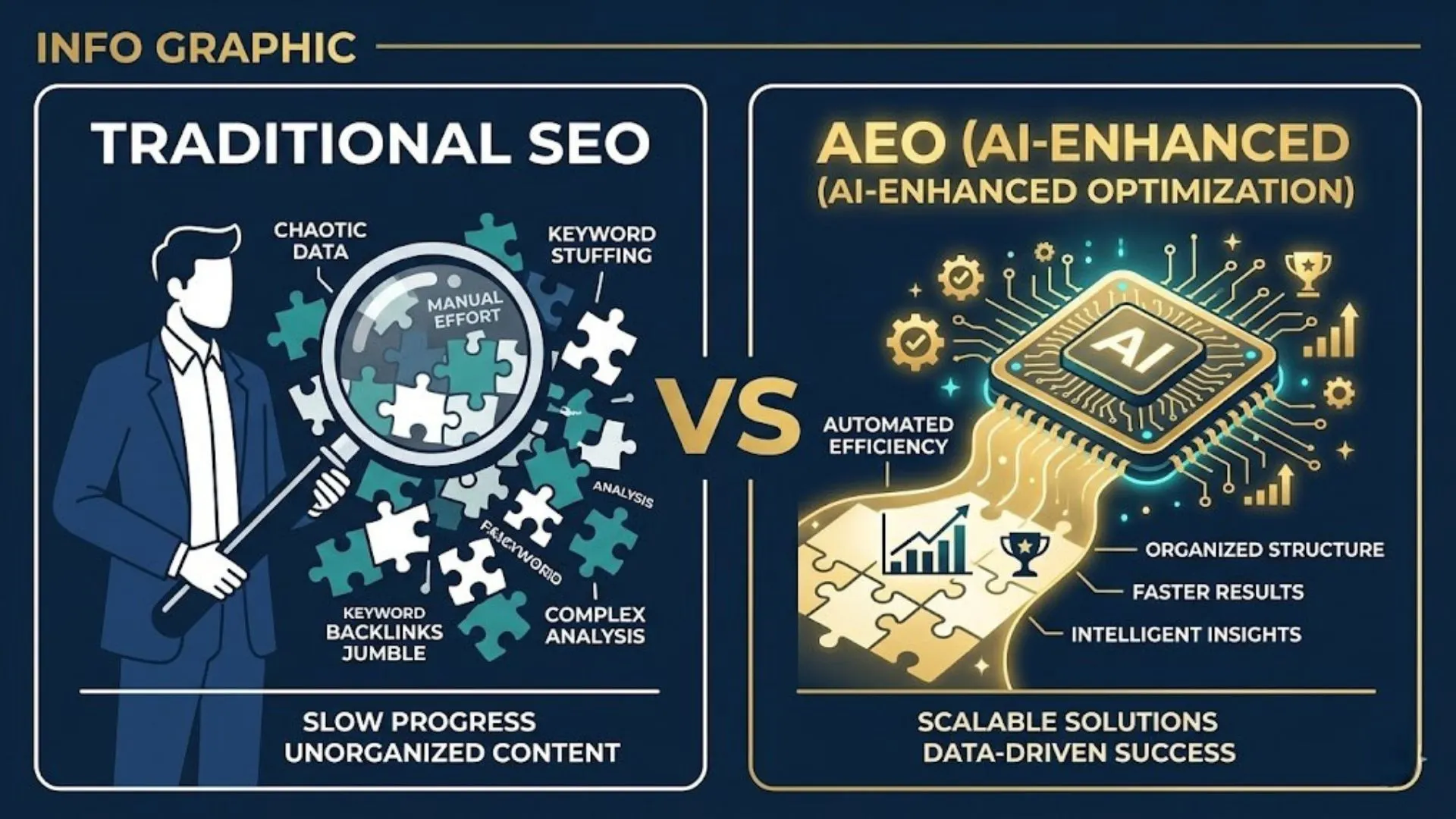
The Showdown: Key Differences at a Glance
To effectively integrate these tools into your workflow, you need to understand where they diverge. Here is a breakdown of how they compare.
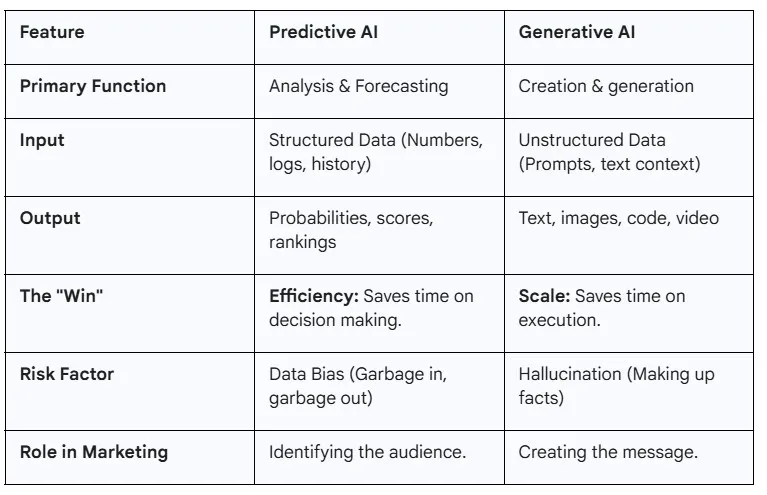
Creating the message.
The Power Duo: How They Work Together
The magic happens when you stop viewing these as separate tools and start seeing them as two halves of a complete marketing system. For a business owner like Alex Rivers—ambitious but resource-constrained—combining Predictive and Generative AI is the closest thing to having a full marketing department.
The Integrated Workflow Example
Let's look at a practical scenario of how this works in the real world for a B2B consultant.
Step 1: The Analysis (Predictive)
You have an email list of 2,000 past contacts. You want to launch a new workshop, but you don't have time to personally email everyone, and you know generic blasts get low open rates.
- Action: You use a CRM with predictive capabilities. It analyzes your list and identifies the 150 people who have engaged with your content in the last 60 days and fit your ideal customer profile.
- Result: A highly targeted segment of "Warm Leads."
Step 2: The Creation (Generative)
Now that you know who to target, you need the what.
- Action: You open your Generative AI tool. You input a prompt detailing your workshop’s value proposition and ask the AI to draft three email variations: one focusing on ROI, one focusing on time-savings, and one focusing on competitive advantage.
- Result: Three polished, persuasive email drafts generated in seconds.
Step 3: The Execution (Human + AI)
- Action: You review the drafts, tweak the tone to match your personal brand voice (The "Expert" touch), and load them into your email platform.
- Result: You launch a highly targeted campaign in 30 minutes that would have previously taken two days.
Moving From Hype to ROI
The goal of adopting AI in your business isn't to look tech-savvy; it is to reclaim your time and secure your financial freedom.
Predictive AI helps you make better decisions. Use our AI ROI Calculator for Small Business to quantify exactly how much time and money AI can save your operation — before you invest a dollar. It ensures that when you spend energy, you are spending it in the right place. It minimizes the risk of failure by using data to guide your path.
Generative AI helps you execute those decisions. It removes the bottlenecks of content creation and allows you to present a polished, expert-level brand to the world, even if you are a team of one working from a home office.
Start Small, Scale Fast
You do not need to overhaul your entire business overnight. Start by identifying your biggest bottleneck.
- Is your problem knowing who to sell to? Look into Predictive tools (often found in upgraded CRM tiers).
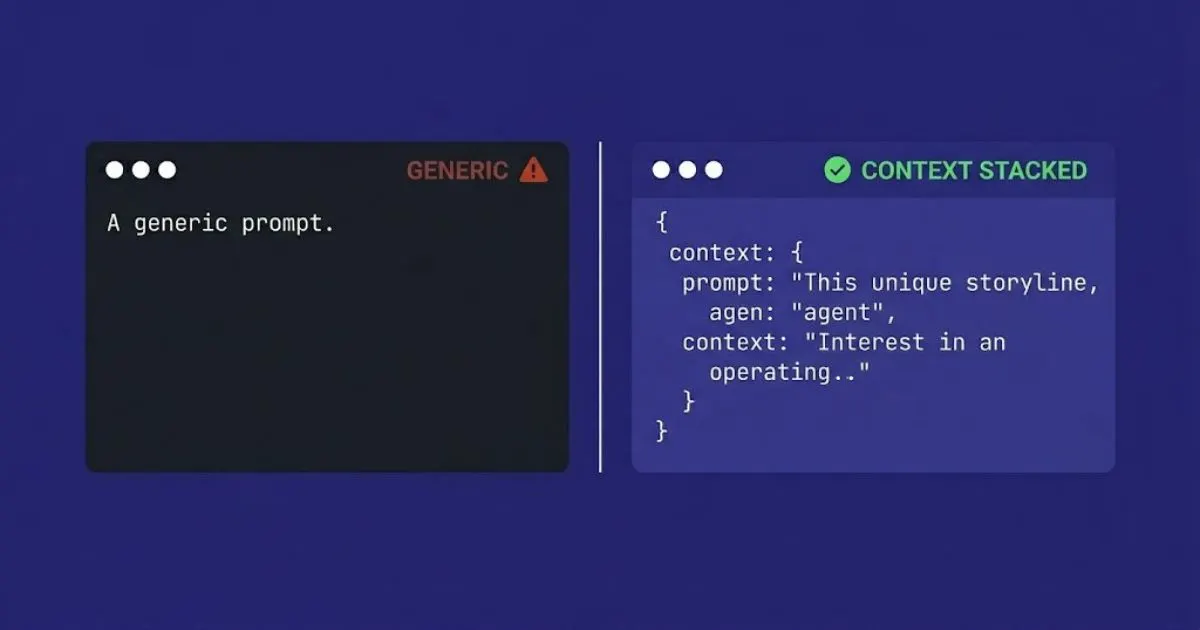
- Is your problem creating the marketing materials? Start mastering generative prompting strategies.
The future of marketing doesn't belong to the businesses with the biggest budgets. It belongs to the businesses that can combine human strategy with AI efficiency. By leveraging generative ai marketing alongside predictive insights, you can stop hustling for every inch of growth and start building a scalable, sustainable business engine.
Further Reading
• Developing an AI Marketing Strategy That Actually Drives ROI
• Beyond ChatGPT: Why You Need Specialized Prompts
• How I Saved 10 Hours This Week Using These 3 Prompts
Ready to Reclaim Your Time?
Understanding the theory is step one. Step two is getting your hands on the actual tools and prompts that drive results. We have curated a list of the best resources, prompt packs, and guides specifically designed for small business owners who want to scale without the stress.
Download a free prompt pack from our Free Offers Hub and start saving time this week.
Browse our full library of industry-specific prompt packs at the Expert AI Prompts Pricing Catalog.
Or explore all AI resources for guides, tools, and tutorials built for small business owners.