Why Your Etsy Listings Aren't Converting (And How to Fix Them)
Why Your Etsy Listings Aren't Converting (And How to Fix Them)
Feb 01, 2026

You know the feeling. You hear the "cha-ching" notification on your phone in your dreams, but in reality, your dashboard tells a different story. You have the traffic. People are visiting your shop. But they aren't buying.
For a business owner like you—juggling marketing, creation, shipping, and strategy—this isn't just annoying; it’s an efficiency leak. You have invested hours creating the product and setting up the shop, but the Return on Investment (ROI) isn't there. Learn how leading e-commerce sellers are applying AI to fix exactly this problem in the Practical AI for Ecommerce, Retail and Real Estate Guide.
If you are stuck in the cycle of "post and pray," it is time to shift gears. Low etsy sales usually aren't a product problem; they are a communication problem. Your listing has a job: to guide a stranger from curiosity to confidence in seconds. If it fails, you lose the sale to a competitor who optimized better.
Understanding the Math: What is a Good Conversion Rate?
Before we start fixing things, we need a baseline. Many sellers panic because they don't know what "normal" looks like. In e-commerce, the math is simple:
To calculate your conversion rate, simply divide your total number of orders by your total number of shop visits, then multiply the result by 100.
On Etsy, the average conversion rate hovers between 1% and 3%.
- If you are below 1%: You have a conversion problem. Your listing isn't convincing people to buy.
- If you are above 3%: You have a traffic opportunity. Your listing works; you just need more eyes on it.
If you are sitting at 0.5%, don't worry. It means your listing has leaks. This guide will help you plug them so you can stop hustling for traffic that doesn't convert and start scaling your revenue.
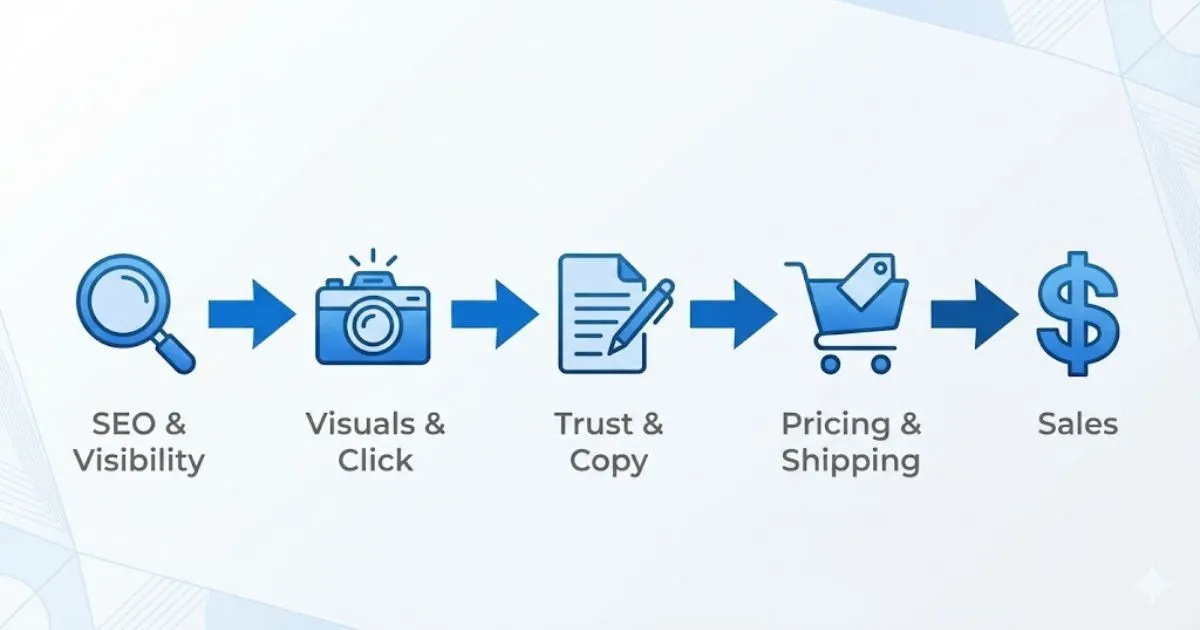
Phase 1: The Visibility Trap (SEO & Keywords)
You cannot sell to someone who can't find you. However, many sophisticated sellers make the mistake of thinking SEO (Search Engine Optimization) is just about cramming the word "gift" into the title five times. That used to work in 2015. Today, Etsy’s algorithm is smarter, and so are buyers.
The Problem: Keyword Stuffing vs. Shopper Intent
If your title looks like a robotic word salad (“Blue Mug Coffee Cup Gift For Him Dad Gift Ceramic Mug Blue”), you are hurting your brand credibility. It looks cheap, and Etsy actually demotes titles that look spammy.
The Fix: The "Long-Tail" Strategy
You need to target "Shopper Intent." What is the customer actually typing when they are ready to buy?
- Generic (Low Intent): "Coffee Mug" (Thousands of results, low conversion).
- Specific (High Intent): "Hand-thrown speckled ceramic mug large handle."
The person searching for the specific phrase knows exactly what they want and is ready to pull out their credit card.
Action Step: Rename your top 5 listings. Place the most descriptive, "long-tail" phrase at the very front of your title. Keep it readable for humans.
- Bad: Leather Bag Brown Tote Bag Work Bag
- Good: Cognac Leather Tote Bag for Women | Oversized Work Laptop Bag
The Tagging Strategy
You get 13 tags. Using only 5 is leaving money on the table. Repeating words in tags that are already in your title is a waste of space.
- Diversify your tags. Use synonyms (e.g., if your title says "Bag," use "Purse," "Satchel," or "Handbag" in tags).
- Use multi-word tags. "Silver Ring" is better than just "Ring."
By refining your SEO, you ensure that the traffic landing on your page is actually looking for what you sell, which naturally increases your etsy sales conversion rate.
For a deeper look at how AI lifts e-commerce performance at every stage, explore 7 Ways AI in Ecommerce Boosts Sales.
Phase 2: The Click Barrier (Visuals & Presentation)
Once you appear in the search results, you have exactly 0.4 seconds to win the click. In a sea of thumbnails, your image is your handshake. If it’s weak, the customer keeps scrolling.
The Problem: The "Garage Sale" Aesthetic
Grainy photos, clutter in the background, or dark lighting scream "amateur." You might be running a serious business, but if your photos look like you took them on a flip phone in a basement, buyers will assume your product quality is low, too.
The Fix: The First Photo Rule
Your primary image (the thumbnail) has one job: Stop the scroll.
- Clean Backgrounds: White or neutral backgrounds generally perform best for product clarity.
- Context: Show the scale. If you sell earrings, show them on a model (or a realistic stand) so the buyer immediately understands the size.
- Lighting: Natural light is free and superior to yellow indoor bulb lighting.
Lifestyle & Infographic Images
Do not just upload five angles of the same item. Use your 10 image slots to answer questions.
- The "In Use" Shot: Show the candle burning on a cozy mantle. Show the planner being written in at a coffee shop. Sell the vibe, not just the item.
- The Infographic: This is a secret weapon for scaling. Create a graphic that details dimensions, color options, or shipping times.
- Why this works: Mobile shoppers hate reading descriptions. If you put the critical info in the images, you reduce friction and questions.
Video is Non-Negotiable
Etsy explicitly favors listings with videos in search results. You don't need a film crew. A simple 15-second smartphone clip showing the product turning, sparkling, or being used builds massive trust. It proves the item is real and gives the buyer confidence in the texture and quality.
Phase 3: The Trust Gap (Copywriting & Description)
Congratulations, they clicked. Now they are on your product page. This is where the sale is won or lost.
The Problem: The "Specs-Only" Robot
Many sellers write descriptions that read like a manufacturing manifest: "Size: 5x7. Material: Paper. Color: White."
While accurate, this is boring. It doesn't trigger emotion. It doesn't explain why this product solves a problem or improves their life.
The Fix: Copywriting that Connects
Your description needs to act like a high-end sales assistant. Use expert AI copywriting prompt examples to shortcut the process and produce professional-quality product descriptions in minutes. It needs to anticipate needs and evoke feelings.
The "Hook" Formula:
Start with the benefit, not the feature.
- Instead of: "This is a lavender soy candle."
- Try: "Transform your chaotic evenings into a spa-like retreat with the calming scent of French Lavender."
Formatting for Skimmers:
Alex, you know how you read online—you scan. Your customers do the same.
- Use Bold Headers for sections (e.g., The Details, Shipping, Care Instructions).
- Use Bullet Points for specs.
- Keep paragraphs short (2-3 sentences max).
The "Objection Buster"
What stops someone from buying?
- "Will it fit?"
- "Is the material itchy?"
- "Will it arrive in time?"
Address these directly in your description. "We know buying clothes online is tricky, so we’ve included a detailed size chart in the photos and offer hassle-free exchanges."
By answering the objection before they even ask it, you remove the risk. When risk goes down, etsy sales go up.
Phase 4: The Friction Point (Pricing & Shipping)
You have hooked them with the title, dazzled them with photos, and charmed them with the description. They add the item to the cart. They go to checkout. And then... they abandon the cart.
Why? Usually, it's "Sticker Shock."
The Problem: The Hidden Shipping Tax
In the age of Amazon Prime, customers have been conditioned to view shipping costs as a nuisance. Seeing a $20 item suddenly become $32 at checkout is the number one killer of conversion rates.
The Fix: Psychological Pricing & Shipping
You have two strategic options here:
- Free Shipping Guarantee: Bake the average shipping cost into your product price. A $35 item with free shipping often converts better than a $25 item with $10 shipping. Mentally, the customer feels they are paying for the value of the product, not the logistics of getting it.
- Threshold Free Shipping: "Free shipping on orders over $50." This encourages a higher Average Order Value (AOV), prompting the customer to buy two items instead of one to "save" on shipping.
Pricing for Value, Not Just Cost
Don't just calculate (Materials + Time). Look at the market. If you are priced significantly lower than competitors, buyers might assume your quality is inferior. If you are higher, you must justify it with better branding and photography.
- The "9" and "5" Rule: Prices ending in .99 or .95 still psychologically register as "deals." $19.95 feels significantly cheaper than $20.00.
Phase 5: The Growth Loop (Analysis & Iteration)
You are a business owner, not a gambler. You don't guess; you track.
The "Set and Forget" Myth
The biggest mistake ambitious entrepreneurs make is thinking a listing is "done." A listing is a living asset. You need to review your Etsy Stats weekly.
What to look for:
- High Views, Low Orders: Your SEO is working, but your Description, Price, or Photos are failing. (Refer to Phases 2, 3, and 4).
- Low Views, High Orders: Your product is amazing, but your SEO is weak. (Refer to Phase 1).
A/B Testing:
Change one variable at a time. If you change the title, price, and photos all at once, you won't know what fixed the problem.
- Week 1: Change the main photo. Did the Click-Through Rate go up?
- Week 2: Adjust the tags. Did traffic increase?
This systematic approach takes the emotion out of the process and relies on data. It turns your shop into a machine that generates consistent etsy sales.
Scaling Without the Burnout
Optimizing an Etsy shop isn't rocket science, but it is labor-intensive.
You have to research 13 tags for every product. You have to write compelling, emotional descriptions for every variation. You have to analyze data and tweak headlines.
For a solopreneur like Alex Rivers, this is where the bottleneck happens. You know what to do, but you physically don't have the hours in the day to execute it at an expert level for every single listing. You are too busy fulfilling orders and running the business to spend 20 minutes crafting the perfect SEO-rich description for a new product launch.
See how one Etsy seller doubled their conversion rate using structured AI prompt workflows in this real-world ecommerce conversion case study.
This leaves you in a trap: You need to optimize to scale, but you can't find the time to optimize until you scale.
There is a Smarter Way
You don't have to hire a copywriter or an SEO agency. You just need better tools. Imagine if you could generate expert-level titles, SEO tags, and descriptions in seconds—content that is strategically designed to trigger the Etsy algorithm and convert browsers into buyers.
This is where AI becomes your competitive advantage. Not generic AI that sounds like a robot, but structured, industry-specific prompts designed for e-commerce growth.
Start with zero risk — grab your free AI prompt toolkit here and see the difference structured prompts make before you invest a cent.
Ready to stop fixing listings manually and start scaling automatically?
We have built a specific toolkit for shop owners who want high-performance listings without the headache. It includes pre-engineered prompts to generate SEO titles, persuasive descriptions, and shop policies instantly.
Ready to see the full range? Browse all 30 prompt packs and pricing and find the toolkit that fits your industry.
Get Your Etsy Sales Toolkit Here: Expert AI Prompts - Etsy Edition
Ready to see the full range? Browse all 30 prompt packs and pricing and find the toolkit that fits your industry.
Stop spinning your wheels. Upgrade your workflow, reclaim your time, and watch your conversion rate climb.
Further Reading
• Sell More on Etsy in 2026: The AI Copywriting Secret for Handmade Sellers
• Reducing Cart Abandonment with AI-Generated Email Sequences
• How Artificial Intelligence in Retail Levels the Playing Field