Podcast Production on Autopilot: AI Prompts for Show Notes and Promotion
Podcast Production on Autopilot: AI Prompts for Show Notes and Promotion
Jan 23, 2026
Introduction: Stop the "Podfade" Before It Starts
If you are reading this, you likely know the feeling: You’ve just finished recording a 45-minute interview. The conversation was electric, the value was high, and the audio is crisp. But instead of feeling accomplished, you feel a pit in your stomach. Why? Because the real work has just begun.
Now comes the editing. Then the listening back to find timestamps. Then writing the show notes. Then figuring out a catchy title. Then creating clips for Instagram, writing a post for LinkedIn, and drafting an email to your list. By the time you hit "publish," you are too exhausted to do it all again next week.
This is why "podfade"—the phenomenon where podcasts stop producing episodes after just a few months—is so common. For ambitious business owners like you, the podcast is supposed to be a growth engine, not a second full-time job.
The difference between the solopreneurs who burnout and the ones who scale isn't usually talent; it's leverage. If you want to build a complete AI content system beyond podcasting, explore our AI content workflows that save hours every week. Today, that leverage is AI for podcasters. We aren't talking about generating robotic voices or fake interviews. We are talking about using AI as an executive producer who handles the grunt work, allowing you to remain the strategic voice of your brand.
This guide will walk you through a production workflow that can save you 10+ hours per episode, helping you compete with big media teams without hiring a single employee.
Phase 1: Pre-Production & Research
Many podcasters think AI is only useful after the recording is done. However, using AI in the pre-production phase is how you ensure your content creates ROI before you even hit record.
Guest Research on Autopilot
Nothing kills credibility faster than asking a guest generic questions they’ve answered fifty times before. To look like a pro, you need to do deep research. Usually, this involves reading their book, stalking their LinkedIn, and watching their previous talks—a process that takes hours.
With the right prompts, you can compress this into minutes.
The "Deep Dive" Research Prompt:
"Act as a senior podcast producer. I am interviewing [Guest Name], who is an expert in [Topic]. Please analyze their online presence, recent articles, and LinkedIn activity. to generate innovative interview questions that they likely haven't been asked before, focusing on [Specific Angle relevant to your audience]. Also, provide a brief bio I can use for the intro."
Structuring the Episode
Rambling episodes double your editing time. A tight structure reduces post-production stress. You can use AI to build a run-of-show that keeps the conversation focused on value.
The Episode Flow Prompt:
"I am recording a solo episode about [Topic]. The goal is to help [Target Audience] achieve [Specific Result]. Create a structured episode outline with an engaging hook, 3 main teaching points with examples, and a clear call-to-action at the end."
By front-loading this work to AI, you enter the recording booth prepared and confident, significantly reducing the "umms," "ahhs," and tangents that bog down your editing process later.
Phase 2: Show Notes & SEO (The Heavy Lifting)
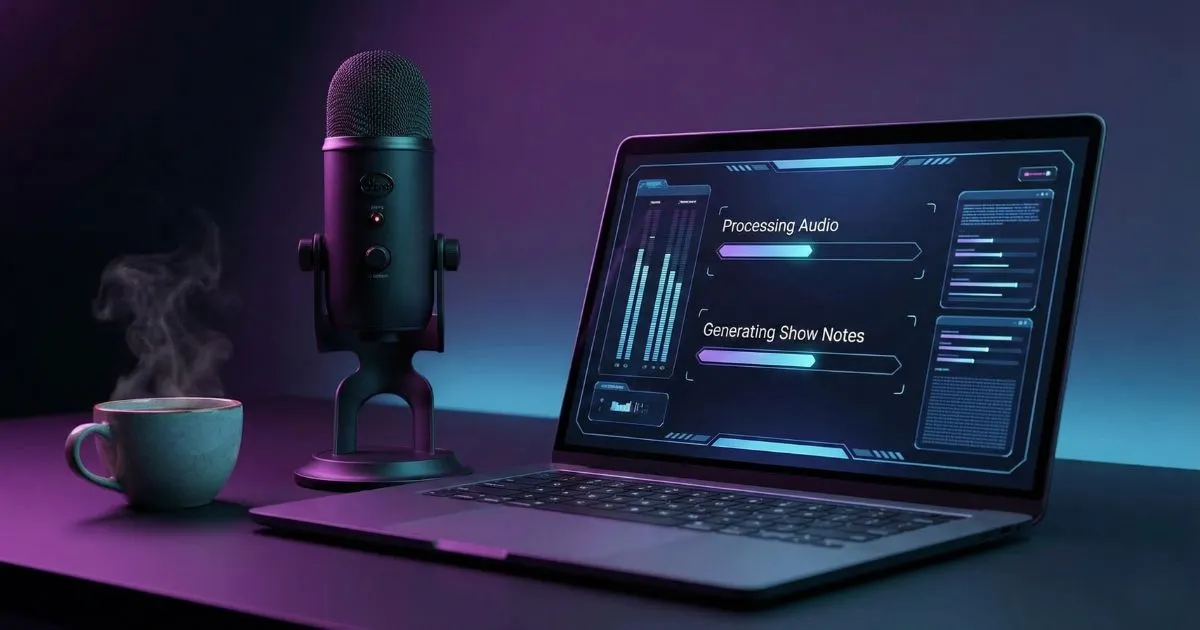
This is the bottleneck that breaks most creators. You have the audio file, but you need text. Show notes are essential for streamlining your entire SEO workflow with AI, and for providing value to listeners who want a recap, but writing them manually is a painful, slow process.
To use AI for podcasters effectively in this phase, the first step is non-negotiable: Get a Transcript. Tools like Otter.ai, Descript, or generic whisper models can generate a text file of your episode. Once you have that text, you can feed it into an LLM (Large Language Model) to do the heavy lifting.
SEO-Optimized Titles and Summaries
A great episode with a boring title will never get played. You are too close to the content to see the hook; AI is objective.
The Viral Title Generator:
"Analyze the attached transcript. Generate 10 engaging podcast episode titles. 5 should be 'How-to' focused for SEO, and 5 should be 'Curiosity-gap' focused for clicks. The target audience is [Insert Persona]. Keep them under 60 characters."
Comprehensive Show Notes
Your show notes need to look professional. They should include a summary, timestamps, and links. Doing this manually requires listening to the episode at least one more time (an hour lost). AI can do it in seconds.
The "Show Notes in Seconds" Prompt:
"Act as an expert copywriter. Using the provided transcript, write a set of show notes including:
- A compelling 2-paragraph summary of the episode.
- A bulleted list of 5 key takeaways.
- A 'Timestamped Chapter' list highlighting the most valuable moments (format: 00:00 - Topic).
- A list of all resources and books mentioned."
The SEO Boost
If you want your podcast to drive traffic to your website long-term, you need to rank for keywords. For a comprehensive strategy on how to make your podcast drive long-term organic traffic, our ROI-Driven Guide to AI for SEO covers every step.
The Keyword Extraction Prompt:
"Based on this transcript, identify the top 5 long-tail SEO keywords that this episode addresses. Write a meta-description for a blog post version of this episode that naturally includes these keywords."
By automating this phase, you transform a task that typically takes 2–3 hours into a 15-minute review process. You are no longer writing from scratch; you are simply editing and polishing. This is how you maintain quality while reclaiming your evening.
Phase 3: Promotion & Content Repurposing
You’ve likely heard the saying: "Create once, distribute forever." The problem is, distribution takes time. You see competitors like Gary Vaynerchuk or Alex Hormozi posting 10 times a day and wonder how they do it. The answer? They have massive teams.
You have AI.
For the complete framework on turning one podcast episode into a week of social media content, explore the Definitive Guide to AI for Social Media.
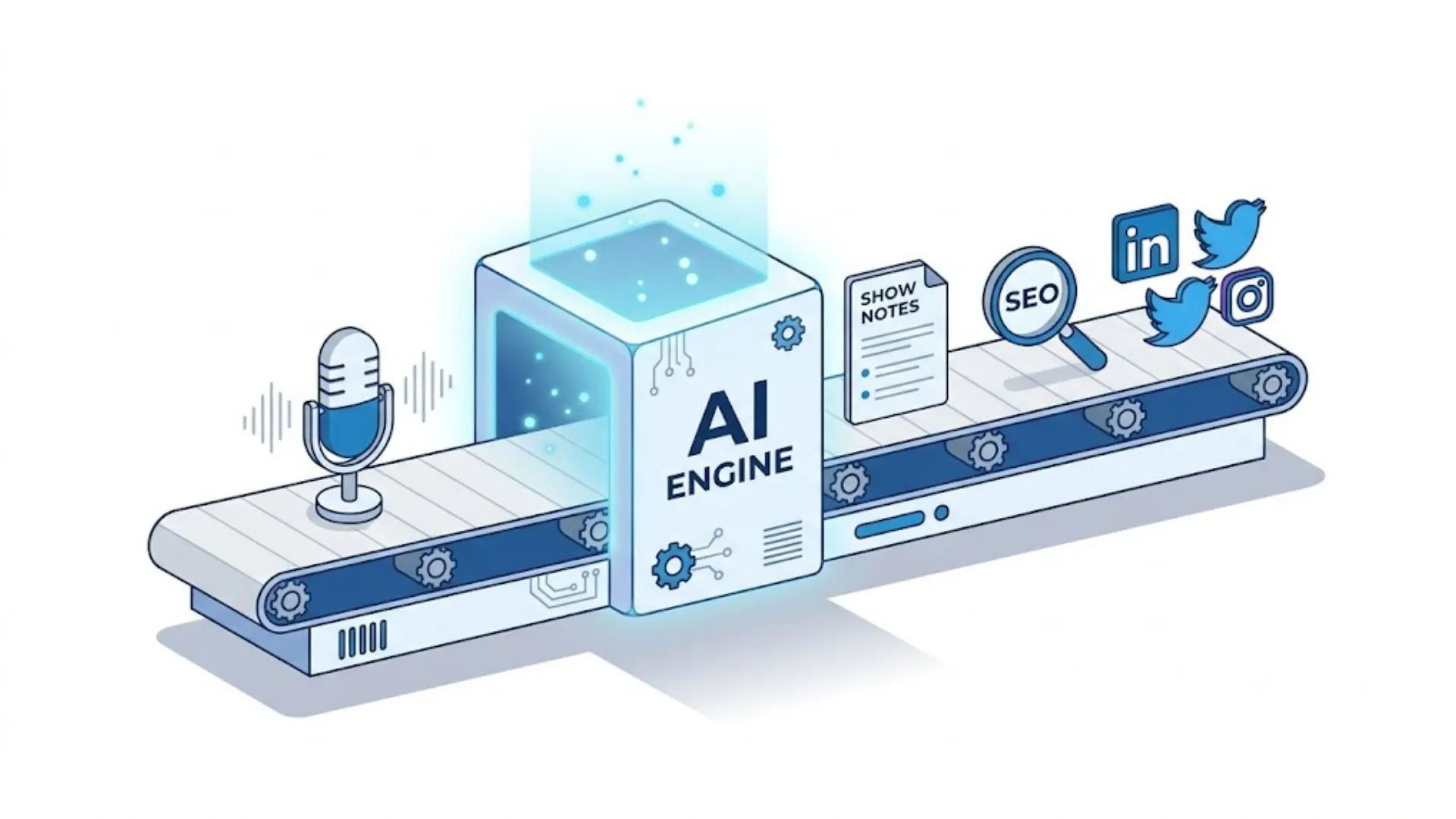
Your podcast episode is a "pillar" piece of content. From that single transcript, you can generate a week’s worth of social media posts. This is where AI for podcasters becomes a growth engine rather than just a production tool.
LinkedIn: The Authority Builder
For B2B creators, LinkedIn is the gold standard. But dumping a link to your episode in a post rarely works. You need to write a native post that delivers value within the feed.
The "Contrarian" LinkedIn Prompt:
"Read the transcript. Find a controversial or counter-intuitive point made in the episode regarding [Topic]. Write a LinkedIn post that challenges the status quo using that point. Hook the reader in the first line. Use short, punchy sentences. End with a question to drive engagement. Do not include the link until the first comment."
If LinkedIn is a core channel for your business, the AI Prompt System for LinkedIn gives you 50 pre-built prompts specifically crafted to grow authority and drive engagement on the platform.
Twitter/X Threads
Threads are excellent for breaking down complex topics. Your podcast is full of complex topics waiting to be simplified.
The "Value Thread" Prompt:
"Extract the step-by-step process discussed in this episode for [Result]. Turn this into a Twitter/X thread. The first tweet should promise a specific benefit. Use emojis sparingly but effectively."
The Newsletter Teaser
Your email list is your most valuable asset. You need to drive them to the audio, but you also want the email to stand on its own.
The Storytelling Email Prompt:
"Write an email newsletter to my subscribers promoting this episode. Start with a short personal story or analogy that relates to the episode's main theme. Then, transition into the 3 biggest lessons from the podcast. Subject line should be intriguing but not clickbait."
Short-Form Video Scripting
If you record video, you likely have clips. But you also need captions and hooks for TikTok or Reels.
The Viral Hook Script:
For a complete system built around TikTok and short-form video, the TikTok Prompt Playbook delivers 50 platform-specific prompts that remove the guesswork entirely.
"Identify the 3 most emotionally resonant or surprising moments in this text. Write a 'Hook' text overlay for a TikTok/Reel for each moment that would stop someone from scrolling."
By using these prompts, you ensure that your podcast doesn't just sit in a directory gathering dust. It becomes a content waterfall that feeds every marketing channel you have, keeping your brand top-of-mind without you having to stare at a blank cursor every morning.
Phase 4: Monetization & Outreach
Finally, let’s talk about growth. You want to scale this business. That means landing better guests and securing sponsors. This usually falls to the bottom of the to-do list because you are too busy editing. Once you automate production, you have time for this.
Sponsorship Pitches
Cold emailing potential sponsors is daunting. AI can help you frame your value proposition clearly.
The "ROI-Focused" Sponsor Pitch:
"I want to pitch [Company Name] to sponsor my podcast. My audience is [Demographic] who are interested in [Interests]. Write a concise, professional cold email explaining why their product is a perfect fit for my listeners. Focus on the ROI for them, not just 'supporting the show.'"
Guest Outreach
Want to land a "reach" guest? You need a personalized invite that proves you know who they are.
The High-Profile Invite:
"Draft an invitation email to [Name]. Mention their recent work on [Project] and explain specifically why my audience needs to hear their perspective on [Topic]. Keep it respectful of their time and offer flexible recording options."
Conclusion: From Overworked to Outstanding
Podcasting is one of the most powerful ways to build authority and trust with your audience. But for too long, the "production tax" has kept small business owners stuck in the weeds, unable to leverage the medium effectively.
You don't need a team of ten to sound like a media empire. You just need a system.
By integrating these AI for podcasters workflows, you are doing more than just saving time. You are:
- Improving Quality: Better research leads to better interviews.
- Increasing Reach: Strategic SEO and repurposing gets you found.
- Reducing Stress: Moving from a chaotic scramble to a calm, automated process.
The technology is here. The prompts are ready. The only variable left is whether you will continue to hustle harder, or start scaling smarter.
Ready to fully automate your podcast workflow?
Not ready to invest yet? Start with our free resources — grab your free AI prompts and resources, including time-saving templates, prompt frameworks, and content planning tools.
Or if you're ready to go all-in, see all 30 industry-specific prompt packs and pricing — one-time access, no subscriptions.
Don't waste time testing hundreds of prompts to see what works. We’ve packaged the exact frameworks used by top-tier pros into one accessible toolkit.
Get the Expert AI Prompts for Podcast Pros Toolkit
Further Reading
• The Future of Podcasting: Interactive and AI-Enhanced
• Creator Burnout is Real: How to Offload Work to AI
• The Secret to Consistency: Batching Content with Prompts