Stop Posting Randomly: A Data-Driven Content Plan for Busy Owners
Stop Posting Randomly: A Data-Driven Content Plan for Busy Owners
Jan 31, 2026

Most small business owners post content when they find the time — a burst of activity one week, silence the next. The result is an inconsistent brand presence that confuses audiences and wastes hours of effort. A data-driven content strategy replaces guesswork with a repeatable system that saves time and drives compounding results. If you want the full framework for making this work with AI, the complete AI content creation playbook for small business covers every stage from content planning to automated publishing.
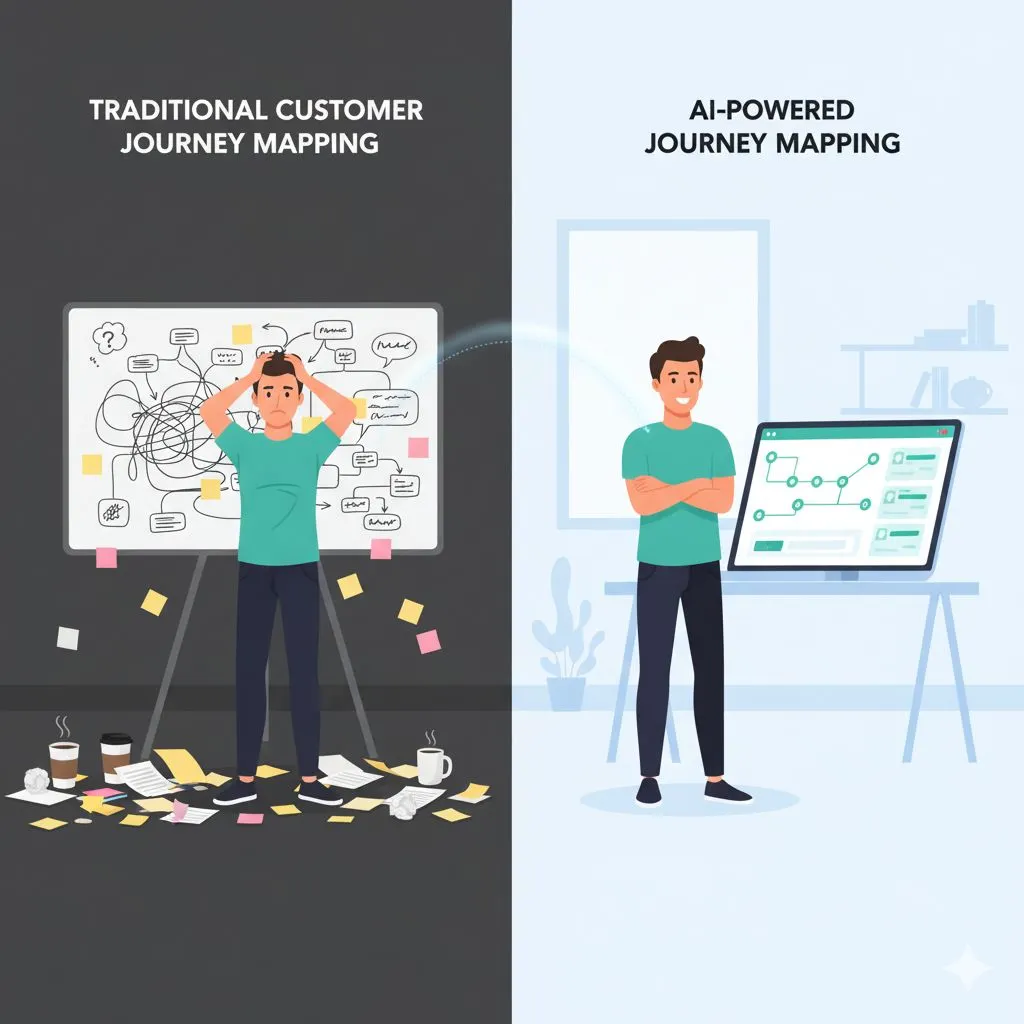
If you are like most small business owners, your relationship with content marketing is likely a mix of guilt and panic. You know you should be posting. You see your competitors dominating LinkedIn feeds and ranking on Google. You understand that visibility equals revenue.
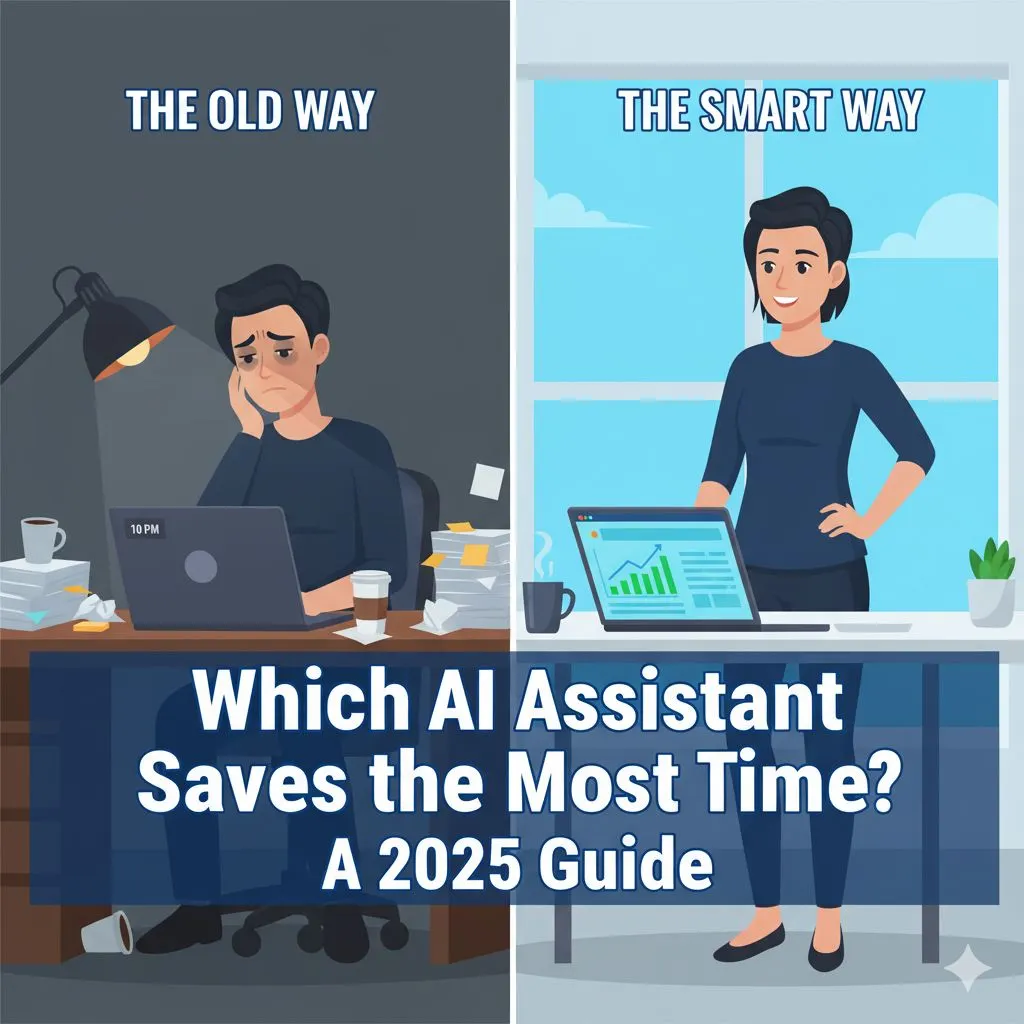
But the reality of your day-to-day operations tells a different story. You are managing client deliverables, putting out fires in operations, and trying to keep the cash flow positive. Marketing usually happens in the frantic margins of your day—a hastily written LinkedIn post at 8:00 PM or a generic blog update squeezed in between meetings.
This is what we call "Random Acts of Content."
It feels like work, but it rarely moves the needle. It generates activity, not leverage.
The solution isn't to work harder or hire an expensive agency you can’t afford yet. The solution is to stop operating as a frantic content creator and start thinking like a content strategist. By implementing a data-driven AI content strategy, you can reclaim your time, elevate your brand authority, and compete with players ten times your size.
The AI Advantage: Strategy Over Syntax
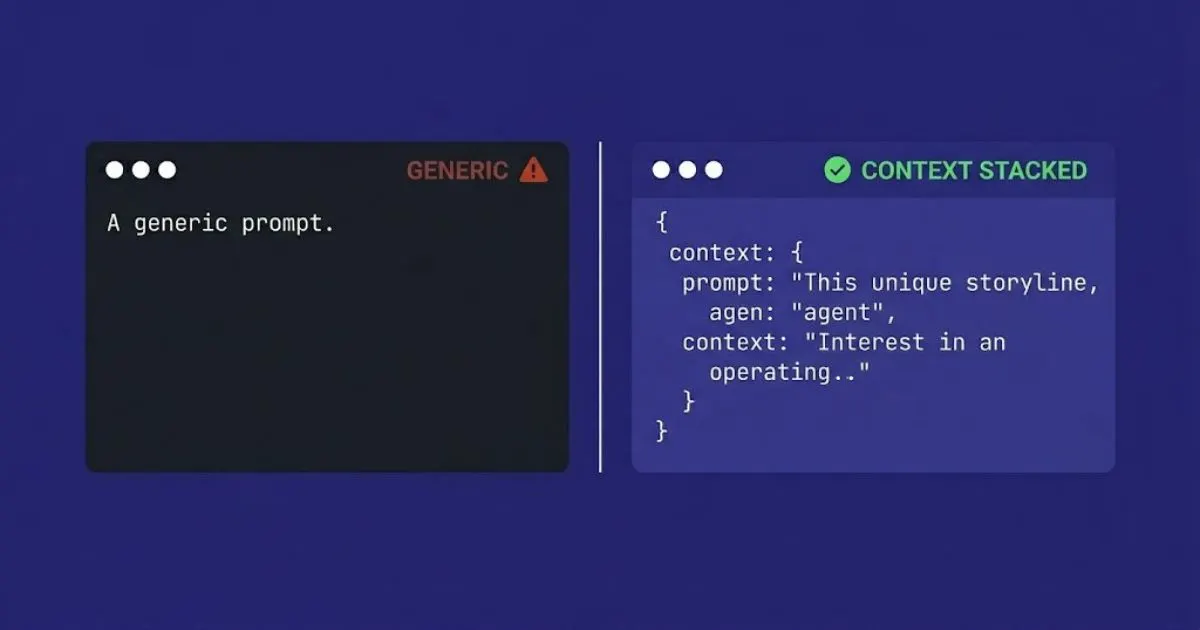
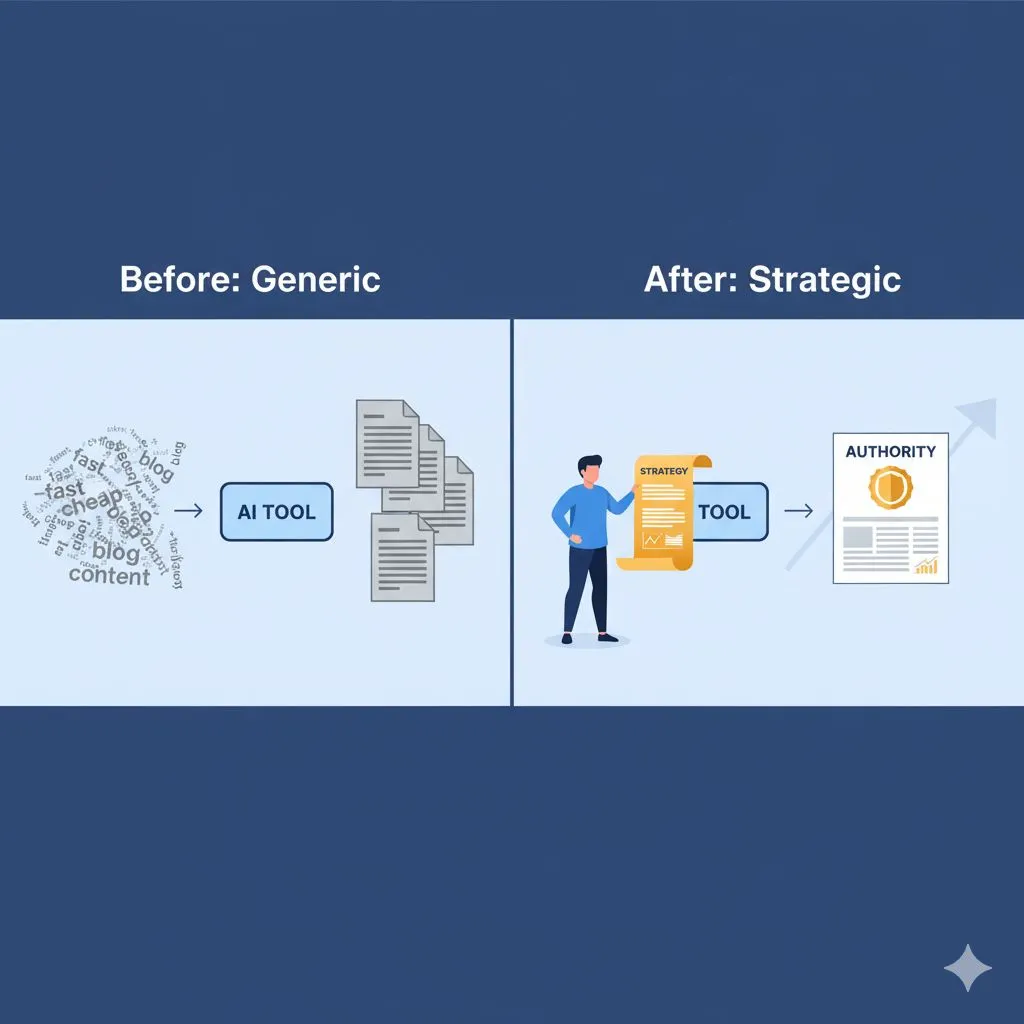
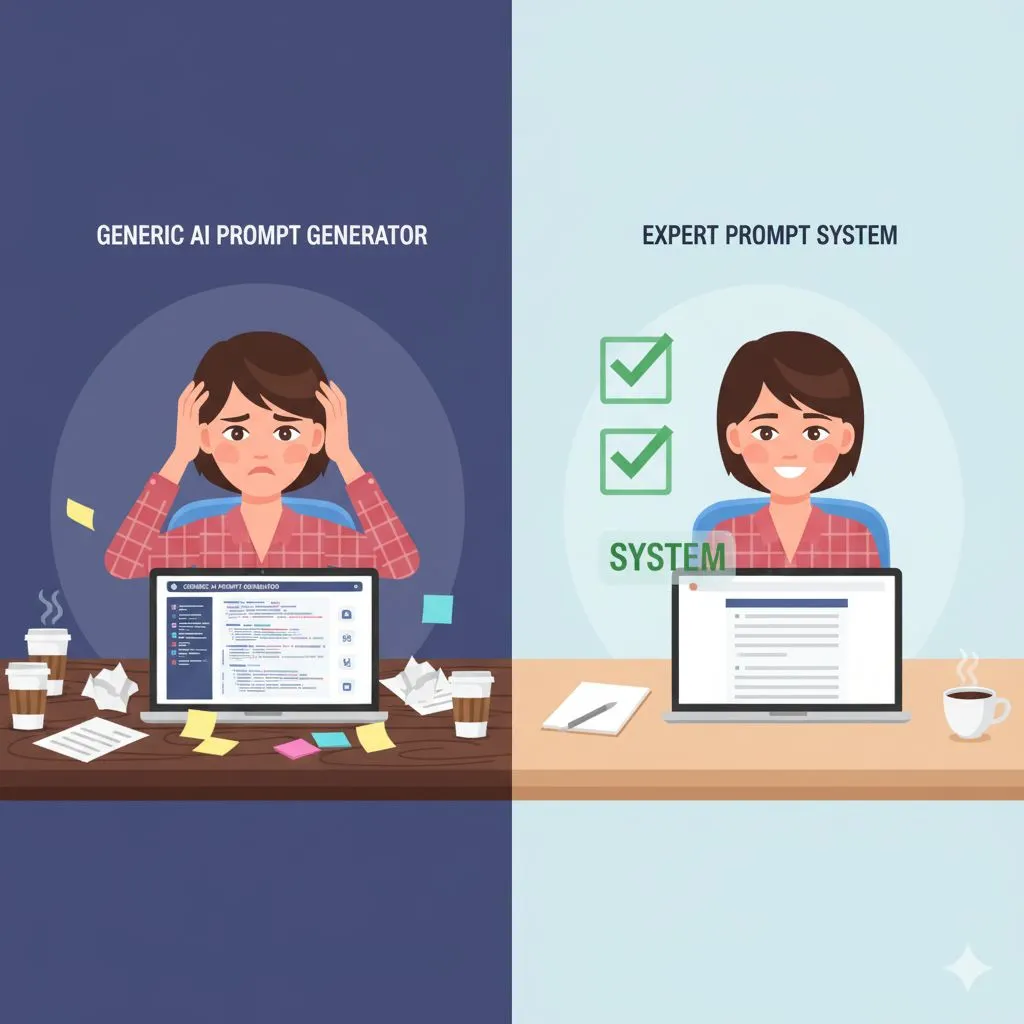
Most entrepreneurs use AI incorrectly. They treat tools like ChatGPT or Claude as junior copywriters, tossing in a generic command like "Write me a post about leadership" and hitting publish.
The result? Bland, robotic content that damages your credibility.
A true AI content strategy doesn't just use AI to write words; it uses AI to think, plan, and structure. It treats AI as a data analyst and a strategic partner.
When you shift your mindset, the benefits are immediate:
- Predictability: You stop wondering what to post.
- Efficiency: You reduce a 10-hour workflow to 2 hours.
- Authority: You produce deep, insightful content that positions you as an expert, not a commodity.
Phase 1: The Diagnosis – Stop Guessing, Start Analyzing
Before generating a single headline, you must audit your current situation. Random posting usually stems from a lack of clarity on who you are talking to and what actually drives business.
1. Identify Your Bottlenecks
Where are you currently losing the war for attention?
- The Ideation Gap: You stare at a blank screen for 20 minutes wondering what to say.
- The Production Drag: You have an idea, but writing it takes three hours you don't have.
- The Quality Drop: You rush the content, and it comes out looking amateurish.
AI can help solve all three, but only if you have a plan.
2. Reverse-Engineer the Market
You don’t need to reinvent the wheel. Your competitors—or the industry leaders you admire—have already validated what works.
Actionable AI Tactic:
Instead of guessing, use AI to analyze high-performing content in your niche. You can feed an AI tool three or four successful articles or posts from your industry and ask:
"Analyze these three articles. What are the common themes? what is the tone? What pain points are they addressing? Based on this, suggest 5 counter-intuitive angles that would appeal to the same audience but offer a fresh perspective."
This moves you from "copying" to "innovating" based on data.
3. Define Your "Power Pillars"
To build authority, you cannot be a generalist. You need "Power Pillars"—3 to 4 core topics that strictly relate to your revenue streams. If you run a digital marketing agency, your pillars shouldn't be "generic business tips." They should be:
- Lead Generation Systems (The "How-To")
- Marketing Automation (The "Efficiency")
- ROI Measurement (The "Business Case")
- Agency Culture (The "Human Element")
If a content idea doesn't fit into one of these pillars, you don't write it. This discipline is the first step in a successful AI content strategy.
Phase 2: Building the Engine – The AI Content Strategy Workflow
Now that we have established the strategy, we need to build the engine. For a busy owner like you (let's call you Alex), the goal is not to spend all day prompting AI. The goal is to build a system that runs smoothly.
Step 1: Deep-Dive Audience Research
The biggest mistake in marketing is solving problems your customers don’t know they have. To write content that converts, you need to enter the conversation already happening in your prospect's head.
AI excels here. It can simulate your customer persona with frightening accuracy.
The Strategy:
Don't just ask AI for demographics. Ask for psychographics.
"Act as a busy small business owner with a team of 5. You are stressed about scaling and feel limited by your budget. List your top 10 waking-worry thoughts regarding business growth. What are the specific phrases you use when complaining to a friend about your workload?"
The output from this prompt gives you the exact language your customers use. You can then infuse this language into your content, making your readers feel like you are reading their minds. This builds instant trust—a currency more valuable than traffic.
A proper AI workflow audit changes this immediately. For a practical, step-by-step implementation approach, how to build an AI content workflow step by step, gives you a 1-day system to automate your blog content production.
Step 2: The "Endless Ideation" System
Writer's block is usually just a lack of data. Once you have your Power Pillars and your Audience Research, you can use AI to generate a quarter’s worth of ideas in under 20 minutes.
Content pillars are the backbone of any data-driven plan — without them, every piece of content exists in isolation. To map yours in less than an hour, download the free content pillar planner for AI-powered strategy — it is the fastest way to move from random posting to structured publishing.
The Matrix Method:
Create a grid. On the Y-axis, list your 4 Power Pillars. On the X-axis, list 5 "Content Angles":
- The Mistake: Common errors in the industry.
- The How-To: A step-by-step tutorial.
- The Contrarian: Why the popular advice is wrong.
- The Case Study: A real-life example of success/failure.
- The Prediction: Where the industry is going.
Feed this matrix to your AI tool.
"I have 4 content pillars: [List Pillars]. Please generate 5 unique content headlines for EACH pillar using these angles: Mistake, How-To, Contrarian, Case Study, Prediction. Total of 20 headlines."
You now have 20 high-quality, strategic ideas. If you post twice a week, that is 10 weeks of content, generated in 5 minutes.
The goal is not to produce more content — it is to produce the right content with less effort. AI-powered scheduling, repurposing, and prompt-led drafting all play a role here. Done correctly, AI-driven marketing automation done right outlines how to integrate automation without losing your brand voice.
Step 3: Structure Before Syntax
Here is where the "Expert" part of Expert AI Prompts comes in. Do not ask the AI to "write the blog post" yet. If you do, it will ramble.
Instead, ask for an outline.
"Create a comprehensive outline for a 1,000-word guide based on the headline '[Insert Headline]'. The structure should include a hook, 3 main arguments with supporting data points, and a conclusion with a clear call to action. Focus on actionable advice, not fluff."
Review the outline. Does it make sense? Is it logical? Does it provide value?
You—the human strategist—approve the skeleton. Only then do you ask the AI to put meat on the bones. This ensures the content follows your logic, not the AI’s random prediction patterns.
A content plan is only as good as the prompts feeding it. Generic ChatGPT prompts produce generic blog posts. If you publish a blog as part of your content strategy, the prompt-engineered blogging toolkit gives you 50 prompts built specifically for small business bloggers — from ideation and drafting to SEO optimisation and repurposing.
Phase 3: The Quality Filter – Protecting Your Brand Authority
Efficiency is meaningless if the output destroys your reputation. We have all seen "ChatGPT-ese"—those LinkedIn posts that start with "In the fast-paced world of digital marketing..." and end with "In conclusion, it is important to remember..."
That kind of content signals to your potential clients that you are lazy or out of touch. As a business owner competing with larger players, your brand voice is your differentiator. You cannot afford to sound like a robot.
The "Generic Fluff" Danger Zone
Generic AI content fails because it lacks nuance and opinion. AI creates the average of the internet. It plays it safe. It avoids strong stances.
To combat this, your AI content strategy must include a rigorous quality control filter.
The Human-in-the-Loop Protocol
You are the pilot; AI is the autopilot. You must be in the cockpit.
1. Injecting Experience:
AI cannot hallucinate your personal experience. You must provide it.
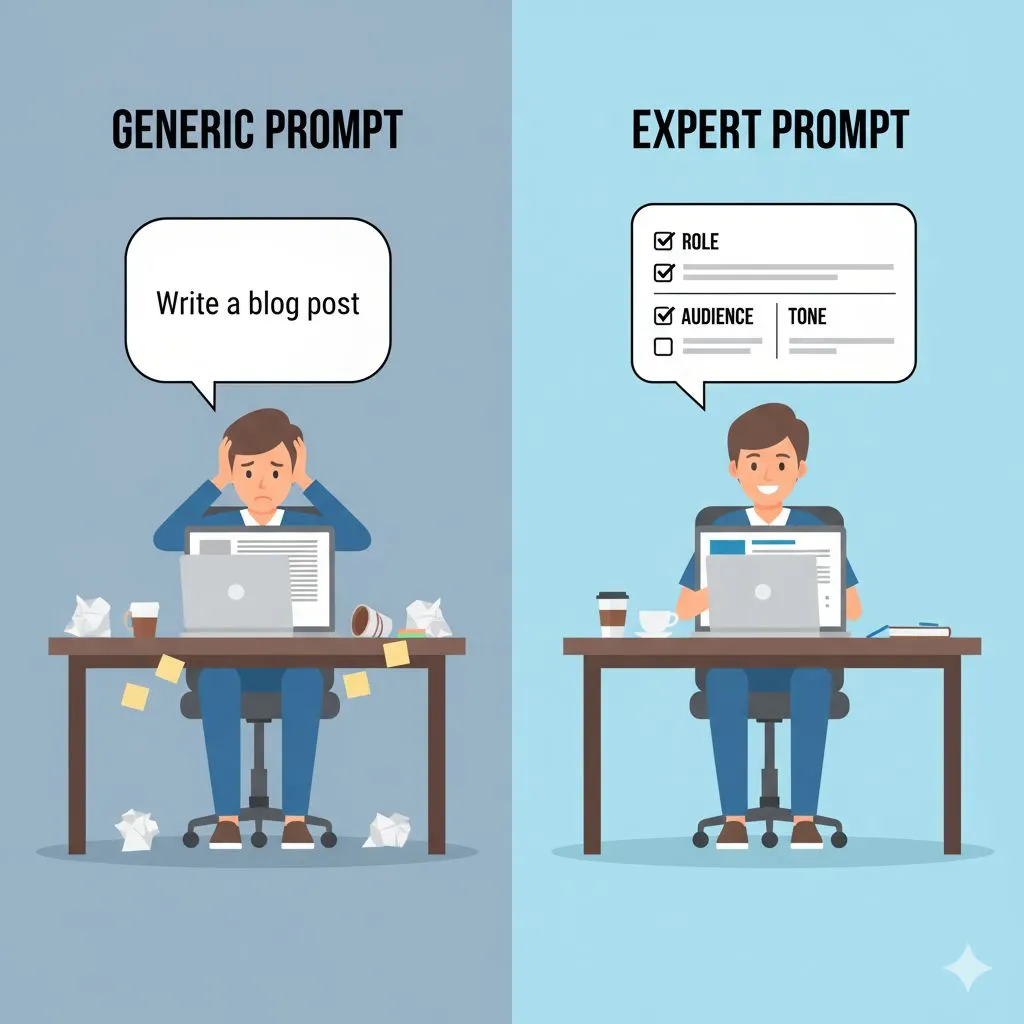
- Bad Prompt: "Write a post about client management."
- Good Prompt: "Write a post about client management. Include a specific anecdote where a project went wrong because of poor communication, and explain how setting boundaries upfront fixed it. Use a tone that is professional but vulnerable."
2. The "So What?" Test:
Read every paragraph the AI generates. After each section, ask yourself: "So what?"
- If the AI says: "Efficiency is key to business growth." (Boring. Obvious.)
- Change it to: "If you can't deliver your service without working 60 hours a week, you don't have a business; you have a low-paying job." (Punchy. Insightful.)
Injecting Brand DNA
You need to train the AI on your voice. If you are naturally sarcastic, or strictly formal, or warm and encouraging, the AI needs to know.
The "Voice Context" Prompt:
Before starting a session, prime the AI:
"Adopt the persona of Alex Rivers. My tone is direct, pragmatic, and ambitious. I use short sentences. I despise corporate jargon. I focus on ROI and efficiency. Critique the following text and rewrite it to match this tone."
This simple step transforms generic text into brand assets. It turns a "robot" into a "staff writer" that understands your style guide.
Phase 4: The Execution – Batching and Scaling
You have the strategy. You have the quality control. Now, how do you actually get this done without spending your life in front of a screen?
The secret to scaling is Batching and Repurposing.
The "One-to-Many" Method
The most efficient content strategy is the "Waterfall Method." You create ONE core piece of long-form content (like a blog post, a YouTube video script, or a detailed newsletter), and then use AI to chop it up into micro-content.
The Workflow:
- The Hero Piece: Write a high-value, 1,200-word guide on a specific pain point in your industry.
- The Splintering: Feed that guide into your AI tool.
- "Turn Section 1 of this guide into a LinkedIn carousel script."
- "Summarize the key takeaways into a Twitter/X thread."
- "Extract 3 quote-worthy sentences for Instagram graphics."
- "Write a teaser email for my newsletter linking to this guide."
Suddenly, one hour of work becomes two weeks of social media posts across every platform. You appear omnipresent to your audience, but you only did the "heavy lifting" once.
Want the full workflow, not just the plan? Explore the Implementation & How-To Guides for AI content — a complete library of step-by-step playbooks for automating your content engine.
Building a Monthly Content Calendar in an Afternoon
Here is the challenge for you, the busy owner: Stop trying to post every day. Start planning once a month.
Block out four hours on the first Sunday of the month.
- Hour 1: Review your "Power Pillars" and run the "Endless Ideation" prompts. Select your topics.
- Hour 2: Generate outlines for your Hero Pieces.
- Hour 3: Draft the Hero Pieces (using AI to speed up the drafting, then editing for voice).
- Hour 4: Run the "One-to-Many" prompts to generate your social captions.
Load everything into a scheduler. You are now done with marketing for the month.
Automation vs. Authenticity
A final word of caution: You can automate the posting, and you can accelerate the writing, but you cannot automate the engagement.
Use the time you saved on creation to actually talk to people in the comments. That is where the sales happen. Your AI content strategy buys you the freedom to be human where it counts.
Conclusion
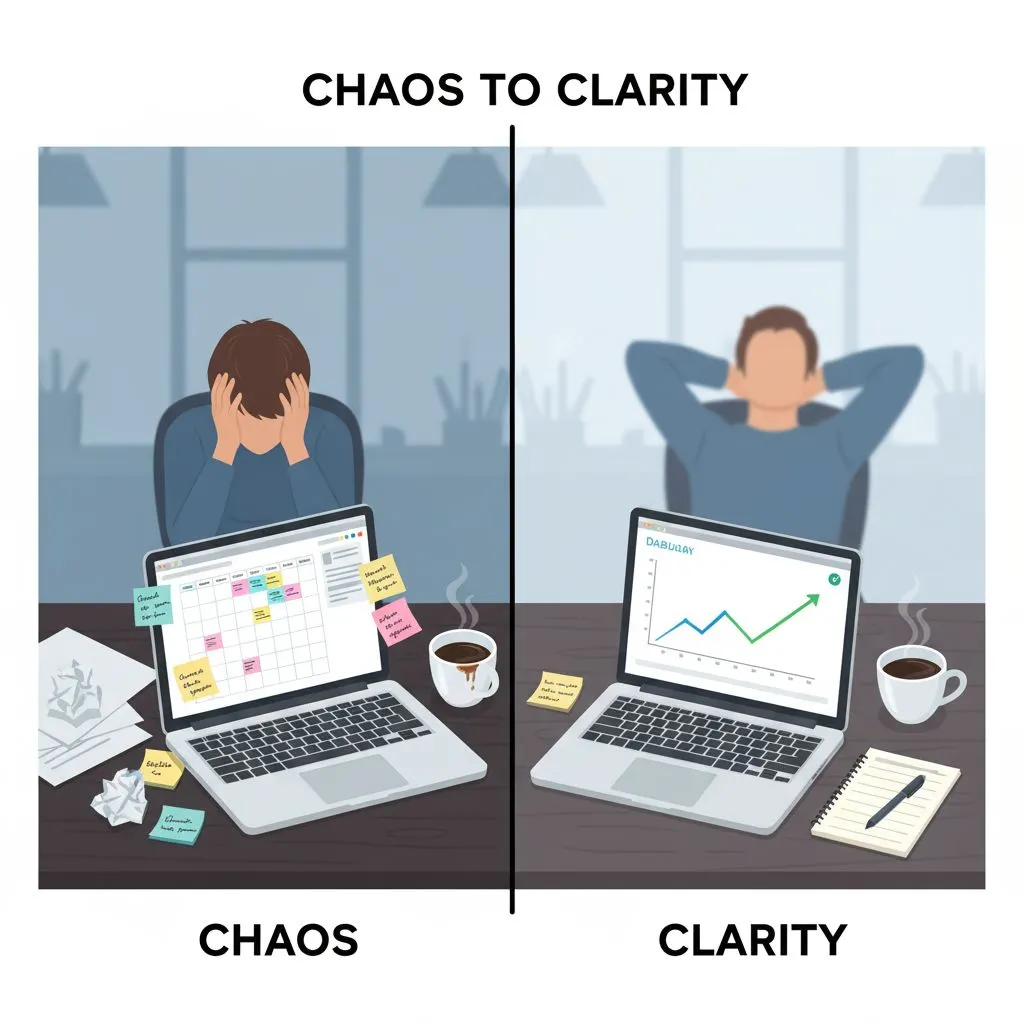
The difference between a stressed business owner and a scaling entrepreneur is often the systems they build. If you are posting randomly, you are relying on luck. If you build a data-driven content plan, you are relying on strategy.
You don't need a massive team. You don't need an unlimited budget. You just need to stop viewing AI as a toy and start using it as the lever that lifts your business to the next level.
Stop hustling harder. Start strategizing smarter.
Ready to stop spinning your wheels?
We have done the heavy lifting for you. We created a structured, plug-and-play template designed to get your strategy sorted in under an hour.
Download Your Free 1-Week Content Plan Template + AI Prompts Here
A data-driven content plan is not a luxury reserved for big marketing teams — it is the system that separates consistent, growing brands from those that fade out mid-year. The tools, prompts, and frameworks you need are already available.
Start free: grab your free AI content tools and templates — 11 ready-to-use resources including a content plan, a content pillar planner, and a prompt framework guide.
Ready to go further? See all 30 industry-specific prompt packs — built for busy owners who want expert-level content without the trial and error.
Further Reading
• The Small Business Playbook for AI Content Creation — the complete strategic guide for content-focused entrepreneurs
• Your Complete AI Marketing Strategy Guide — move from content tactics to a full integrated marketing system
• AI Content Strategy: Expert Prompts Blueprint — implementation roadmap for building a prompt-led content system
• The 1-Day Workflow to Automate Blog Content with AI — step-by-step for time-poor business owners