The ROI of AI: How to Calculate Time Saved vs. Tool Costs
The ROI of AI: How to Calculate Time Saved vs. Tool Costs
Jan 30, 2026
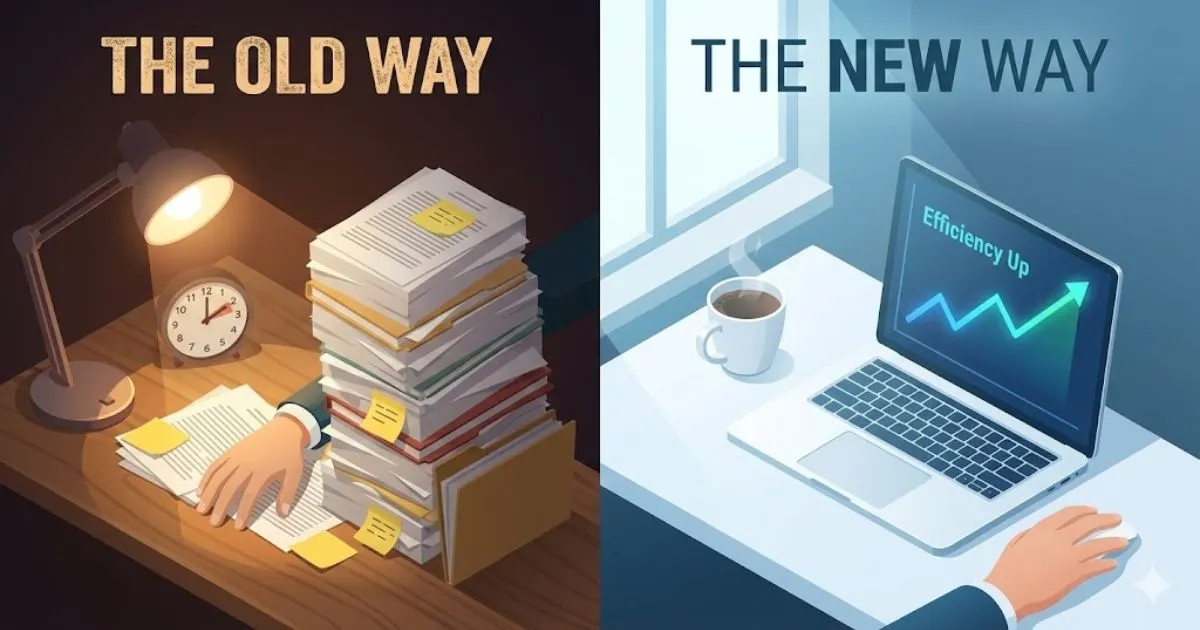
If you are like most small business owners, your to-do list is a mile long, and your workday often bleeds into your personal time. You are the CEO, the marketing director, the customer support lead, and the cleaner. You know you need to scale, but you are stuck in the "hustle trap"—working in your business rather than on it.
You’ve heard the hype about Artificial Intelligence. You’ve seen the headlines claiming it changes everything. But you’re also a realist. You’ve subscribed to software before that promised to save the world, only to have it sit unused, draining your bank account $29 at a time. Skepticism is healthy. In fact, it’s necessary for survival.
However, viewing AI purely as a "cost" is a strategic error that keeps smaller players small. To compete with larger agencies and bigger teams without hiring more staff, you must shift your perspective. You need to look at ai cost savings not just in terms of dollars saved, but in leverage gained.
This guide isn’t about convincing you to buy more tech. It’s about doing the math. We are going to calculate the Return on Investment (ROI) of AI so you can decide, with data, whether it’s a distraction or the leverage you’ve been waiting for.
Establishing Your Baseline: What Is Your Hour Actually Worth?
Before we can calculate savings, we need to know what you are "spending" right now. The currency of a solopreneur or small business owner is time.
Most entrepreneurs vastly undervalue their time. You might think, "Well, if I write this blog post myself, it’s free." That is the most expensive lie in business. If you spend three hours writing a blog post, you have spent three hours not doing business development, not refining your product strategy, and not resting so you can perform better tomorrow.
The Replacement Cost Calculation
To get a real baseline, you need to determine your Effective Hourly Rate. There are two ways to look at this:
- The Revenue Model: If your business generates $20,000 a month and you work 160 hours, your time is worth $125/hour. See how solopreneurs benchmark and calculate their AI productivity ROI.
- The Replacement Model: If you had to hire a consultant to do your job (strategy, branding, high-level decisions), what would they charge? Likely $200+ per hour.
Let’s be conservative and say your time is worth $100/hour. Every time you spend an hour struggling with a caption or formatting a document, you are effectively writing a check for $100. If a task takes you 10 hours a week, that’s a $4,000 monthly expense in "founder time."
Identifying Low-Value Tasks
The goal of AI isn't to replace you; it's to replace the low-value tasks that clog your schedule. Drafting emails, brainstorming blog topics, resizing images, and checking grammar are necessary tasks, but they are not $100/hour tasks. They are bottlenecks.
The True Cost of AI Adoption (It’s Not Just the Subscription)
To calculate ROI fairly, we have to be honest about the costs. A standard AI setup for a small business usually involves a few key tools.
The Sticker Price
- LLM Subscription (e.g., ChatGPT Plus): ~$20/month.
- Image Generation (e.g., Midjourney): ~$10–$30/month.
- Expert Prompt Libraries: ~$50–$100 (one-time).
Let’s estimate a monthly "AI Tech Stack" cost of roughly $50 to $70.
The "Fiddle Factor"
This is where most ROI calculations fail. The subscription is cheap, but the learning curve is expensive. If you spend 5 hours trying to get ChatGPT to sound like your brand and it still sounds like a robot, you haven't saved money. You’ve lost $500 of your time plus the subscription cost.
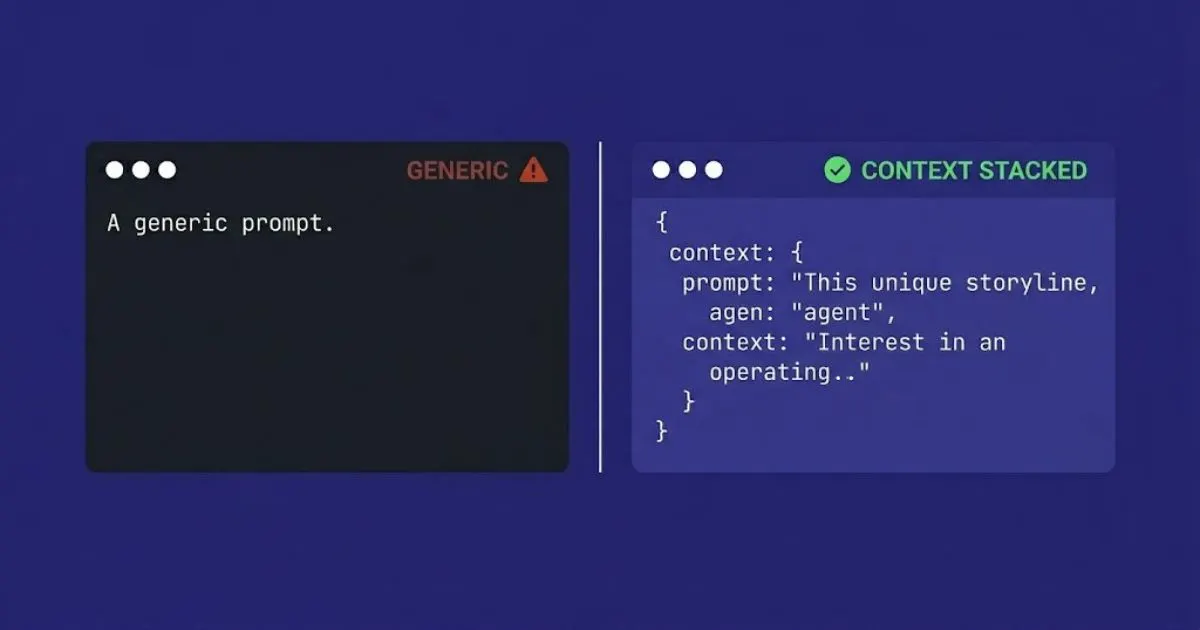
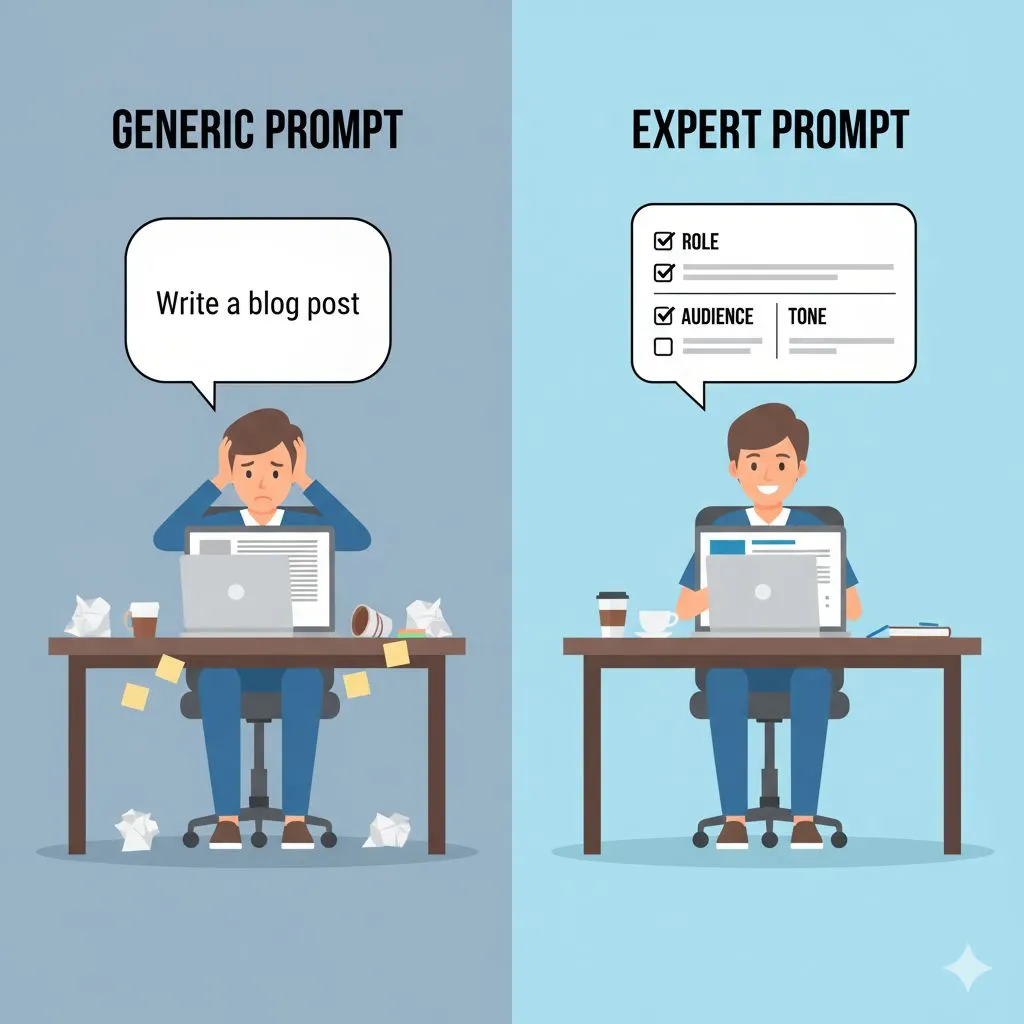
This is the "complexity objection" many business owners face. AI is powerful, but only if you can control it. This is why "raw" AI often fails for small businesses. Without structured, proven inputs (prompts), the output is generic. To ensure positive ROI, you must minimize the "fiddle factor." This is where investing in pre-built, industry-specific prompt packs changes the math. By removing the trial-and-error phase, you turn a 60-minute "prompt engineering" struggle into a 5-minute copy-paste execution.
Calculating Hard Savings: The Direct Math
Now, let’s look at the hard numbers. AI cost savings come from two places: reducing external costs (hiring) and reducing internal costs (time).
Agency vs. AI
If you currently outsource content creation, the savings are immediate and massive.
- Freelance Blog Post: $150–$300 per post.
- Social Media Manager (Part-time): $1,000–$2,000/month.
If AI allows you to bring 80% of this in-house without adding hours to your week, the ROI is infinite because you are eliminating a cash outflow entirely.
Speed of Execution
Let's assume you do the work yourself.
- Task: Write a comprehensive industry guide (1,500 words).
- Manual Method: Research (2 hours) + Drafting (3 hours) + Editing (1 hour) = 6 Hours.
- Cost: 6 hours x $100 = $600.
Now, apply the Expert AI method using a structured prompt workflow:
- AI Method: Strategy/Prompting (15 mins) + AI Generation (5 mins) + Human Review/Polishing (40 mins) = 1 Hour.
- Cost: 1 hour x $100 = $100.
The Result: You saved $500 on a single piece of content. Even if you pay $70/month for tools, you are in the green after the very first project.
Want to skip the guesswork entirely? Download the free AI ROI Calculator for Small Business and see your specific numbers in under 5 minutes.
The Opportunity Cost: What Could You Be Doing Instead?
Hard savings are great, but for the ambitious entrepreneur, opportunity cost is where the real growth happens.
When you reclaim 10 hours a week using AI, you don't just "save" that time—you reinvest it.
- Strategy: Instead of writing emails, you are designing a new sales funnel.
- Client Experience: Instead of drafting reports, you are on a Zoom call deepening a client relationship.
- Scale: Instead of managing one marketing channel poorly, you are managing three channels effectively because the content production is automated.
From Operator to Strategist
The biggest barrier to scaling a 2-person team to a 10-person team is the founder getting stuck in the weeds. AI provides the leverage to escape the weeds. It allows you to produce expert-level work at a volume that usually requires a full team. This builds brand authority. When your audience sees consistent, high-value content, they assume you are a larger, more capable entity. That perception drives higher-ticket sales.
Sanity is a Metric
We cannot ignore the human element. Burnout is the enemy of ROI. If AI allows you to shut your laptop at 5:00 PM instead of 9:00 PM, the reduction in stress improves your decision-making capabilities the next day. A rested business owner makes fewer mistakes and spots more opportunities.
Case Study: The Content Marketing Workflow
Let's pull this all together into a concrete monthly scenario for "Alex," a digital consultant.
The Goal: Alex needs to maintain visibility to get leads.
- 4 Educational Blog Posts.
- 12 LinkedIn Thought Leadership Posts.
- 1 Monthly Newsletter.
Scenario A: The "Grind" (Manual)
- Blogs: 4 x 4 hours = 16 hours.
- LinkedIn: 12 x 45 mins = 9 hours.
- Newsletter: 3 hours.
- Total Time: 28 hours/month.
- Total Cost ($100/hr): $2,800.
Scenario B: The Expert AI Workflow
Alex uses a specific "Blog Post Generator" prompt and a "LinkedIn Authority" prompt from a trusted pack.
- Blogs: 4 x 45 mins (review/edit) = 3 hours.
- LinkedIn: 12 x 10 mins = 2 hours.
- Newsletter: 45 mins.
- Total Time: 5.75 hours/month.
- Total Cost ($100/hr): $575.
- Tool Cost: $70 (Software + Prompts).
The Final Calculation:
- Old Cost: $2,800
- New Cost: $645 ($575 time + $70 tools)
- Net Monthly Savings: $2,155
- Time Reclaimed: 22.25 Hours
That is over 20 hours a month given back to Alex. That is almost three full workdays. What could you do with three extra days every month? That is the ROI of AI.
Results like Alex's are documented across multiple industries. Explore the Expert AI Prompts Case Studies hub to see real numbers from real businesses.
Conclusion
The numbers don't lie. While skepticism is a natural defense mechanism for business owners protecting their resources, the math proves that avoiding AI is actually the more expensive choice. The cost of "business as usual"—of manual drafting, slow workflows, and missed opportunities—far outweighs the cost of the tools.
However, the key takeaway is that the tool alone isn't the magic bullet; the process is. To achieve these ai cost savings, you need to minimize the "fiddle factor" and maximize output quality. You need systems, not just software.
When you equip yourself with expert-level prompts and a clear strategy, you stop competing on hours worked and start competing on value delivered. You move from the overworked operator to the confident strategist.
Don't just guess how much time you could save. See the exact numbers for your specific industry and workflow.
Not ready to commit to a full pack yet? Explore our 11 free AI prompt resources and get expert-level results before spending a cent.
When you are ready to scale, see all 30 industry-specific prompt packs and pricing and choose the pack built for your industry.
Calculate Your Potential Savings Now with the AI ROI Calculator for Small Business