Packaging Your Knowledge: AI Frameworks for Digital Products
Packaging Your Knowledge: AI Frameworks for Digital Products
Apr 05, 2026

Introduction: The Bottleneck of the Service-Based Business
You are likely working harder than ever, yet the needle isn't moving as fast as it should. If you are a small business owner, consultant, or agency leader, you know the daily reality of the ten-hour workday. You are juggling client delivery, marketing, business development, and putting out operational fires, leaving almost zero time for high-level strategy. You have built a successful business based on your unique skills, but you have also built a cage. When your revenue is strictly tied to the hours you or your small team can physically work, you hit a growth ceiling. You cannot scale past your calendar.
The traditional advice is to hire more staff. But hiring brings overhead, management complexities, and increased financial stress—often the exact opposite of the freedom you started your business to achieve. The modern, sustainable way to scale is to decouple your income from your time. To do this, you must learn to monetize domain expertise.
Monetizing your expertise means taking the frameworks, strategies, and solutions you deliver 1:1 to clients and packaging them into digital products that can be sold 1:many. This transition is how you shift from an overworked operator stuck in the weeds to a confident strategist leading a scalable, competitive business. However, the prospect of creating a digital product—an eBook, a playbook, a course, or a template system—feels like yet another massive project added to an already overwhelming workload.
This is where artificial intelligence, when applied strategically, changes the game. Generic AI tools might spit out fluffy, unreliable text, but structured AI frameworks can do the heavy lifting of extracting, organizing, and polishing your expertise into a high-value asset. This guide will walk you through a proven framework to package your knowledge efficiently, allowing you to reclaim your time, elevate your brand credibility, and build a sustainable revenue stream.
Section 1: The Productization Mindset
Before you can package your knowledge, you have to change how you view it. Service providers are used to customizing every solution. A client comes in with a problem, and you create a bespoke strategy to solve it. This is highly valuable, but it is not scalable. Productization requires you to find the common denominators in your work.
Think about the questions you answer every single week. Think about the processes you walk every new client through. Think about the specific bottlenecks you solve time and time again in your industry. That repetitive problem-solving is your intellectual property (IP). It is the raw material for a highly profitable digital product.
Most digital products created by solopreneurs fail for two reasons. First, they lack strategic structure; they are just a collection of random tips rather than a step-by-step solution. Second, they take too long to create, causing the creator to burn out halfway through or rush the final output, resulting in a product that damages their brand credibility rather than elevating it.
To successfully monetize domain expertise, you must adopt a framework approach. You are not writing a novel; you are building a tool. Your customers do not want more information; they want transformation. They want a shortcut to the result you have already mastered. When you view your knowledge as a system rather than a fluid, customized service, it becomes much easier to package.
The obstacle, of course, is getting that system out of your head and onto the screen. Staring at a blank document is paralyzing when you are already low on time and energy. This is where strategic AI intervention becomes your greatest competitive advantage. By using highly specific, industry-calibrated prompts, you can turn an AI assistant into a sounding board, an interviewer, and an executive editor, cutting the product creation timeline from months to a matter of days.
Section 2: The AI Knowledge Extraction Framework
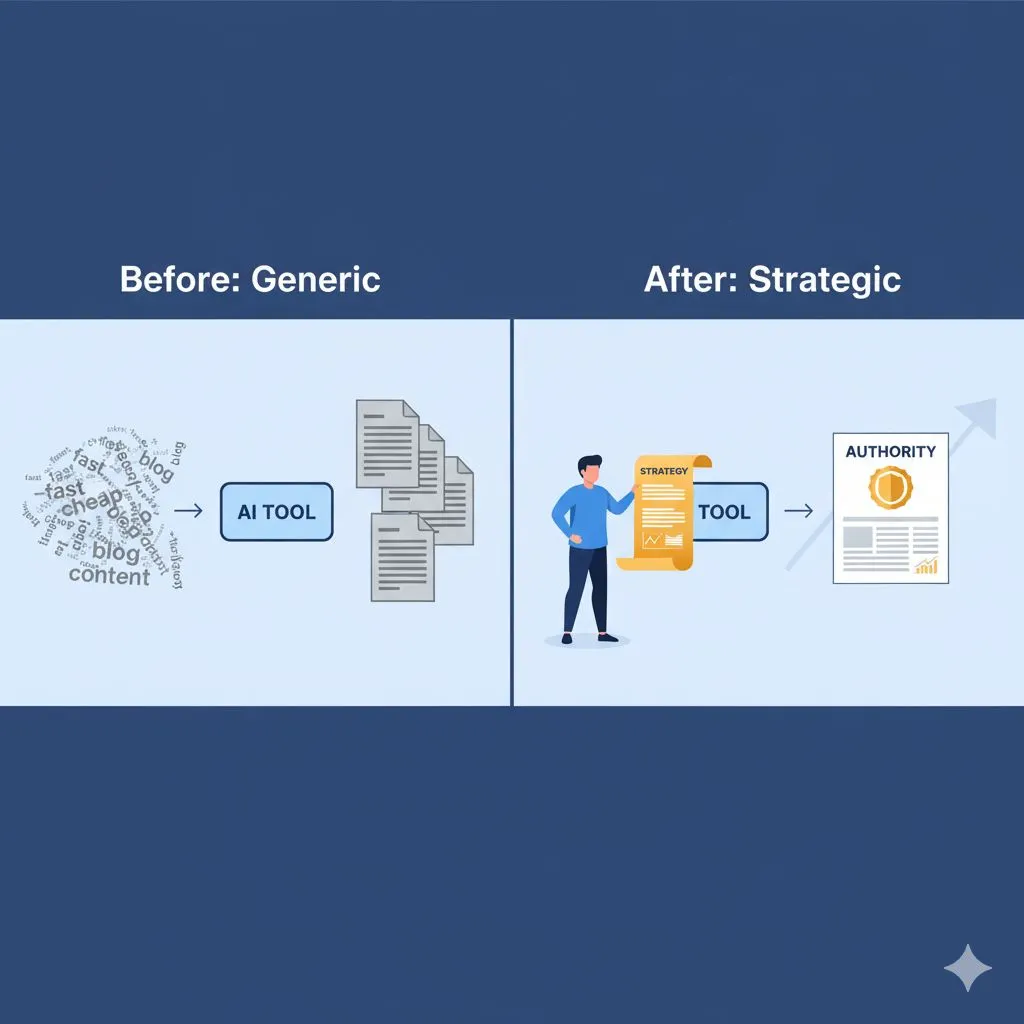
Generic AI outputs are obvious, uninspired, and damaging to a professional brand. If you simply ask an AI to "write an eBook about marketing," you will get a generic compilation of internet noise. To produce expert-level content that builds authority and trust, you must feed the AI your unique insights. The following three-step framework uses AI to extract and structure your knowledge efficiently.
Step 1: The Brain Dump Protocol
The fastest way to get your expertise out of your head is not to write it, but to answer targeted questions. You can use AI to act as an expert interviewer. Instead of trying to outline your product from scratch, provide an AI with a prompt designed to pull the right information from you.
Provide the AI with your target audience, your industry, and the core problem you solve. Then, instruct the AI to ask you a series of probing questions, one at a time, about your process, your unique methodology, and the common mistakes your clients make. By dictating your answers using voice-to-text or typing out quick, unpolished thoughts, you are giving the AI the high-quality raw data it needs. You are providing the substance; the AI is simply capturing it. This eliminates the friction of the blank page and captures the nuances of your specific domain expertise.
Step 2: The Audience Alignment Filter
Once you have extracted your core knowledge, it must be filtered through the lens of your customer's exact pain points. A common mistake in digital product creation is building what you want to teach, rather than what the customer desperately needs to learn.
Feed your raw "brain dump" notes back into the AI. Prompt it to analyze the information against your specific customer persona. Ask the AI to identify which parts of your process are the most urgent, which parts are highly actionable, and which parts might be too advanced or theoretical for the intended buyer. This alignment ensures your digital product is focused entirely on delivering a tangible ROI to the user. It cuts out the fluff and hones in on the immediate value, ensuring that your product serves as a streamlined solution rather than an overwhelming textbook.
Step 3: The Framework Builder
Now that you have your filtered, high-value information, it is time to give it a structure. People pay for frameworks, not disorganized thoughts. A framework makes your expertise digestible, repeatable, and actionable.
Use AI to organize your insights into a logical progression. Prompt the AI to take your aligned notes and structure them into a multi-phase system. For example, if you are a marketing consultant, the AI can help organize your knowledge into a "Four-Week Client Acquisition Blueprint." If you are an operations expert, it can structure your insights into a "Three-Phase Workflow Optimization Audit."
Ask the AI to generate clear headings, bulleted action items for each phase, and required resources. This step transforms your abstract knowledge into a concrete, tangible asset that carries a high perceived value. You now have the exact blueprint for your digital product, built entirely on your authentic expertise, structured in a fraction of the time it would take to outline manually.
Section 3: Structuring and Designing the Digital Product
With a solid framework in place, the next phase is turning that structure into a polished, professional digital asset. The execution of your product must match the quality of your expertise. A poorly formatted or confusing product will trigger skepticism and buyer buyer's remorse, undoing the credibility you have worked so hard to build.
Choosing the Right Vehicle
How you deliver your knowledge is just as important as the knowledge itself. You need to choose a format that aligns with your audience's desire for efficiency and your need for scalable delivery.
Consider these high-value, low-friction formats:
- Playbooks and Standard Operating Procedures (SOPs): Highly actionable, step-by-step guides that allow another business to copy your exact internal processes.
- Template Libraries: Pre-written emails, design assets, or project management boards that save the user immediate time.
- Prompt Toolkits: Curated lists of AI prompts specifically designed to solve niche problems in a particular industry.
- Actionable Workbooks: Interactive PDFs that guide the user through a specific business audit or strategy session.
Avoid the trap of the 200-page theoretical eBook. Your target buyer is likely an overworked professional just like you; they want the fastest route to the result.
Using AI for Expert-Level Formatting
Once you have chosen your vehicle, utilize AI to draft the detailed content of each section based on your approved framework. This is where you leverage AI for speed and polish.
Provide the AI with your structured outline and your brand voice guidelines. Instruct it to write the content clearly, concisely, and without hype. AI is exceptionally good at taking your core concepts and expanding them into well-structured paragraphs, creating instructional text for templates, and generating practical examples to illustrate your points.
Crucially, you remain the executive editor. You are not blindly copying and pasting; you are reviewing the generated text, injecting your specific industry terminology, and ensuring the tone perfectly matches your brand. This collaborative process allows you to produce comprehensive, expert-level materials in days instead of months.
Elevating Brand Perception
The final layer of product design is the visual and structural presentation. Even if you lack design skills, you can create a premium product. Use AI to generate clear, structured layouts, suggest typography pairings, and even write the copy for your internal design elements (like call-out boxes, summary checklists, and chapter introductions).
A well-designed digital product does more than just deliver information; it builds authority. When a customer opens a polished, highly organized playbook, their trust in your brand increases immediately. They view you not just as a practitioner, but as a thought leader who has mastered their craft enough to teach it systematically. This elevated perception directly impacts your ability to sell higher-ticket services down the line, should you choose to offer them.
Section 4: The Go-To-Market Positioning Strategy
You have successfully packaged your knowledge. Now, you must position it in the market so that it sells. Many entrepreneurs build incredible products but fail to launch them effectively because they treat the marketing as an afterthought. To successfully monetize domain expertise, your launch strategy must be as robust as your product.
Crafting the Value Proposition
Your marketing should not focus on what the product is; it must focus on what the product does. Your customers do not want a "50-page PDF." They want the result that the PDF delivers.
Use AI to help you draft your sales narrative by focusing on the transformation. Input the features of your product and prompt the AI to translate those features into tangible benefits. For example, a feature might be "includes 10 email templates." The benefit is "saves you 5 hours of copywriting a week." The transformation is "never stare at a blank screen wondering how to pitch a client again."
Your core message must resonate with the pain points of your target persona. If they are overworked, emphasize time savings. If they are struggling to compete, emphasize expert-level quality and credibility.
Positioning as a Growth Enabler
Frame your digital product as a strategic investment, not an expense. You are offering a system that refines and supports their business model. Address objections head-on in your sales copy. If your audience is skeptical of digital products, highlight your real-world experience, showcase your specific framework, and use language that proves you understand the nuances of their industry.
Avoid hype and overpromising. Instead, rely on clear ROI, structured methodologies, and a confident, professional tone. Let the quality of your framework be the loudest part of your marketing.
Pricing for Perceived Value
Pricing a digital product can be challenging. Because there is no physical cost of goods, entrepreneurs often underprice their knowledge. Remember that you are not pricing the pages; you are pricing the outcome.
If your product helps a business owner save ten hours a month or land a new client, price it according to the value of that time and revenue. A higher price point often increases the perceived value and attracts a more committed buyer who is actually going to implement your framework.
Conclusion: Your Next Step to Scalable Growth
Transitioning from an overworked operator to a strategic business owner requires a fundamental shift in how you deliver value. By choosing to monetize domain expertise, you stop trading hours for dollars and start building assets that work for you around the clock.
You already possess the knowledge needed to compete with larger players and scale your operations. The challenge has always been the time and energy required to package that knowledge effectively. By utilizing strategic AI frameworks, you eliminate the bottlenecks of content creation, formatting, and structuring. You can capture your unique IP, transform it into a polished digital product, and position it for maximum ROI without sacrificing your current client commitments.
It is time to stop hustling through manual delivery and start scaling with strategic assets. Reclaim your time, elevate your brand authority, and build the leverage you need to grow on your own terms.
If you are ready to stop spinning your wheels and want the exact, step-by-step systems to build your digital products faster, you do not have to start from a blank page. Upgrade your workflow and unlock expert-level content creation today.
Scale Smarter. Grow Faster. Begin Here: https://expertaiprompts.com/ai-prompt-toolkit-digital-product-creation