Mapping the Customer Journey with AI Precision
Mapping the Customer Journey with AI Precision
Feb 02, 2026
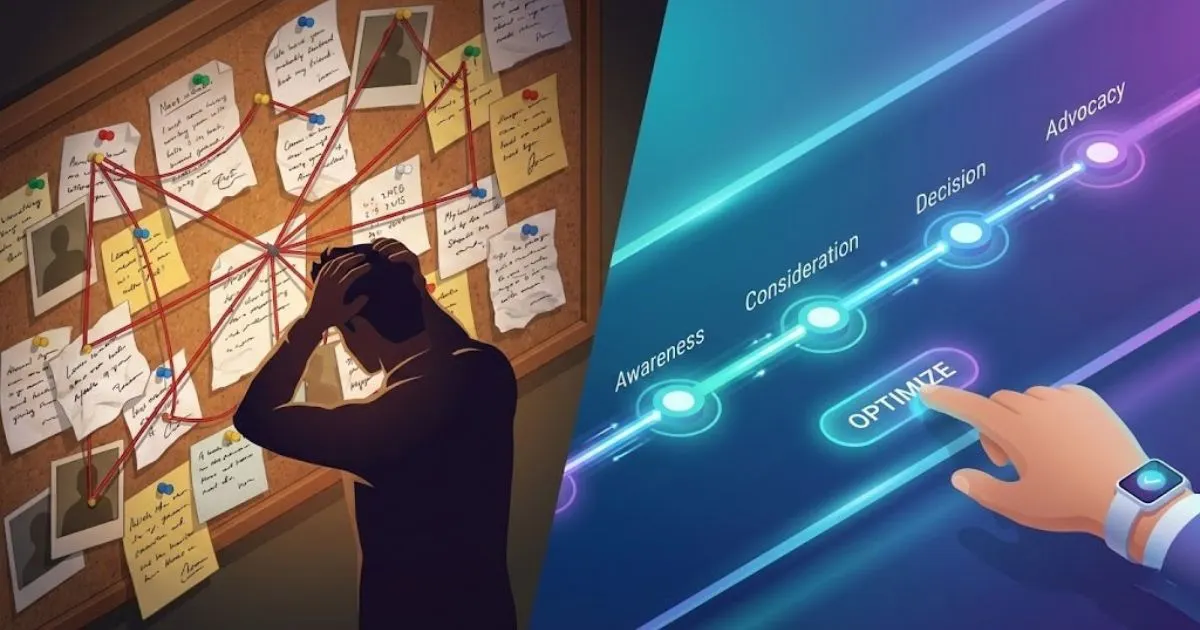
If you are like most small business owners, you are tired. You are likely reading this between client calls, putting out fires in your inbox, or late at night after the rest of the team—or your family—has gone to sleep. You know you need a "marketing strategy." You know you need to "map the customer journey." But when you are wearing every hat in the business, from CEO to customer support, sitting down to map out a theoretical journey feels like a luxury you can’t afford.
So, the default mode becomes survival. You post on social media when you have a spare ten minutes. You send an email newsletter only when you have something new to sell. You rely on word-of-mouth because you don’t have time to build a funnel.
Here is the hard truth: Random acts of marketing don’t scale. They just keep you on the hamster wheel.
To compete with larger agencies and bigger players, you don’t need more hours in the day. You need leverage. Executing a complete AI marketing strategy is where Artificial Intelligence shifts from a novelty tool to a business asset.
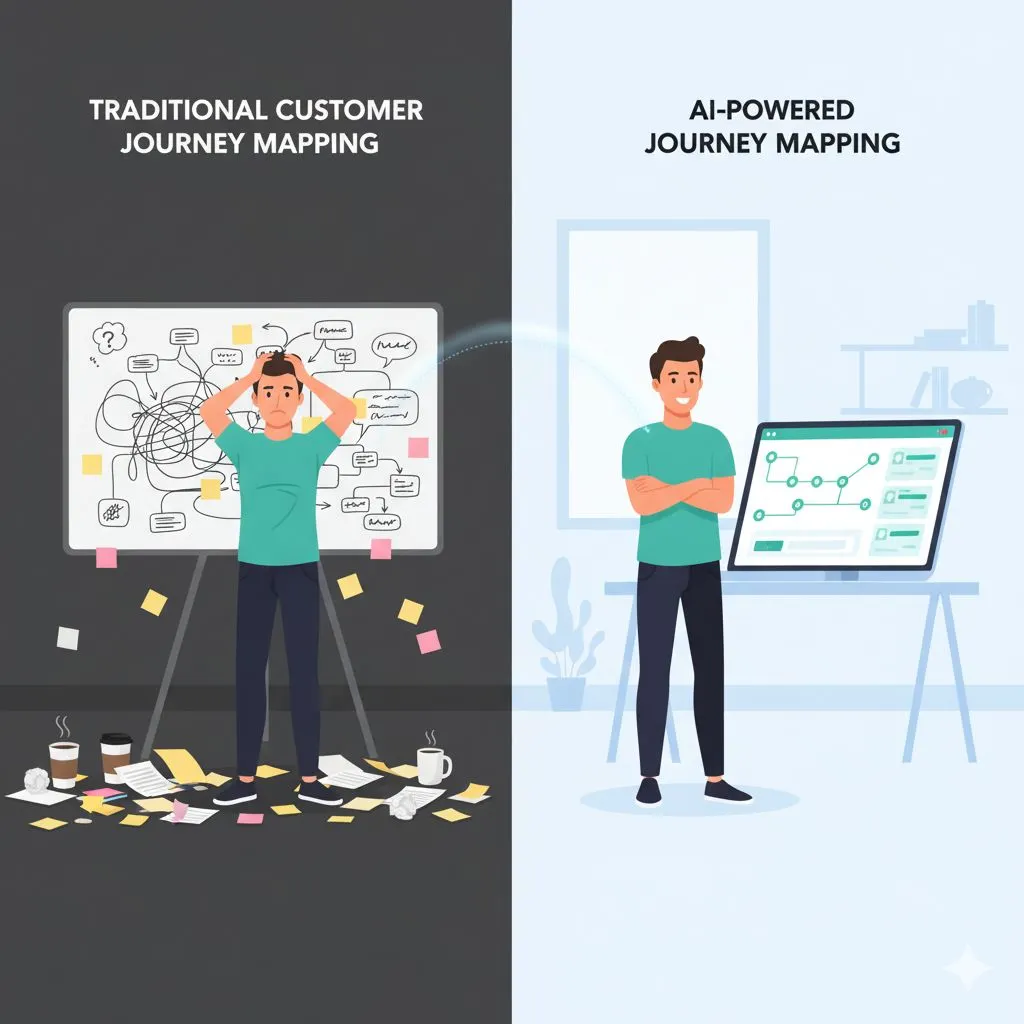
Most people use AI to "write a blog post." That is the wrong approach. To truly scale, you must use AI as a strategist. You can use it to map the entire ai customer journey—from the moment a stranger sees your brand to the moment they refer three friends.
This guide isn’t about generating spammy text. It’s about using AI to build a precision-engineered path that guides your prospects to the sale, so you can stop hustling and start scaling.
Phase 1: Awareness – Stopping the Scroll
The Awareness stage is where most small businesses waste the most money and time. You create content you think people want, only to hear crickets. Without a dedicated marketing research team, you are guessing.
AI removes the guesswork. Before you write a single word of copy, you can use AI to step into the mind of your prospect.
Deep-Dive Persona Research
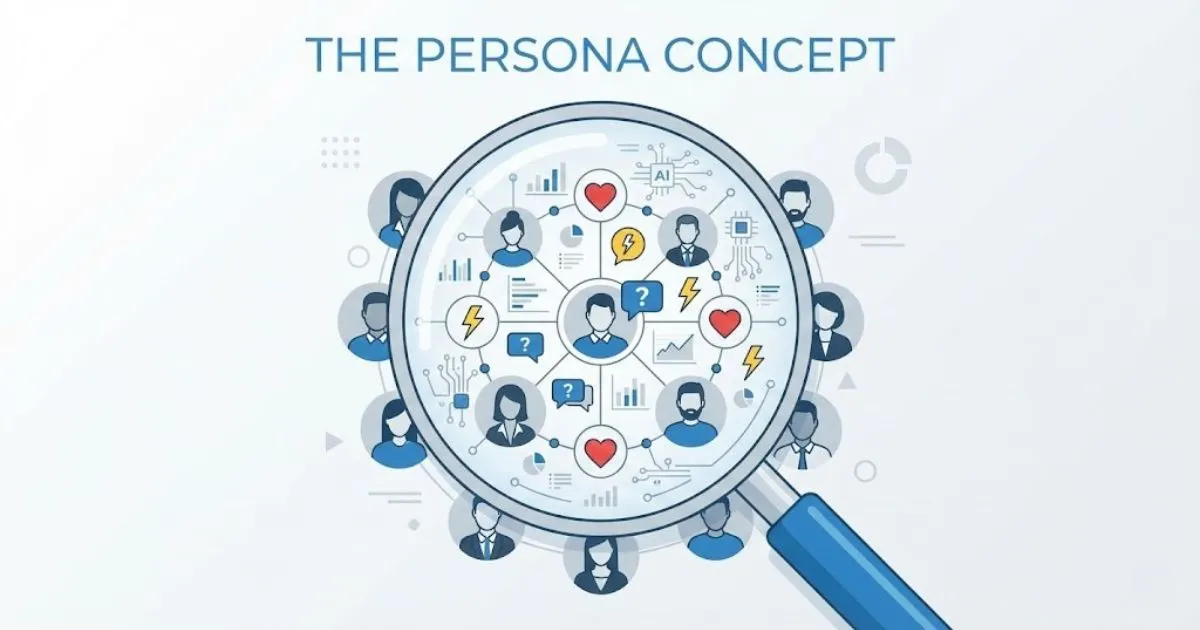
Alex, your ideal customer isn't just "Male, 30-50, likes golf." That is demographic data, and it is useless for strategy. You need psychographics. You need to know what keeps them awake at 3 a.m.
AI excels at pattern recognition. You can feed an AI model a brief description of your business and ask it to generate a psychological profile of your target audience. Ask specifically for:
- Hidden anxieties: What are they afraid to admit to their peers?
- Immediate triggers: What specific event happens that makes them search for your solution today?
- Skepticism: Why do they distrust your industry?
When you understand that your client isn't looking for "SEO services," but is actually looking for "a way to stop feeling invisible to their competitors," your messaging changes. You stop selling features and start selling relief.
The "Competitor Gap" Strategy
You don’t have time to read 50 competitor blogs to see what they are missing. But AI does.
You can paste the text from competitor websites or reviews into an AI tool and ask: "Analyze the negative reviews of these competitors. What are customers complaining about? Where is the gap in the market?"
Perhaps you find that in your industry, the biggest complaint is "lack of communication." Now, your Awareness content shouldn't just be about how good your product is; it should be about how responsive your team is. You have found a wedge in the market without spending a dime on focus groups.
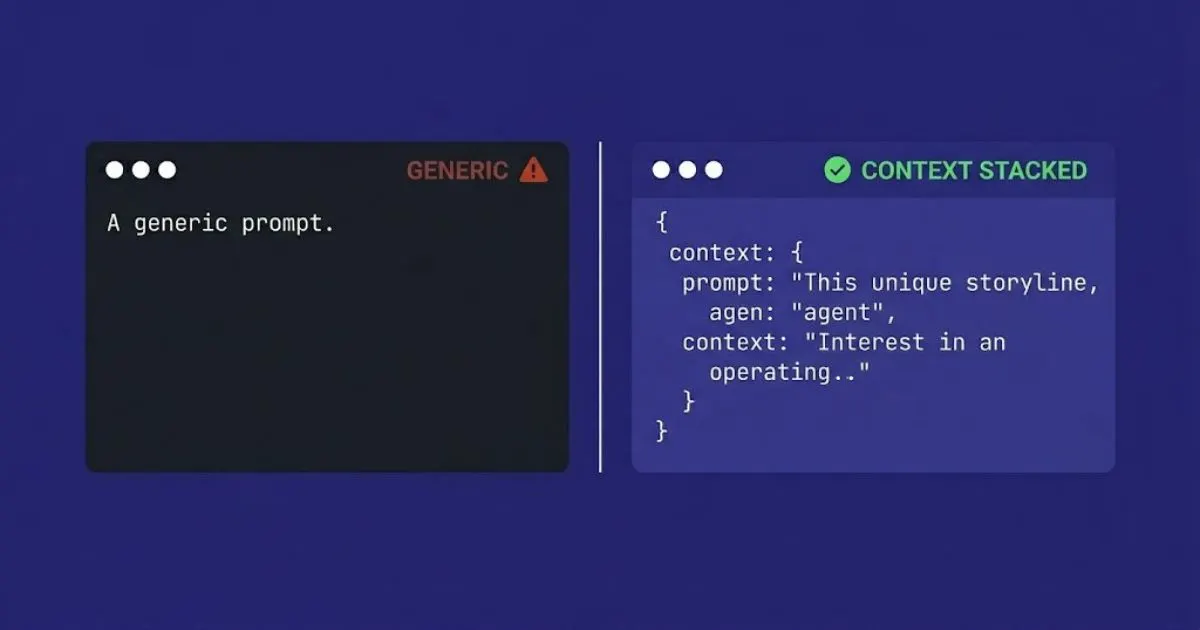
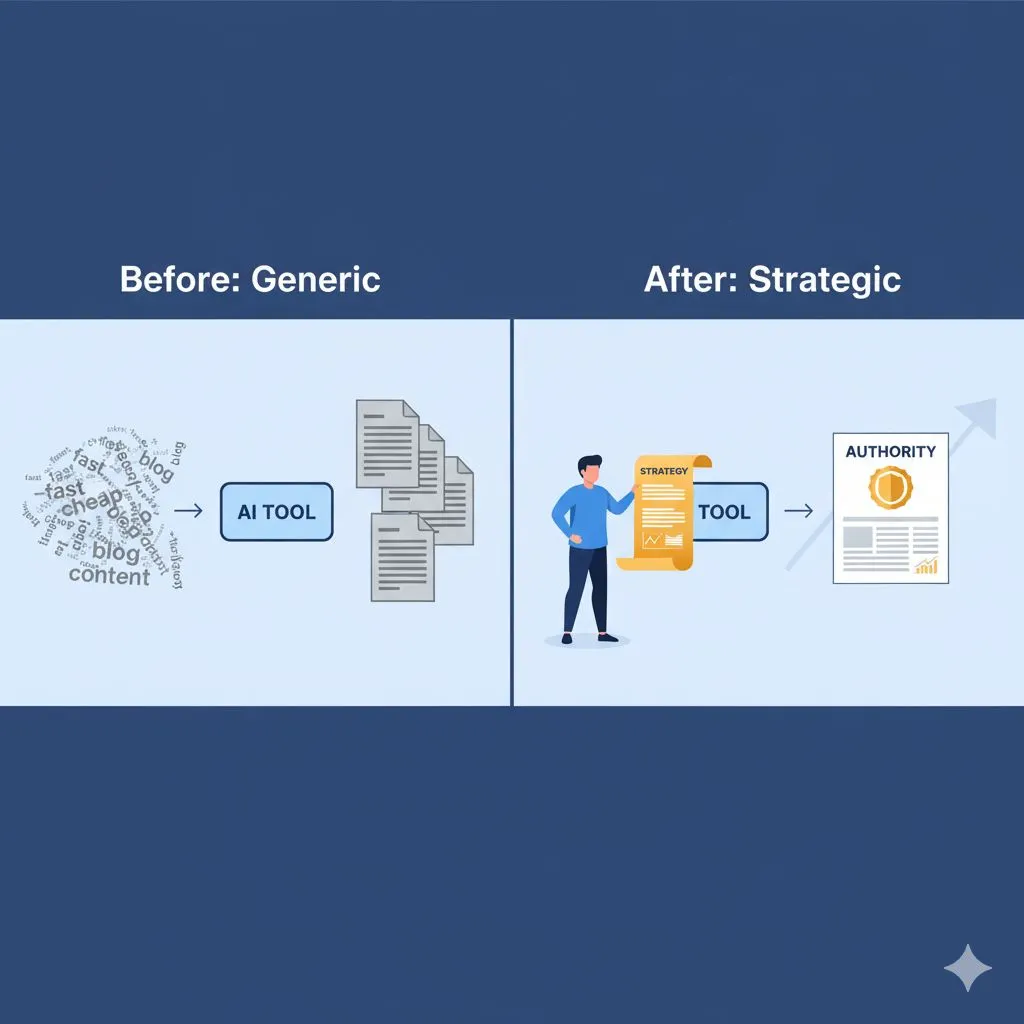
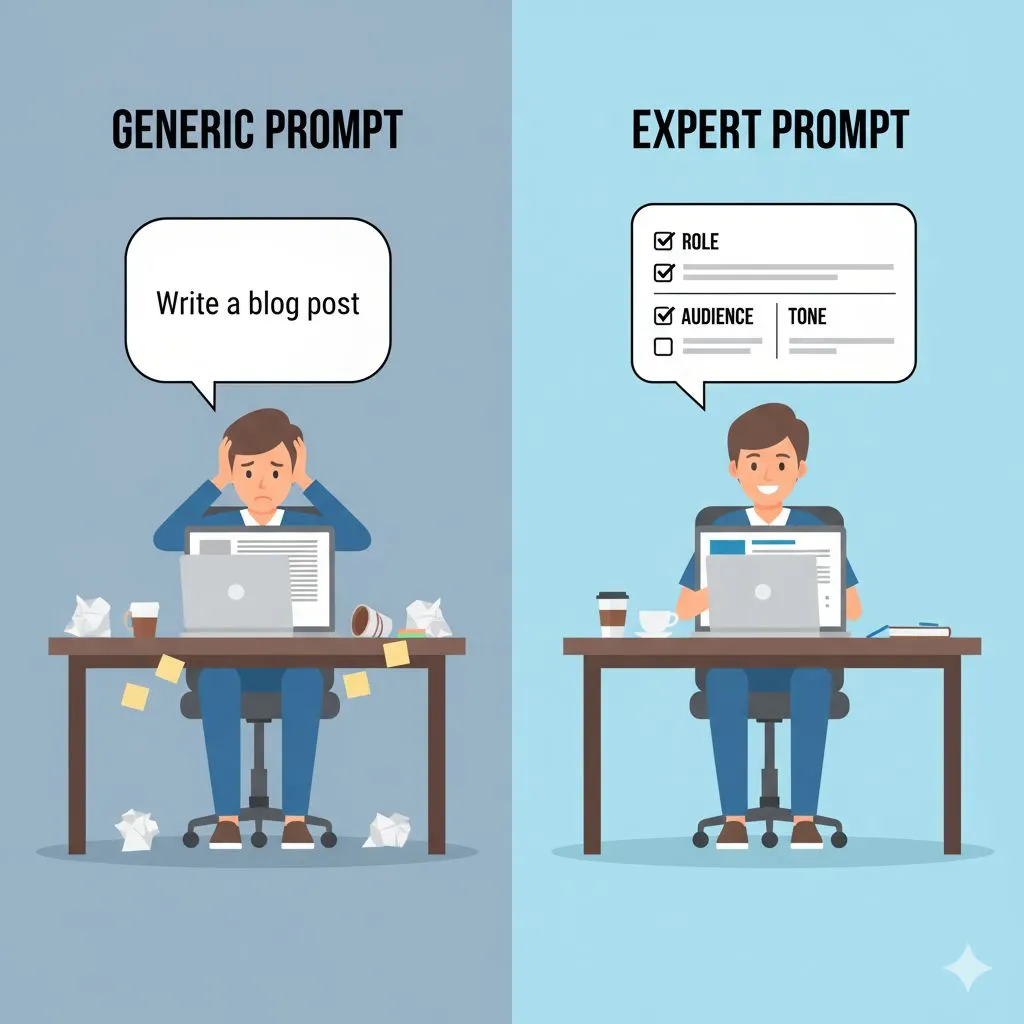
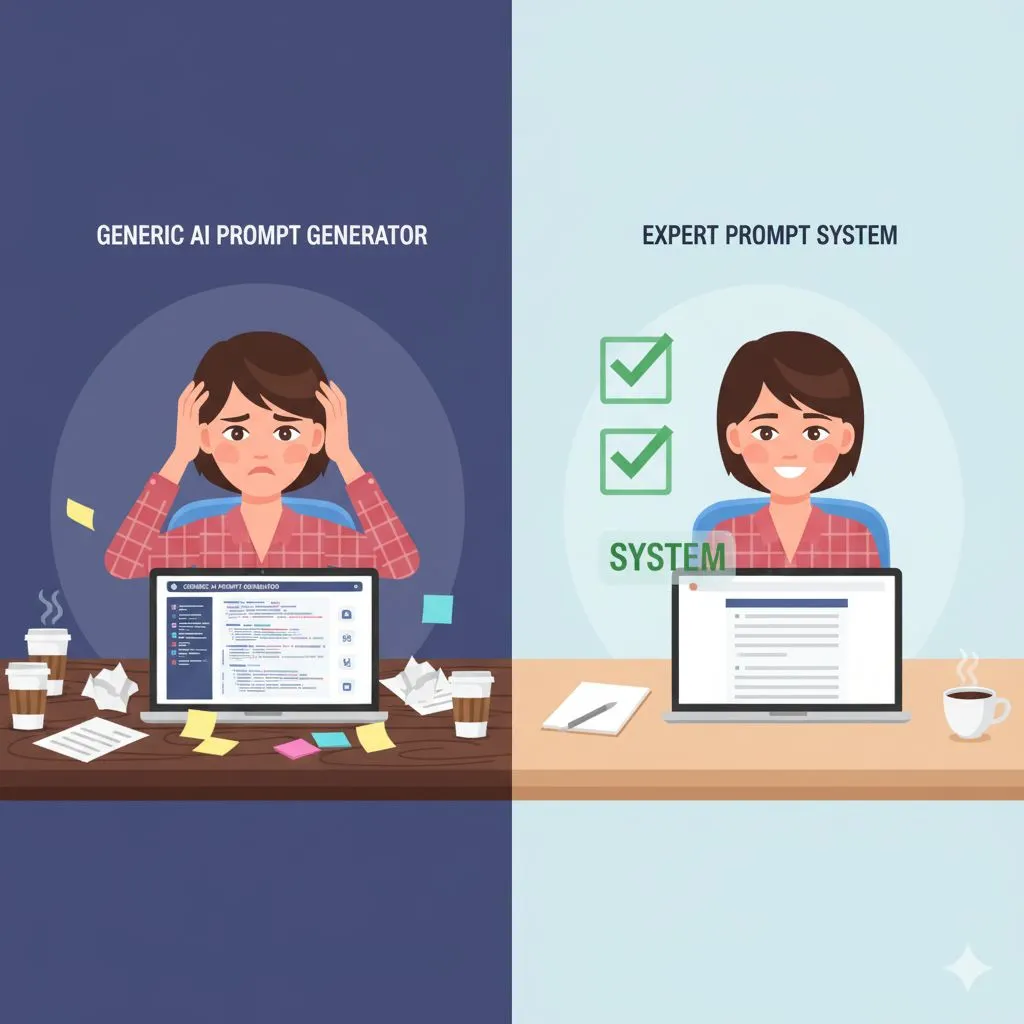
For a deeper breakdown of why generic vs strategic AI prompts produce such different results, see this breakdown on the difference in quality and business impact.
Creating "Stop-Scroll" Hooks
Once you have the data, you need content. But not just any content—you need content that earns attention in a distracted world. Use AI to generate "hook" variations based on the pain points you identified.
Instead of writing one headline and hoping it works, ask AI to generate 20 variations using proven copywriting frameworks like PAS (Problem-Agitation-Solution) or AIDA (Attention-Interest-Desire-Action). Your job is no longer to write from scratch; your job is to curate the best option.
Phase 2: Consideration – Building Trust While You Sleep

This is the "Messy Middle." This is where you lose people.
A potential client visits your site or follows you on LinkedIn. They are interested, but they aren't ready to buy. In a manual business model, this is where you would personally email them or schedule a coffee chat. But you cannot scale coffee chats.
You need an automated bridge that builds trust without your constant presence.
The AI-Assisted Nurture Sequence
The goal of the Consideration phase is education. You need to position yourself as the expert authority. Writing a 5-email welcome sequence usually takes a business owner three days of agonizing over drafts. With AI, it takes 30 minutes.
The key is structure. Don't ask AI to "write an email sequence." That will give you generic fluff. Instead, map the sequence strategically:
- Email 1 (The Welcome): Deliver the value/lead magnet immediately.
- Email 2 (The Problem): Empathize with their struggle (using the data from Phase 1).
- Email 3 (The Epiphany): Introduce your unique methodology or worldview.
- Email 4 (The Proof): Share a case study or testimonial. For ready-to-use proof, explore the proven case studies showing how small businesses have achieved measurable results with Expert AI Prompts.
- Email 5 (The Soft Ask): Invite them to the next step.
Feed this structure into your AI tool. Provide it with your specific tone of voice guidelines (e.g., "Professional but approachable," "No corporate jargon"). You will get a 90% complete draft that you only need to polish.
If you need a starting point, download the free content plan template — it gives you a structured one-week content calendar built around AI prompts.
Predicting and Handling Objections
In a sales call, you can handle objections in real-time. In digital marketing, your content must handle objections before they are even raised.
If a prospect thinks, "This looks great, but it's too expensive," and you don't address price or value, they leave.
Use AI to roleplay. Ask the AI to adopt the persona of your skeptical customer and list the top 10 reasons they wouldn't buy from you. The answers might surprise you. They might worry about implementation time, or whether your solution works for their specific niche.
Once you have this list, create specific pieces of content—FAQs, blog posts, or social captions—that dismantle these objections one by one. This is how you use the ai customer journey to clear the path to the sale.
Phase 3: Decision – The Art of the Efficient Close
You have their attention. They trust you. Now, they need to buy.
For many entrepreneurs, this is the uncomfortable part. We love helping, but we hate "selling." We worry about sounding pushy or desperate. AI removes the emotion from the drafting process, allowing you to focus on the psychology of the offer.
Auditing Your Sales Assets
Take a look at your current sales page or proposal template. Is it focused on you or them?
Paste your sales copy into an AI tool and ask for a critique based on conversion principles. Ask: "Does this copy clearly communicate the ROI? Is the Call to Action clear? Is there too much passive voice?"
AI is ruthless. It will point out that your opening paragraph is too long or that your value proposition is buried. Use this feedback to tighten your copy. Clarity converts.
The "Benefit Stacking" Framework
When someone is about to buy, they are weighing the Price vs. the Value. To tip the scale, you need to stack the benefits.
Features are what your product does (e.g., "50 AI Prompts"). Benefits are what your customer gets (e.g., "Save 10 hours a week"). Deep benefits are how they feel (e.g., "Reclaim your evenings and stop feeling guilty about work").
Use AI to translate your features into deep benefits.
- Input: "Feature: Weekly reporting dashboard."
- AI Output: "Benefit: Never wonder where your money is going. Gain total visibility and peace of mind at a glance."
This subtle shift in language, applied across your sales pages and proposals, increases the perceived value of your offer without you having to lower your price.
Personalization at Scale
If you are sending proposals or cold outreach, generic templates are trash. However, writing 100 custom emails is impossible.
You can use AI to create a "Mad Libs" style template where the core value proposition remains the same, but specific variables (Industry, recent news, specific pain point) are inserted. This allows you to send high-touch, personalized "decision" content that looks like it took you an hour to write, but took minutes to assemble.
Phase 4: Retention & Advocacy – The Loop
The journey doesn't end when they pay. In fact, for a scalable business, that is just the beginning. It is far cheaper to keep a client than to get a new one. Yet, most businesses ghost their clients the moment the invoice is paid because they are too busy hunting for the next kill.
Automated Onboarding Delight
Buyer’s remorse is real. The moment someone pays, they feel a twinge of anxiety. "Did I make the right choice?"
You need to reassure them immediately. Use AI to draft a comprehensive "Welcome Kit" or onboarding email sequence that outlines exactly what happens next. Clarity reduces anxiety.
You can even use AI to generate "Unexpected Delight" moments. Ask AI: "What are low-cost, high-value ways to surprise a new client in [Your Industry] during their first week?" You might get ideas like sending a curated list of resources, a personalized video script, or a specific checklist.
Turning Clients into Advocates
You need reviews and referrals to grow. But asking for them feels awkward, so you don't do it.
Let AI draft the email.
- Prompt: "Write a polite, low-pressure email asking a satisfied client for a testimonial. Include three specific questions to guide their response so they don't have to think too hard."
By providing questions (e.g., "What was your biggest challenge before us?" "What specific result did you achieve?"), you make it easy for the client to say yes.
Furthermore, take those testimonials and feed them back into your AI. Ask it to turn a 3-paragraph testimonial into three snappy social media graphics and a case study headline. You are now recycling your success to fuel the Awareness phase for new prospects. The journey becomes a loop.
Conclusion: From Operator to Strategist
The difference between a stressed solopreneur and a scalable business owner isn't magic. It's systems.
By mapping the ai customer journey, you are building a system that works for you.
- Awareness becomes a data-backed dragnet, not a guessing game.
- Consideration becomes an automated nurture machine.
- Decision becomes a logical next step, not a high-pressure pitch.
- Retention becomes a growth engine.
Ready to put this into practice immediately? Grab your free AI prompts and start saving hours this week — no purchase required, no credit card needed.
Alex, you have the ambition. You have the skills. Now, you have the tools. You don't need to hire a CMO or a six-figure agency. You just need to direct your AI with precision.
Stop treating AI like a writer. Start treating it like your partner in growth.
Ready to stop guessing and start scaling?
Mapping the journey is just the start. You need the specific, battle-tested prompts to execute every single step of this strategy without spending hours engineering them yourself.
Using AI to Write for the Customer Journey
P.S. Want to go deeper? Every Expert AI Prompt Pack comes with two exclusive strategy guides: The Customer-Centric Business Blueprint and the The Customer-Centric Business Blueprint Cheatsheet. These resources walk you through defining your Customer Persona , mapping the Customer Journey touchpoints , and refining your Value Proposition, giving you the strategic clarity to create months of high-performance content. Get your pack here:
Get your pack here: browse all 30 industry-specific prompt packs.
Or if you already know this is for you, see all prompt pack options and pricing in one place.