From Expert to Educator: Structuring Your First Online Course with AI
From Expert to Educator: Structuring Your First Online Course with AI
Apr 05, 2026

You already have the expertise. Your clients pay you for it, your network asks you for it, and your results prove it. But right now, that knowledge is locked inside your head—and tethered directly to your time. You are caught in the classic trap of the ambitious small business owner: you are spending ten-plus hours a day juggling client delivery, marketing, and operations. You want to scale, you want to reclaim your time, but creating an online course feels like a monumental mountain you simply don't have the energy to climb.
Traditionally, course creation is a grueling process. It takes months of brainstorming, outlining, drafting, and filming. It requires resources, financial investment, and hours of trial and error that you simply cannot spare.
But what if you didn't have to start from scratch? What if you could bypass the blank page and compress months of work into days?
Welcome to the new era of ai course creation. By leveraging strategic AI frameworks, you can turn your hard-earned expertise into a scalable digital product without adding more stress to your plate. This playbook is designed for the overworked entrepreneur who needs practical, proven solutions—not hype. We will walk through how to structure, build, and prepare your first online course using AI as your strategic co-pilot, helping you transition from a stretched-thin operator to a confident, scalable educator.
Section 1: Validating Your Course Concept with AI
The biggest mistake first-time course creators make is spending months building a product in a vacuum, only to launch to crickets. When your resources are limited, you cannot afford to guess what your audience wants. You need to know.
AI is an incredibly powerful research assistant that can help you validate your course idea before you write a single lesson plan. Instead of relying on gut feelings, you can use AI to synthesize audience pain points and uncover the specific gaps in the market that your expertise can fill.
Start by feeding an AI model the details of your target customer. Describe their daily struggles, their goals, and the industry landscape. Ask the AI to generate a list of the top ten unfulfilled needs or bottlenecks your ideal client faces regarding your specific niche. This immediate data processing saves you hours of manual market research and provides a crystal-clear picture of what your audience is desperate to learn.
Once you have identified the core problem, use AI to help define your course promise—the tangible transformation your students will achieve. A strong course doesn't just offer information; it offers a result. By prompting your AI to draft several variations of a "transformation statement," you can quickly lock in a compelling value proposition.
This strategic validation ensures that you are building a product with clear ROI for your students, which directly translates to a scalable revenue stream for your business. You eliminate the guesswork and start your ai course creation journey on a foundation of data-backed confidence.
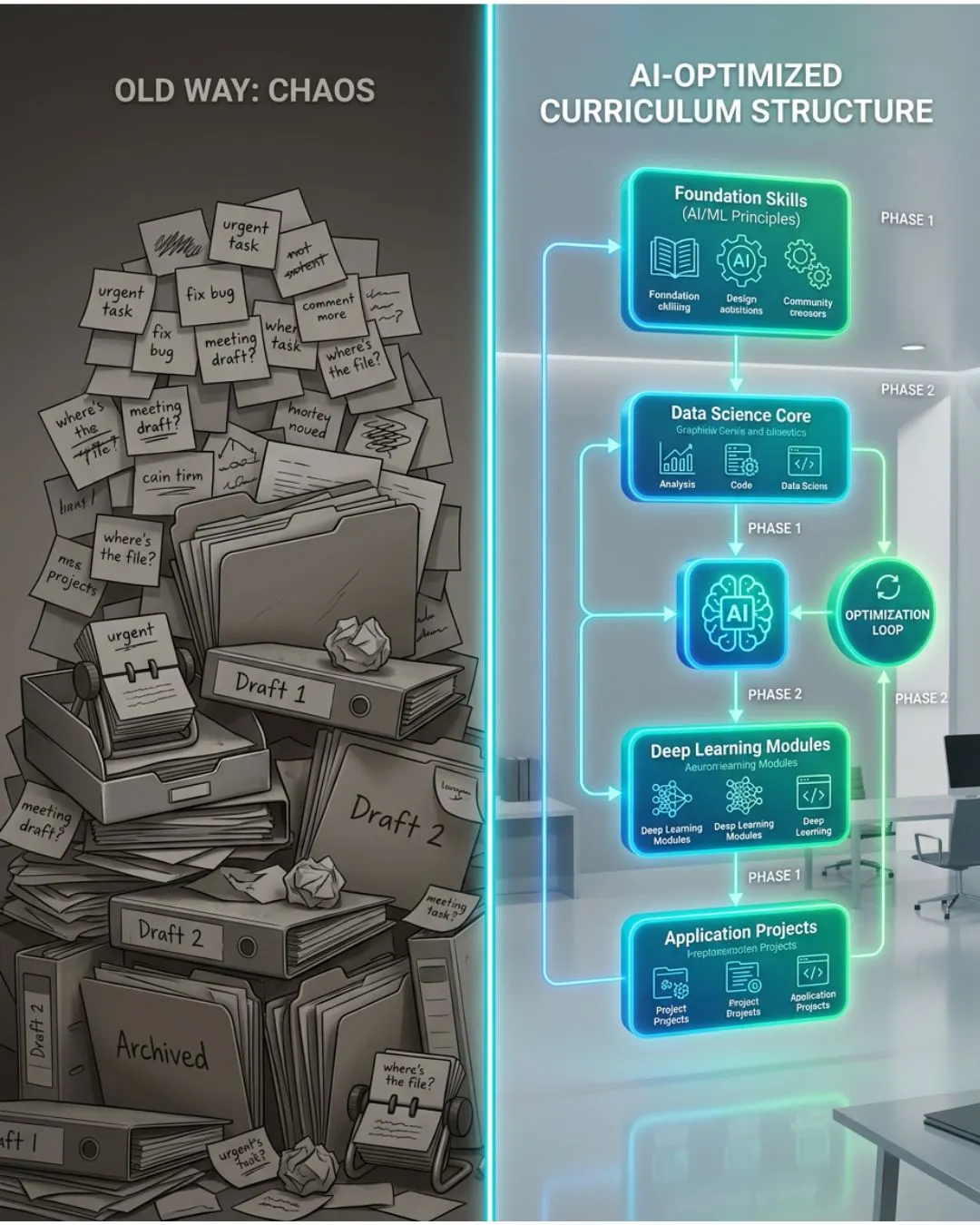
Section 2: Architecting the Curriculum
With a validated concept and a rock-solid promise, you are ready to build the skeleton of your course. For many entrepreneurs, this is where the bottleneck tightens. Staring at a blank document, trying to organize years of accumulated knowledge into a logical, step-by-step curriculum, is overwhelming. You know what to teach, but structuring the how can paralyze your progress.
This is where AI excels. It can take your high-level ideas and instantly organize them into a structured, pedagogical format.
To build your syllabus, provide the AI with your course promise, your target audience, and a brain-dump of the key concepts you want to cover. Then, instruct it to generate a comprehensive, module-by-module outline. Ask it to organize the content sequentially, moving the student from beginner concepts to advanced applications, ensuring a logical flow that prevents overwhelm.
A high-quality AI prompt for curriculum design won't just give you module titles; it will break down each module into specific lessons. More importantly, you can direct the AI to define the "Learning Outcome" for every single lesson. What should the student be able to do after watching this specific five-minute video? By mapping these outcomes early, you guarantee that your course remains actionable and devoid of unnecessary fluff.
If a generated module feels too heavy or complex, you can simply ask the AI to "break this module down into three more digestible lessons." If a section feels light, ask it to "suggest two practical case studies or examples to reinforce this concept."
Using AI for course architecture doesn't replace your expertise; it amplifies it. It acts as an elite information architect, allowing you to drag and drop your knowledge into a proven, psychological framework designed for student retention and success. You reclaim hours of frustrating trial and error, ending up with a polished, professional syllabus that positions you as a credible authority.
Section 3: Accelerating Asset Production
Having a brilliant outline is only half the battle. The next phase—drafting the actual lesson content, video scripts, and supplementary materials—is historically the most time-consuming part of course creation. It is the phase where most busy entrepreneurs simply give up.
By applying an ai course creation strategy, you turn asset production from a months-long slog into an efficient, streamlined workflow.
Drafting Video Scripts and Lesson Notes
You don't need to write every word from scratch. Take the detailed lesson outlines you generated in the previous step and feed them back into the AI one by one. Instruct the AI to act as an expert instructional designer and draft a video script or detailed lesson plan. To ensure the output matches your brand identity, be explicit about your tone. Tell the AI: "Write this in a confident, practical, and approachable tone. Avoid fluff, jargon, and overly academic language. Focus on actionable steps." You can even dictate your own rough thoughts into a voice-to-text app, paste that raw transcript into the AI, and ask it to refine your words into a structured, professional lesson. You are still the author; AI is simply your ghostwriter, formatting your expertise into a polished product.
Generating Supplementary Materials
Top-tier courses don't just rely on video; they provide tools that help students implement what they've learned. Creating these resources manually takes hours, but AI can generate them in seconds.
Once a lesson script is finalized, ask the AI to:
- Generate a one-page summary or checklist of the key takeaways.
- Create a step-by-step implementation worksheet for the student.
- Draft a 5-question multiple-choice quiz to test comprehension of the module.
This is how you elevate your brand perception. By providing comprehensive, expert-level materials alongside your core content, you increase the perceived value of your course. You deliver a premium experience that builds trust and credibility, all while protecting your own time and energy.
Section 4: Preparing for a Profitable Launch
You have validated your idea, structured a brilliant curriculum, and generated high-quality assets. You now have a tangible, scalable digital product. But a course sitting on a hard drive doesn't generate revenue. You need a launch strategy that converts, and AI can streamline this final, crucial phase just as effectively as the creation process.
Marketing your course requires compelling copy that speaks directly to the pain points you identified back in Section 1. Instead of agonizing over a blank sales page, use AI to construct your foundational marketing assets.
High-Converting Landing Pages
Provide your AI with the complete course syllabus, the transformation promise, and the target audience profile. Instruct it to write a long-form sales page using proven copywriting frameworks like PAS (Problem, Agitation, Solution) or AIDA (Attention, Interest, Desire, Action). Ask it to generate attention-grabbing headlines, a compelling introductory hook, bullet points highlighting the core benefits (not just features), and a strong call-to-action.
Email Launch Sequences
A successful launch relies on sustained communication. You can prompt your AI to draft a complete 5-day email launch sequence.
- Email 1: The Teaser and Problem Agitation.
- Email 2: The Solution (Introducing your course).
- Email 3: Logical Proof (What's inside the course).
- Email 4: Emotional Proof (Who this is for and the transformation).
- Email 5: The Final Push (Scarcity and closing the cart).
By generating these assets with AI, you break through the final bottleneck. You maintain a consistent, professional brand voice across all touchpoints, ensuring you present yourself as a credible, competitive player in your industry.
Conclusion
The transition from an overworked, stressed operator to a confident, scalable educator doesn't have to take years. The traditional barriers to entry—time, exhaustion, and resource limitations—are no longer excuses.
By embracing an ai course creation system, you can extract the high-level expertise you already possess and package it into a digital asset that works for you, 24/7. You can reclaim your time, dramatically reduce the friction of content creation, and build a new revenue stream that allows you to scale your business without scaling your workload.
You have the knowledge. You now have the strategic blueprint. The only thing left to do is execute.
Stop spinning your wheels and start building your scalable future today. If you want the exact, strategically engineered prompts to bypass the blank page and build your curriculum instantly, get the toolkit designed specifically for entrepreneurs like you.
Upgrade your workflow and unlock expert-level course content in minutes: https://expertaiprompts.com/sales-landing-page-for-the-ai-prompt-toolkit-for-course-creators